. 2013 May;182(5):1843-53.
doi: 10.1016/j.ajpath.2013.01.030. Epub 2013 Mar 14.

Surfactant protein A suppresses lung cancer progression by regulating the polarization of tumor-associated macrophages

Affiliations

Surfactant protein A suppresses lung cancer progression by regulating the polarization of tumor-associated macrophages

Atsushi Mitsuhashi et al. Am J Pathol. 2013 May.

Abstract

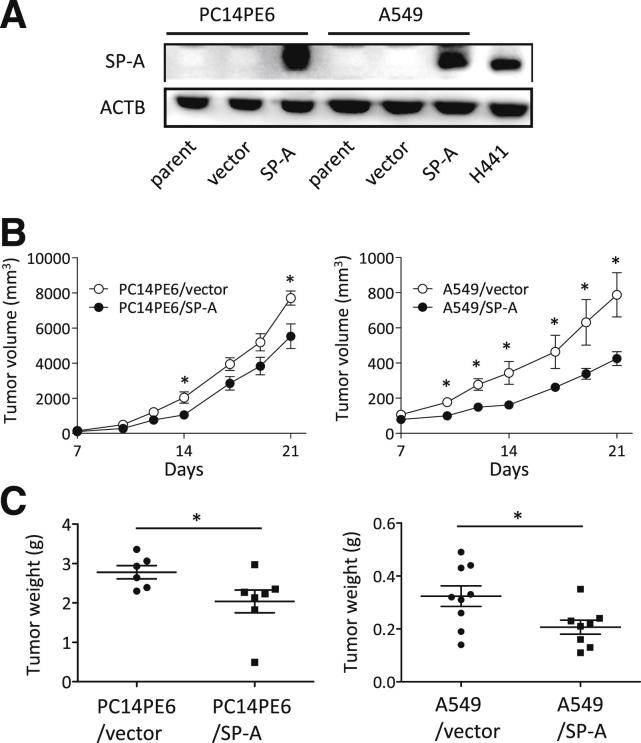
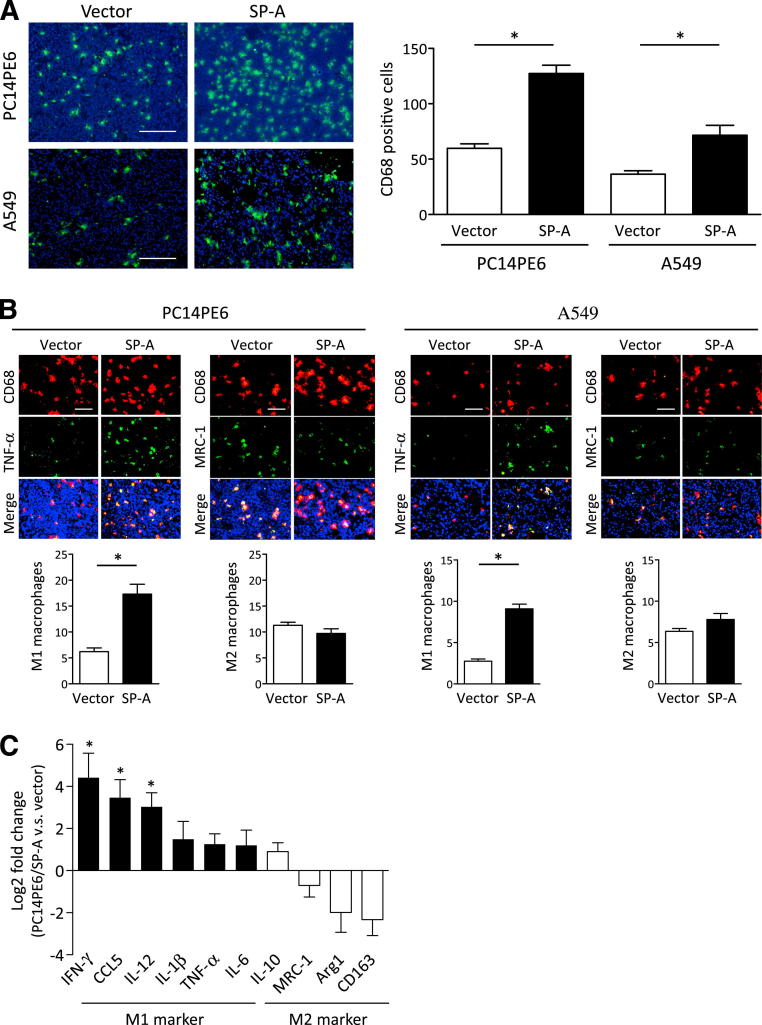
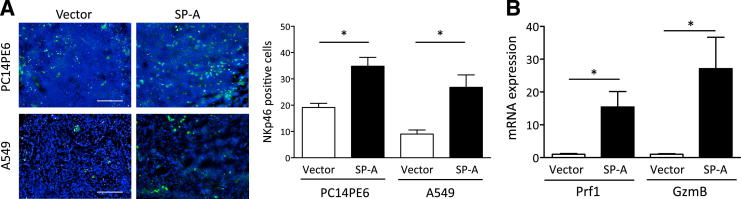
Surfactant protein A (SP-A) is a large multimeric protein found in the lungs. In addition to its immunoregulatory function in infectious respiratory diseases, SP-A is also used as a marker of lung adenocarcinoma. Despite the finding that SP-A expression levels in cancer cells has a relationship with patient prognosis, the function of SP-A in lung cancer progression is unknown. We investigated the role of SP-A in lung cancer progression by introducing the SP-A gene into human lung adenocarcinoma cell lines. SP-A gene transduction suppressed the progression of tumor in subcutaneous xenograft or lung metastasis mouse models. Immunohistochemical analysis showed that the number of M1 antitumor tumor-associated macrophages (TAMs) was increased and the number of M2 tumor-promoting TAMs was not changed in the tumor tissue produced by SP-A-expressing cells. In addition, natural killer (NK) cells were also increased and activated in the SP-A-expressing tumor. Moreover, SP-A did not inhibit tumor progression in mice depleted of NK cells. Taking into account that SP-A did not directly activate NK cells, these results suggest that SP-A inhibited lung cancer progression by recruiting and activating NK cells via controlling the polarization of TAMs.


Figures

Figure 1
Figure 1
The effect of SP-A on lung cancer subcutaneous xenografts in vivo. A: SP-A expression of human SP-A stable transfectants was confirmed by Western blot analysis. H441 cells were used as a positive control. ACTB, β-actin. Tumor growth (B) and weight (C) of xenografts produced by PC14PE6 (left panels; n = 6 per group) and A549 (right panels; n = 8 per group) cells transduced with SP-A or vector. Data are presented as means ± SEM (horizontal lines in C). ∗P < 0.05.
Figure 2
Figure 2
The effect of SP-A on the recruitment of TAMs in xenografts. A: IF staining of CD68 (green). Nuclei were counterstained with DAPI (blue). B: IF double staining of CD68 (red) and TNF-α (green) or MRC-1 (green). C: Gene expression of mouse M1 and M2 markers in PC14PE6 xenografts determined by RT-PCR. The increased gene expression in PC14PE6/SP-A compared with control (vector) is shown as log2-fold changes. Data are the average of four to five mice per group. IFN-γ, interferon γ. Data are presented as means ± SEM. ∗P < 0.05. Scale bars: 200 μm (A); 100 μm (B).
Figure 3
Figure 3
The effect of SP-A on NK cell recruitment in xenografts. A: IF staining of NKp46 (green). Nuclei were counterstained with DAPI (blue). Scale bars: 200 μm. B: Gene expression of mouse Prf1 and GzmB in PC14PE6 xenografts determined by RT-PCR. Data are the average of four to five mice per group. Data are presented as means ± SEM. ∗P < 0.05.
Figure 4
Figure 4
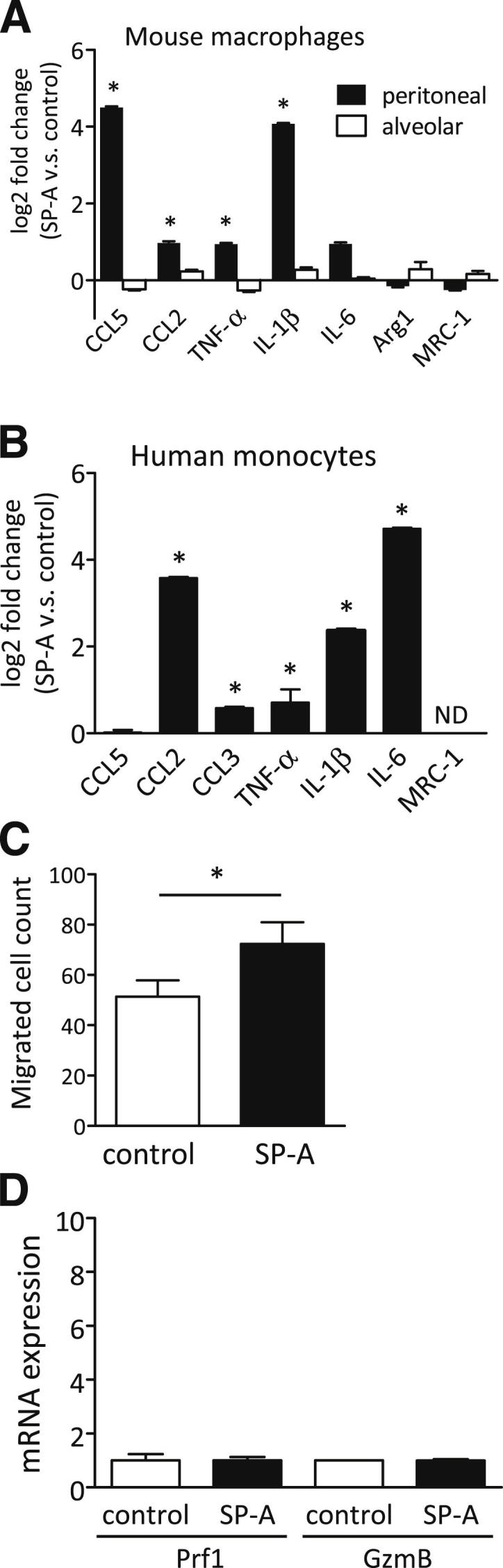
The effect of SP-A on various immune cells in vitro. After exogenous SP-A treatment, the expression of various genes was determined by RT-PCR in mouse PMs and AMs (A) and human peripheral monocytes (B). The increased gene expression in SP-A treatment compared with control (PBS) are shown as log2-fold changes (n = 3 per group). ND, not detected. C: The effect of exogenous SP-A on the migration of mouse PMs (n = 3 per group). D: Gene expressions of Prf1 and GzmB in mouse NK cells treated with exogenous SP-A (n = 3 per group). Data are presented as means ± SEM. ∗P < 0.05.
Figure 5
Figure 5
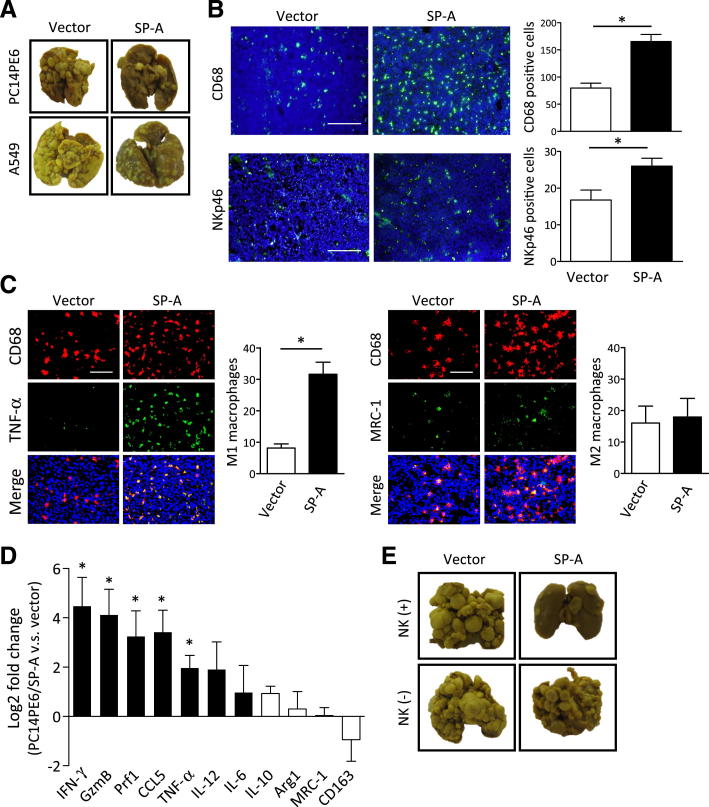
The effect of SP-A on lung cancer metastasis. A: Representative images of lung metastasis produced by SP-A– or vector-transduced lung cancer cell lines. B: IF staining of CD68 or NKp46. Nuclei were counterstained with DAPI (blue). C: IF double staining of CD68 (red) and TNF-α (green) or MRC-1 (green) in PC14PE6 lung metastasis. D: Gene expression of mouse M1 and M2 markers in PC14PE6 metastatic lung nodules determined by RT-PCR. The increased gene expression in PC14PE6/SP-A compared with control (vector) is shown as log2-fold changes. Data are the average of four to five mice per group. IFN-γ, interferon γ. E: Representative images of the lung metastasis formed by PC14PE6/SP-A or vector in nude mice (NK+) or NK cell–depleted nude mice (NK). Data are presented as means ± SEM. ∗P < 0.05. Scale bars: 200 μm (B); 100 μm (C).

References

    1. Jemal A., Siegel R., Ward E., Hao Y., Xu J., Thun M.J. Cancer statistics, 2009. CA Cancer J Clin. 2009;59:225–249. - PubMed
    1. Wright J.R. Immunoregulatory functions of surfactant proteins. Nat Rev Immunol. 2005;5:58–68. - PubMed
    1. Borron P., McIntosh J.C., Korfhagen T.R., Whitsett J.A., Taylor J., Wright J.R. Surfactant-associated protein A inhibits LPS-induced cytokine and nitric oxide production in vivo. Am J Physiol Lung Cell Mol Physiol. 2000;278:840–847. - PubMed
    1. LeVine A.M., Gwozdz J., Stark J., Bruno M., Whitsett J., Korfhagen T. Surfactant protein-A enhances respiratory syncytial virus clearance in vivo. J Clin Invest. 1999;103:1015–1021. - PMC - PubMed
    1. Mariencheck W.I., Savov J., Dong Q., Tino M.J., Wright J.R. Surfactant protein A enhances alveolar macrophage phagocytosis of a live, mucoid strain of P. aeruginosa. Am J Physiol. 1999;277:777–786. - PubMed

Publication types

Substances