. 2013 Jul 28;335(2):412-20.
doi: 10.1016/j.canlet.2013.02.050. Epub 2013 Mar 14.

Minnelide reduces tumor burden in preclinical models of osteosarcoma

Affiliations

Minnelide reduces tumor burden in preclinical models of osteosarcoma

Sulagna Banerjee et al. Cancer Lett. .

Abstract

Osteosarcoma is the most common bone cancer in children and adolescents with a 5-year survival rate of about 70%. In this study, we have evaluated the preclinical therapeutic efficacy of the novel synthetic drug, Minnelide, a prodrug of triptolide on osteosarcoma. Triptolide was effective in significantly inducing apoptosis in all osteosarcoma cell lines tested but had no significant effect on the human osteoblast cells. Notably, Minnelide treatment significantly reduced tumor burden and lung metastasis in the orthotopic and lung colonization models. Triptolide/Minnelide effectively downregulated the levels of pro-survival proteins such as heat shock proteins, cMYC, survivin and targets the NF-κB pathway.


Conflict of interest statement

CONFLICT OF INTEREST

University of Minnesota has filed a patent for Minnelide, which has been licensed to Minneamrita Therapeutics, LLC. AKS have financial interests in this company. AKS is also one of the inventors on this patent. The other authors declare that they have no competing interests.

Figures
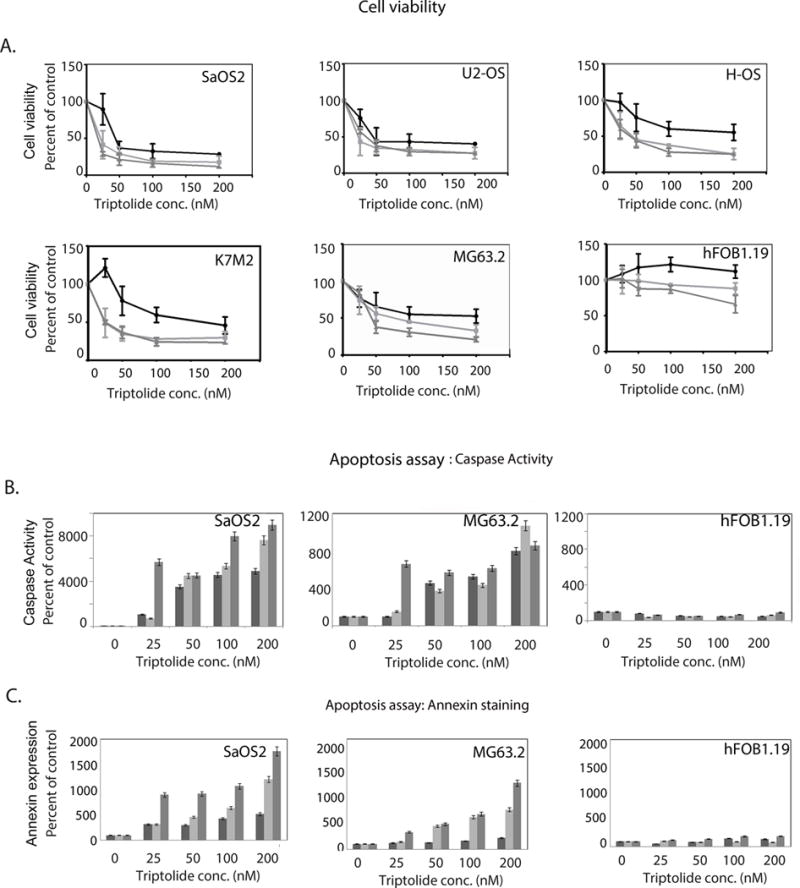
Figure 1
Figure 1. Viability of OS cells in response to triptolide treatment
A) Osteosarcoma cells SaOS2 U2OS, HOS, K7M2, and MG63.2 and human osteoblast cells (fOB1.19) were treated with triptolide for 24h, 48h and 72h. Cell viability was determined by CCK assay and plotted after normalizing to untreated controls. Treatment with triptolide induced apoptosis in both all osteosarcoma cell lines tested but not in the osteoblast cells. B) Caspase-3 was induced in SaOS2 and MG63.2 cells in response to triptolide whereas human osteoblasts did not show any caspase activity. C) Annexin V positive cells confirmed apoptosis specifically in SaOS2 and MG63.2 in response to triptolide.
Figure 2
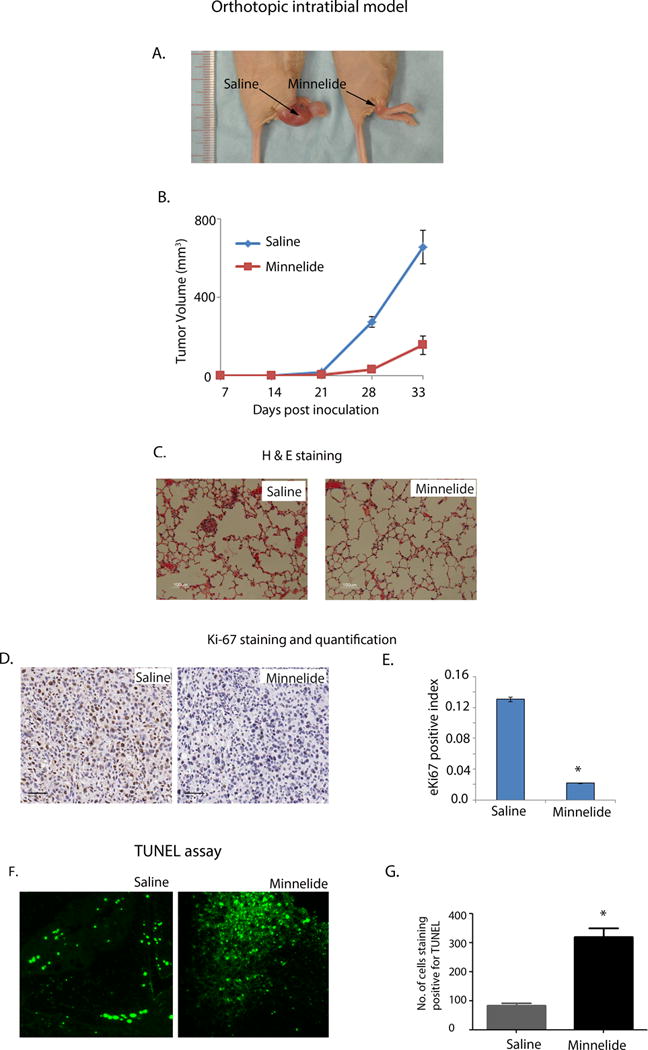
Figure 2. Minnelide, causes tumor regression in an orthotopic mouse model of osteosarcoma
A) Representative mice treated with saline and Minnelide on 33rd day of post tumor cells implantation. Minnelide significantly decreased tumor size. B) Tumor volume in saline and Minnelide treated OS mice on 33rd day of post tumor cells implantation. Minnelide treated animals showed late tumor onset and significantly reduced tumor progression resulting significant difference in tumor size (cumulative average of 4.2 times, p <0.001). C) H&E staining of lung tissue from saline and Minnelide treated OS mice (10× mag). Minnelide decreased the formation of pulmonary micrometastasis relative to saline treatment. D) Ki67 expression in the tumor tissues of saline and Minnelide treated OS mice (20× mag, scale 50μM). E) Quantitation of Ki-67 staining showed decreased proliferation in Minnelide treated tumor as seen in Ki67 positive index of saline and Minnelide treated mice (44-fold, p<0.001). F) TUNEL staining showing increased apoptotic cells in Minnelide treated tumors compared to saline treatment. G) Quantitation of TUNEL staining in saline and Minnelide treated tumors (p<0.001).
Figure 3
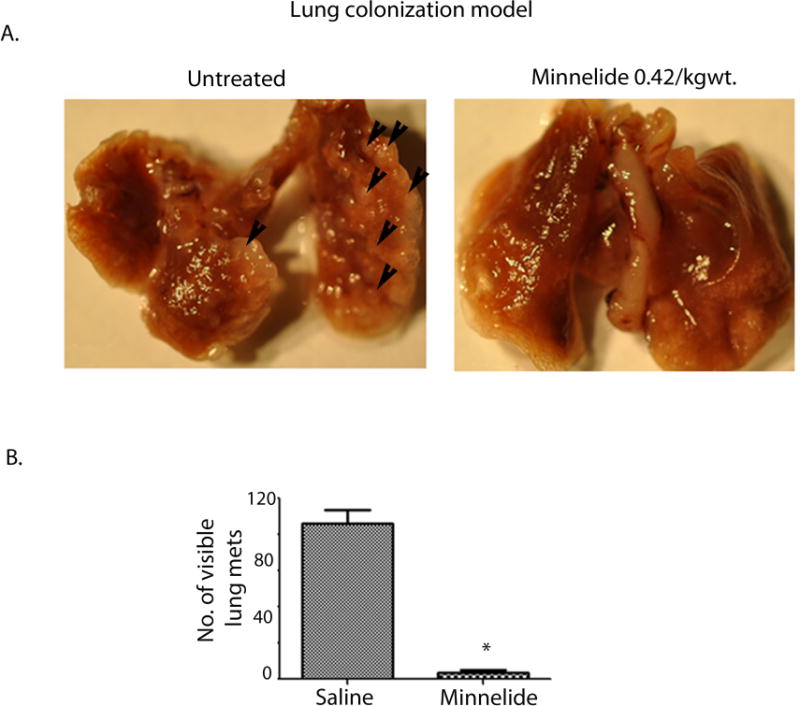
Figure 3. Minnelide reduces the number of metastatic nodules in the lung colonization model for osteosarcoma
A) Representative mouse lungs show metastasizing nodules injected in saline, which decrease with Minnelide treatment. B) Visible nodules were counted and plotted in treated and untreated animals.
Figure 4
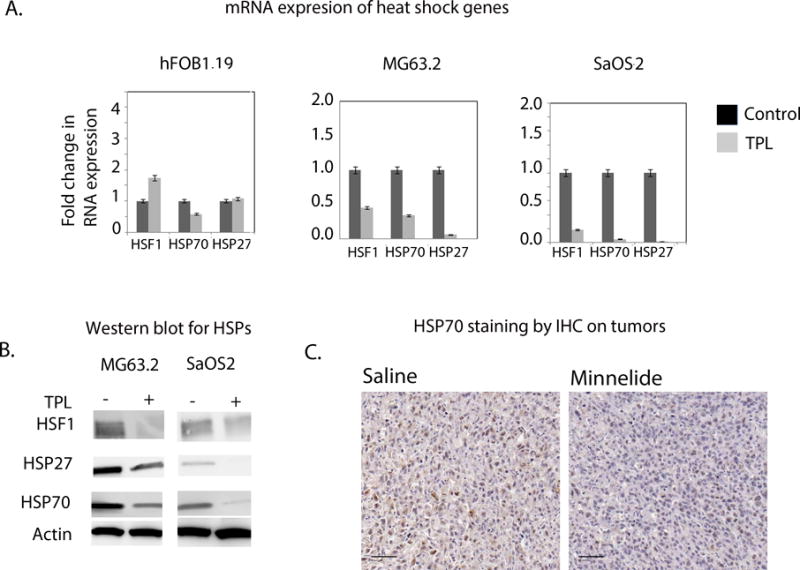
Figure 4. Triptolide decreases HSP70 expression in osteosarcoma cells
A) Heat shock family of genes showed lower mRNA expression in triptolide treated SaOS2 and MG63.2 compared to human osteoblast (fOB1.19) cells. B) Decreased protein expression for HSP70, HSP27 and HSF1 was observed in triptolide treated SaOS2 and MG63.2 cells. C) HSP70 expression in saline and Minnelide treated mice (20×mag, scale 50μM). The in vivo intratibial model for osteosarcoma also showed decreased HSP70 expression in Minnelide treated mice. D) Minnelide treated mice show significantly reduced (2 fold, p <0.001) HSP70 expression compared to the saline treated.
Figure 5
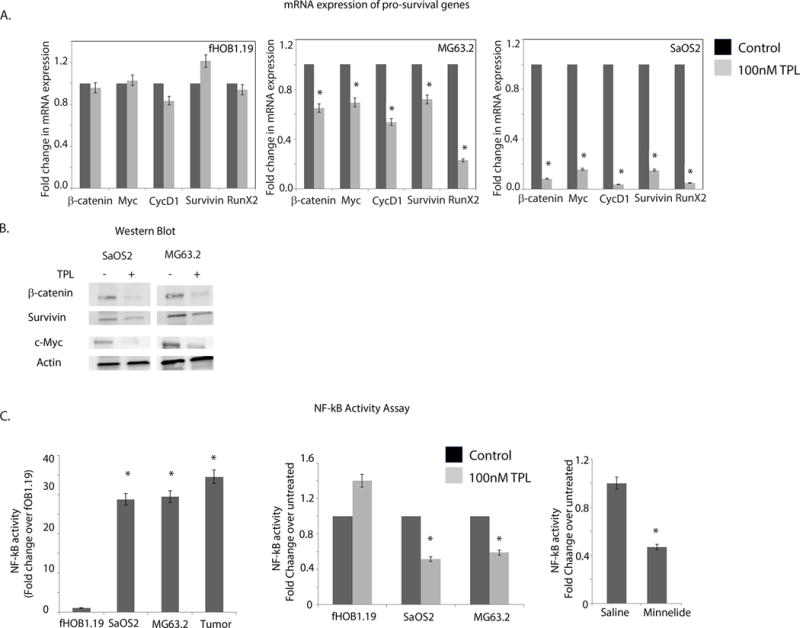
Figure 5. Triptolide reduces expression of survival genes and results in decreased NF-κB activity in osteosarcoma
A) Decreased mRNA expression of regulatory genes in OS like of β-catenin, cMYC, Cyclin D1, survivin and RunX2 was observed in SaOS2 and MG63.2 after treatment with 100nM triptolide but no change in expression was noticed in normal osteoblast cells. B) Reduced protein expression of b-catenin, cMYC, Cyclin D1 and survivin was observed in triptolide treated SaOS2 and MG63.2 but not in normal osteoblast cells. C) DNA binding activity by NF-κB in response to triptolide treatment was studied by ELISA based assay in SaOS2, MG63.2 and fOB1.19 cell lines as well as the intratibial orthotopic model for OS. In SaOS2, MG63.2 and the tumors, NF-κB activity was 25-to 30-fold higher compared to the osteoblast. D) NF-κB DNA binding was reduced following 24h treatment with 100nM triptolide in both SaOS2 and MG63.2 cells but no change in DNA binding was seen in osteoblast fOB1.19 cells. (E) NF-κB activity was significantly decreased in the orthotopic tumors treated with Minnelide.

References

    1. Kansara M, Thomas DM. Molecular pathogenesis of osteosarcoma. DNA Cell Biol. 2007;26:1–18. - PubMed
    1. Marulanda GA, Henderson ER, Johnson DA, Letson GD, Cheong D. Orthopedic surgery options for the treatment of primary osteosarcoma. Cancer Control. 2008;15:13–20. - PubMed
    1. Basu-Roy U, Basilico C, Mansukhani A. Perspectives on cancer stem cells in osteosarcoma. Cancer Lett. 2012 - PMC - PubMed
    1. Lewis VO. What’s new in musculoskeletal oncology. J Bone Joint Surg Am. 2007;89:1399–1407. - PubMed
    1. Westerheide SD, Kawahara TL, Orton K, Morimoto RI. Triptolide, an inhibitor of the human heat shock response that enhances stress-induced cell death. J Biol Chem. 2006;281:9616–9622. - PubMed

Publication types

MeSH terms