Review
. 2013 Mar 15;5(3):834-57.
doi: 10.3390/v5030834.

Antiviral type I and type III interferon responses in the central nervous system

Affiliations
Review

Antiviral type I and type III interferon responses in the central nervous system

Frédéric Sorgeloos et al. Viruses. .

Abstract

The central nervous system (CNS) harbors highly differentiated cells, such as neurons that are essential to coordinate the functions of complex organisms. This organ is partly protected by the blood-brain barrier (BBB) from toxic substances and pathogens carried in the bloodstream. Yet, neurotropic viruses can reach the CNS either by crossing the BBB after viremia, or by exploiting motile infected cells as Trojan horses, or by using axonal transport. Type I and type III interferons (IFNs) are cytokines that are critical to control early steps of viral infections. Deficiencies in the IFN pathway have been associated with fatal viral encephalitis both in humans and mice. Therefore, the IFN system provides an essential protection of the CNS against viral infections. Yet, basal activity of the IFN system appears to be low within the CNS, likely owing to the toxicity of IFN to this organ. Moreover, after viral infection, neurons and oligodendrocytes were reported to be relatively poor IFN producers and appear to keep some susceptibility to neurotropic viruses, even in the presence of IFN. This review addresses some trends and recent developments concerning the role of type I and type III IFNs in: i) preventing neuroinvasion and infection of CNS cells; ii) the identity of IFN-producing cells in the CNS; iii) the antiviral activity of ISGs; and iv) the activity of viral proteins of neurotropic viruses that target the IFN pathway.


Figures
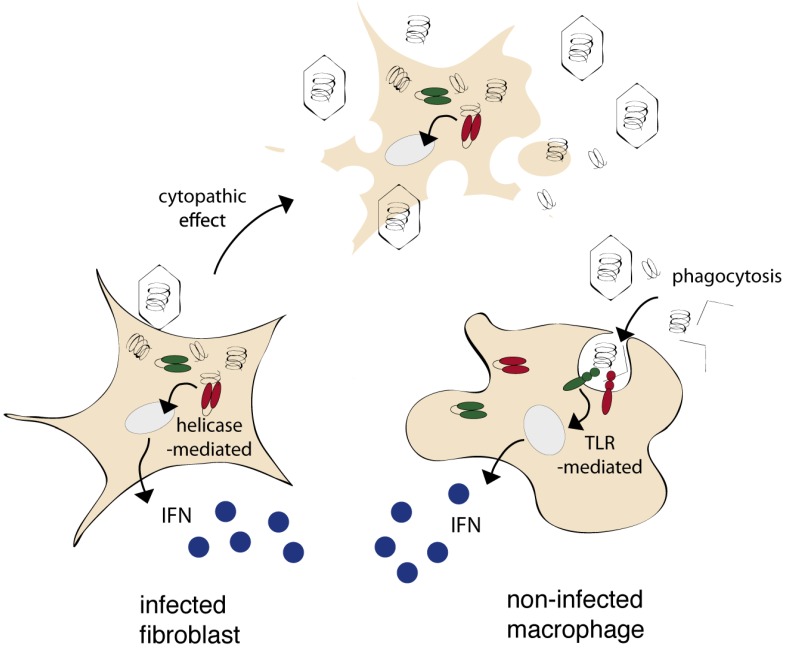
Figure 1
Figure 1
Infected and non-infected cells can produce IFN, using distinct pattern recognition receptors. Most cells express RIG-like helicases (RIG-I or MDA-5) that sense nucleic acids of viral origin in the cytoplasm and thus trigger IFN production by infected cells. Some cells, and particularly phagocytic cells, express TLRs that sense extracellular danger and pathogen-associated molecular patterns from the extracellular milieu. TLRs thus enable non-infected cells to sense viral components released by neighboring cells.
Figure 2
Figure 2
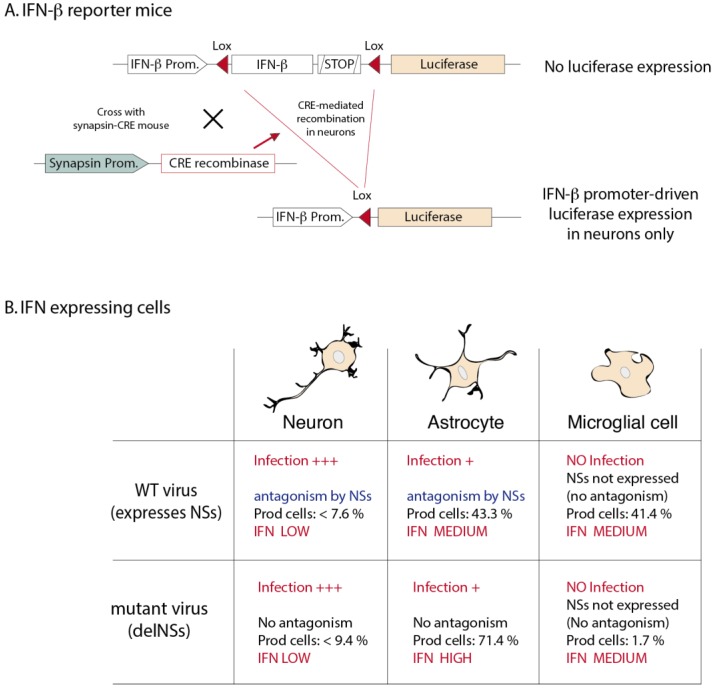
IFN-β reporter mice and IFN-β producing cells after LaCrosse virus infection. (A) Knock-in reporter mice. The IFN-β ORF, followed by a polyadenylation signal is floxed (Lox sites are represented by red arrowheads). A firefly luciferase ORF present downstream of the floxed region can be transcribed by the IFN-β promoter after CRE-mediated recombination. When these mice are crossed with mice that express CRE in a cell-specific fashion, luciferase expression, driven by the IFN-β promoter, will be restricted to that specific cell type. The example of the neuron-specific synapsin promoter is shown (adapted from Lienenklaus et al., [63]). (B) IFN-β expressing cells in La Crosse virus infected brains (adapted from Kallfass et al., [62]). A wild-type (WT) strain of La Crosse virus was used as well as the delNSs mutant, lacking the IFN antagonist non-structural protein NSs. Although neurons were heavily infected, very few produced IFN-β (luciferase), suggesting that IFN production by neurons is strictly regulated. In astrocytes, NSs expression appears to block IFN expression efficiently. Microglial cells are not infected but produce IFN, likely in a TLR-dependent way.
Figure 3
Figure 3
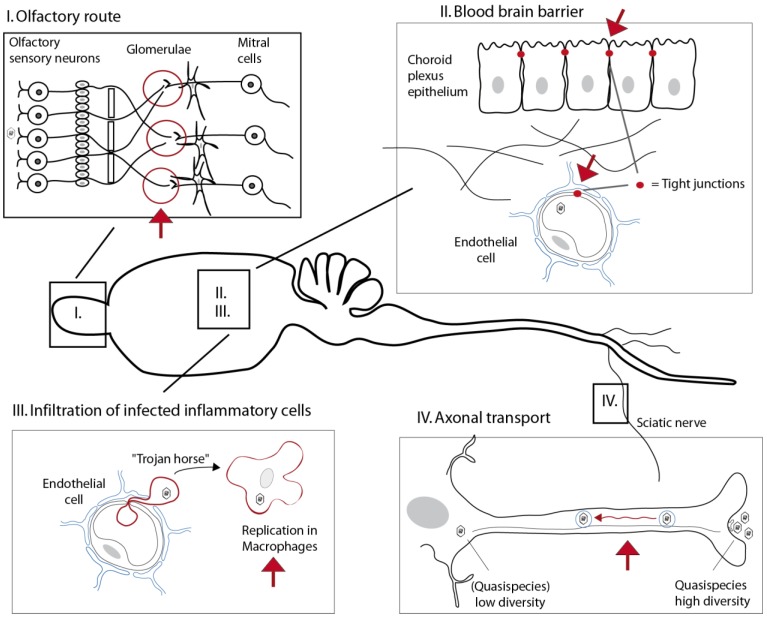
Expected effects of IFN on neuroinvasion pathways. Viruses can reach the CNS by the olfactory route (I), via the blood-brain barrier (II), by infecting infiltrating cells (Trojan horse strategy) (III), or by using axonal transport (IV). (I) In the olfactory pathway, IFN was found to limit viral spread of VSV from the glomerulae that connect olfactory neurons, mitral cells and some periglomerular cells [66]. (II) The blood-brain barrier is tightened by tight junctions formed by capillary endothelial cells and between adjacent epithelial cells of the choroid plexus. Epithelial cells of the choroid plexus strongly respond to circulating IFN-λ and endothelial cells respond to circulating IFN-α/β. Type I and type III IFNs are thus believed to concur to protect BBB-forming cells [54]. (III) Type I IFN produced in the periphery is expected to limit neuroinvasion via Trojan horses by controlling viral replication in the cells that might infiltrate the CNS. (IV) It is still unclear to what extent IFN can control axonal transport. It was reported that IFN acts to restrict the diversity of quasispecies during progression in the sciatic nerve [70].
Figure 4
Figure 4
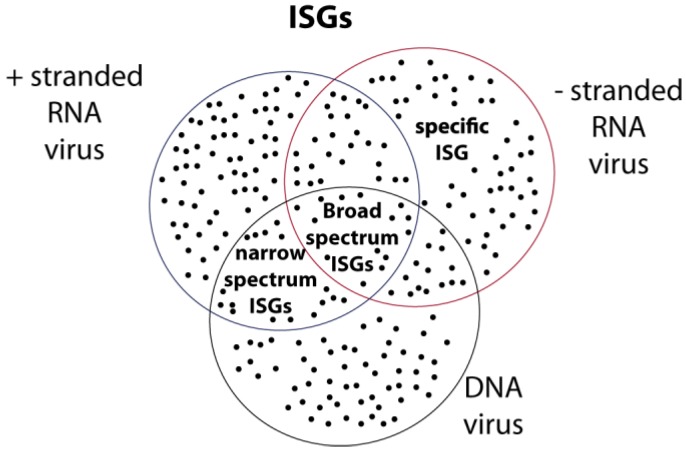
ISGs act in combination. i) The antiviral activity of ISGs appears to be the combination of many individual contributions. ii) As many ISGs display some specificity in their antiviral action, each virus species is likely controlled by a unique combination of many ISGs.

References

    1. Binder G.K., Griffin D.E. Interferon-gamma-mediated site-specific clearance of alphavirus from CNS neurons. Science. 2001;293:303–306. - PubMed
    1. Thompson M.R., Kaminski J.J., Kurt-Jones E.A., Fitzgerald K.A. Pattern recognition receptors and the innate immune response to viral infection. Viruses. 2011;3:920–940. doi: 10.3390/v3060920. - DOI - PMC - PubMed
    1. Paul S., Ricour C., Sommereyns C., Sorgeloos F., Michiels T. Type I interferon response in the central nervous system. Biochimie. 2007;89:770–778. doi: 10.1016/j.biochi.2007.02.009. - DOI - PubMed
    1. Muller U., Steinhoff U., Reis L.F., Hemmi S., Pavlovic J., Zinkernagel R.M., Aguet M. Functional role of type I and type II interferons in antiviral defense. Science. 1994;264:1918–1921. - PubMed
    1. Ryman K.D., Klimstra W.B., Nguyen K.B., Biron C.A., Johnston R.E. Alpha/beta interferon protects adult mice from fatal Sindbis virus infection and is an important determinant of cell and tissue tropism. J. Virol. 2000;74:3366–3378. doi: 10.1128/JVI.74.7.3366-3378.2000. - DOI - PMC - PubMed

Publication types

LinkOut - more resources