


Characterisation of sleep in intensive care using 24-hour polysomnography: an observational study
- PMID: 23506782
- PMCID: PMC3733429
- DOI: 10.1186/cc12565
Characterisation of sleep in intensive care using 24-hour polysomnography: an observational study
Abstract
Introduction: Many intensive care patients experience sleep disruption potentially related to noise, light and treatment interventions. The purpose of this study was to characterise, in terms of quantity and quality, the sleep of intensive care patients, taking into account the impact of environmental factors.
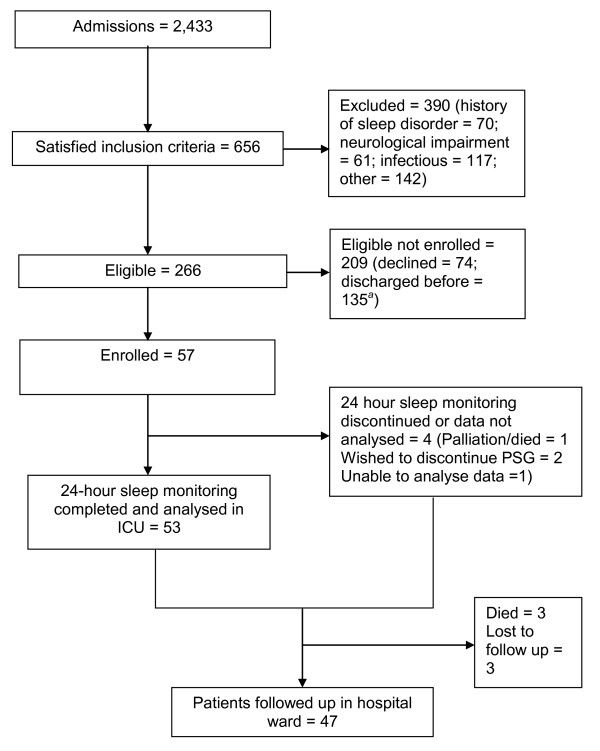
Methods: This observational study was conducted in the adult ICU of a tertiary referral hospital in Australia, enrolling 57 patients. Polysomnography (PSG) was performed over a 24-hour period to assess the quantity (total sleep time: hh:mm) and quality (percentage per stage, duration of sleep episode) of patients' sleep while in ICU. Rechtschaffen and Kales criteria were used to categorise sleep. Interrater checks were performed. Sound pressure and illuminance levels and care events were simultaneously recorded. Patients reported on their sleep quality in ICU using the Richards Campbell Sleep Questionnaire and the Sleep in Intensive Care Questionnaire. Data were summarised using frequencies and proportions or measures of central tendency and dispersion as appropriate and Cohen's Kappa statistic was used for interrater reliability of the sleep data analysis.
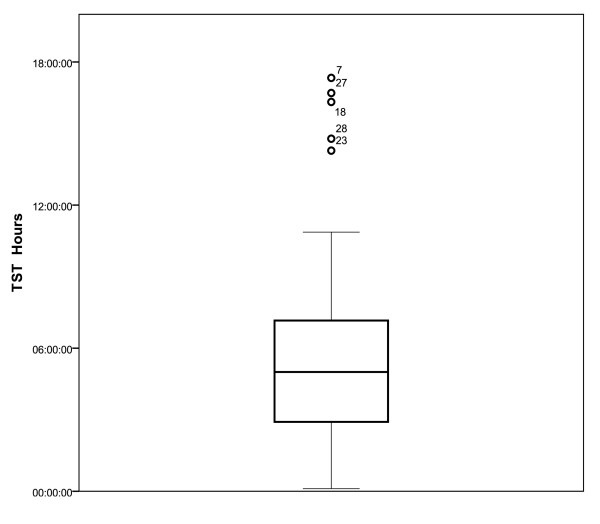
Results: Patients' median total sleep time was 05:00 (IQR: 02:52 to 07:14). The majority of sleep was stage 1 and 2 (medians: 19 and 73%) with scant slow wave and REM sleep. The median duration of sleep without waking was 00:03. Sound levels were high (mean Leq 53.95 dB(A) during the day and 50.20 dB(A) at night) and illuminance levels were appropriate at night (median<2 lux) but low during the day (median: 74.20 lux). There was a median 1.7 care events/h. Patients' mean self-reported sleep quality was poor. Interrater reliability of sleep staging was highest for slow wave sleep and lowest for stage 1 sleep.
Conclusions: The quantity and quality of sleep in intensive care patients are poor and may be related to noise, critical illness itself and treatment events that disturb sleep. The study highlights the challenge of quantifying sleep in the critical care setting and the need for alternative methods of measuring sleep. The results suggest that a sound reduction program is required and other interventions to improve clinical practices to promote sleep in intensive care patients.
Trial registration: Australian New Zealand clinical trial registry (http://www.anzctr.org.au/): ACTRN12610000688088.
Figures
Comment in
-
How do we know when patients sleep properly or why they do not?Crit Care. 2013 May 15;17(3):145. doi: 10.1186/cc12614. Crit Care. 2013. PMID: 23830045 Free PMC article.
References
Publication types
MeSH terms
Associated data
LinkOut - more resources
Full Text Sources
Other Literature Sources
Medical
Miscellaneous
