


Genetically engineered mouse models of pancreatic adenocarcinoma
- PMID: 23506980
- PMCID: PMC5528418
- DOI: 10.1016/j.molonc.2013.02.002
Genetically engineered mouse models of pancreatic adenocarcinoma
Abstract
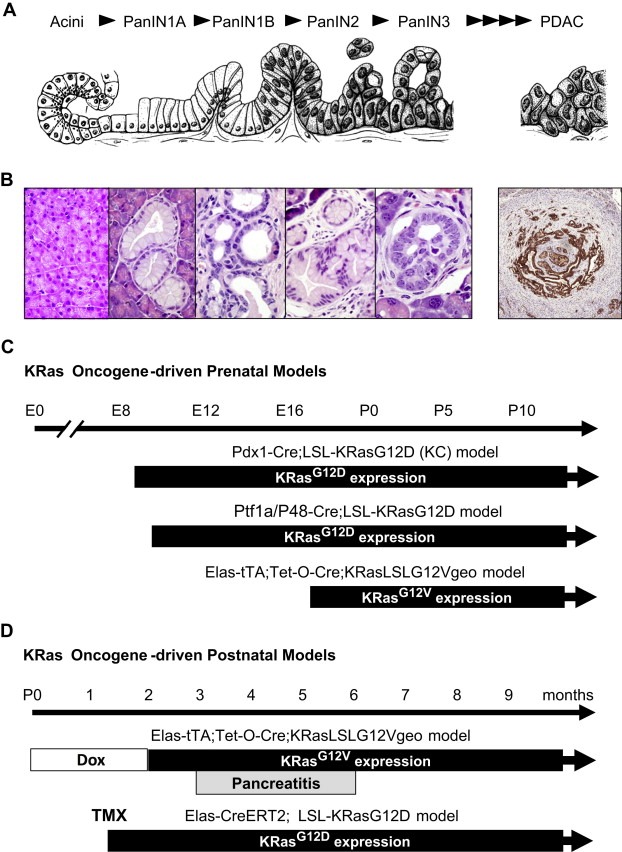
Pancreatic ductal adenocarcinoma (PDAC) is one of the most lethal types of human cancer for which there are no effective therapies. Deep sequencing of PDAC tumors has revealed the presence of a high number of mutations (>50) that affect at least a dozen key signaling pathways. This scenario highlights the urgent need to develop experimental models that faithfully reproduce the natural history of these human tumors in order to understand their biology and to design therapeutic approaches that might effectively interfere with their multiple mutated pathways. Over the last decade, several models, primarily based on the genetic activation of resident KRas oncogenes knocked-in within the endogenous KRas locus have been generated. These models faithfully reproduce the histological lesions that characterize human pancreatic tumors. Decoration of these models with additional mutations, primarily involving tumor suppressor loci known to be also mutated in human PDAC tumors, results in accelerated tumor progression and in the induction of invasive and metastatic malignancies. Mouse PDACs also display a desmoplastic stroma and inflammatory responses that closely resemble those observed in human patients. Interestingly, adult mice appear to be resistant to PDAC development unless the animals undergo pancreatic damage, mainly in the form of acute, chronic or even temporary pancreatitis. In this review, we describe the most representative models available to date and how their detailed characterization is allowing us to understand their cellular origin as well as the events involved in tumor progression. Moreover, their molecular dissection is starting to unveil novel therapeutic strategies that could be translated to the clinic in the very near future.
Copyright © 2013 Federation of European Biochemical Societies. Published by Elsevier B.V. All rights reserved.
Figures
References
-
- Apelqvist, A. , Li, H. , Sommer, L. , Beatus, P. , Anderson, D.J. , Honjo, T. , Hrabe de Angelis, M. , Lendahl, U. , Edlund, H. , 1999. Notch signalling controls pancreatic cell differentiation. Nature 400, 877–881. - PubMed
-
- Apte, M.V. , Wilson, J.S. , 2012. Dangerous liaisons: pancreatic stellate cells and pancreatic cancer cells. J. Gastroenterol. Hepatol. 27, 69–74. - PubMed
-
- Ardito, C.M. , Gruner, B.M. , Takeuchi, K.K. , Lubeseder-Martellato, C. , Teichmann, N. , Mazur, P.K. , DelGiorno, K.E. , Carpenter, E.S. , Halbrook, C.J. , Hall, J.C. , Pal, D. , Briel, T. , Herner, A. , Trajkovic-Arsic, M. , Sipos, B. , Liou, G.-Y. , Storz, P. , Murray, N.R. , Threadgill, D.W. , Sibilia, M. , Washington, M.K. , Wilson, C.L. , Schmid, R.M. , Raines, E.W. , Crawford, H.C. , Siveke, J.T. , 2012. EGF Receptor is required for KRAS-induced pancreatic tumorigenesis. Cancer Cell 22, 304–317. - PMC - PubMed
-
- Bardeesy, N. , Cheng, K.H. , Berger, J.H. , Chu, G.C. , Pahler, J. , Olson, P. , Hezel, A.F. , Horner, J. , Lauwers, G.Y. , Hanahan, D. , DePinho, R.A. , 2006. Smad4 is dispensable for normal pancreas development yet critical in progression and tumor biology of pancreas cancer. Genes Dev. 20, 3130–3146. - PMC - PubMed
Publication types
MeSH terms
LinkOut - more resources
Full Text Sources
Other Literature Sources
Medical
Miscellaneous
