


Utilization patterns and outcomes associated with central venous catheter in septic shock: a population-based study
- PMID: 23507718
- PMCID: PMC3780984
- DOI: 10.1097/CCM.0b013e31827caa89
Utilization patterns and outcomes associated with central venous catheter in septic shock: a population-based study
Abstract
Objectives: In 2001, a randomized trial showed decreased mortality with early, goal-directed therapy in septic shock, a strategy later recommended by the Surviving Sepsis Campaign. Placement of a central venous catheter is necessary to administer goal-directed therapy. We sought to evaluate nationwide trends in: 1) central venous catheter utilization and 2) the association between early central venous catheter insertion and mortality in patients with septic shock.
Design: We retrospectively analyzed the proportion of septic shock cases receiving an early (day of admission) central venous catheter and the odds of hospital mortality associated with receiving early central venous catheter from years 1998 to 2001 compared with 2002 to 2009.
Setting: Non-federal acute care hospitalizations from the Nationwide Inpatient Sample, 1998-2009.
Patients: A total of 203,481 (population estimate: 999,545) patients admitted through an emergency department with principal diagnosis of septicemia and secondary diagnosis of shock.
Interventions: None.
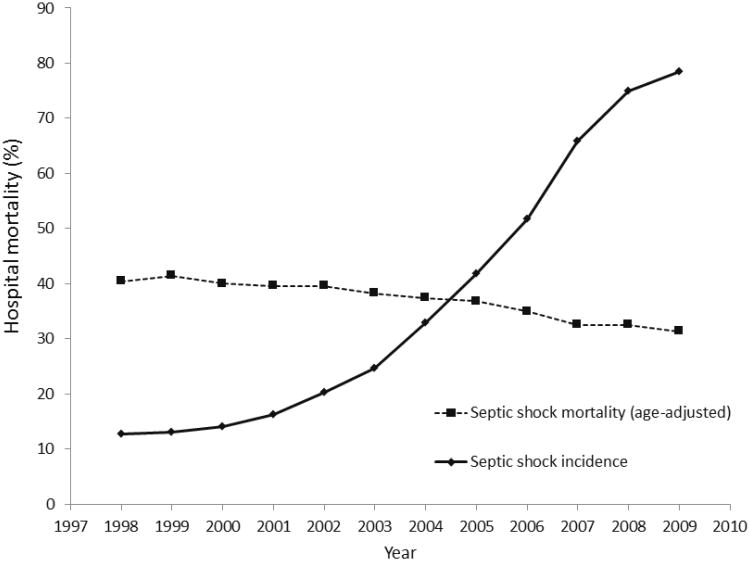
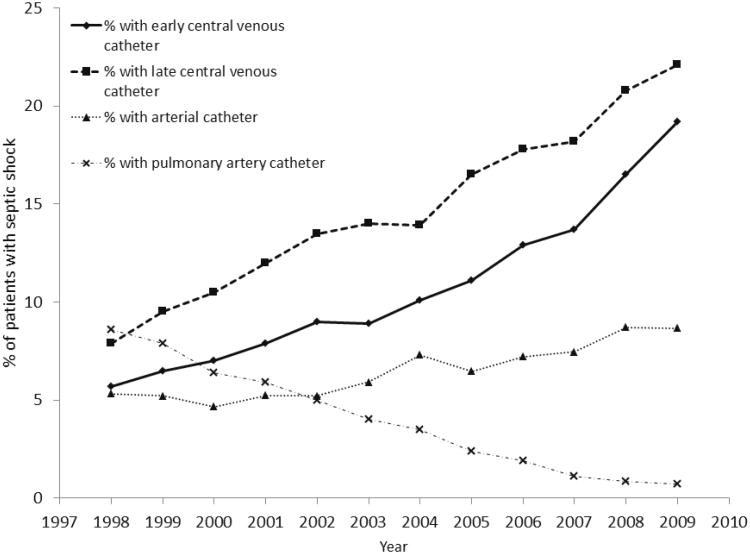
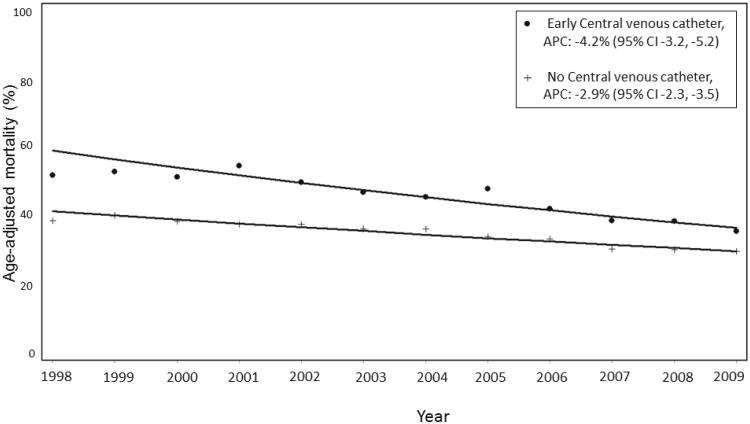
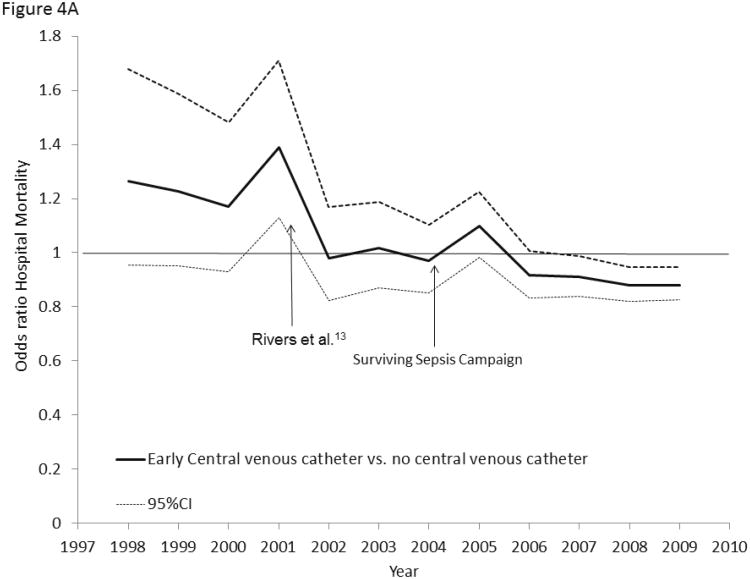
Measurements and main results: From 1998 to 2009, population-adjusted rates of septic shock increased from 12.6 cases per 100,000 U.S. adults to 78 cases per 100,000. During this time, age-adjusted hospital mortality associated with septic shock declined from 40.4% to 31.4%. Early central venous catheter insertion increased from 5.7% (95% confidence interval 5.1% to 6.3%) to 19.2% (95% confidence interval 18.7% to 19.5%) cases with septic shock, with an increased rate of early central venous catheter placement identified after 2007. The rate of decline in age-adjusted hospital mortality was significantly greater for patients who received an early central venous catheter (-4.2% per year, 95% confidence interval -3.2, -4.2%) as compared with no central venous catheter (-2.9% per year, 95% confidence interval -2.3, -3.5%; p = 0.016). Hospital mortality associated with early central venous catheter insertion significantly decreased from a multivariable-adjusted odds ratio of 1.29 (95% confidence interval 1.14-1.45) prior to 2001 to an adjusted odds ratio of 0.87 (95% confidence interval 0.84-0.90) after 2001.
Conclusions: Placement of a central venous catheter early in septic shock has increased three-fold since 1998. The mortality associated with early central venous catheter insertion decreased after publication of evidence-based instructions for central venous catheter use.
Figures
Comment in
-
Trends in mortality and early central line placement in septic shock: true, true, and related?*.Crit Care Med. 2013 Jun;41(6):1577-8. doi: 10.1097/CCM.0b013e318283cc36. Crit Care Med. 2013. PMID: 23685581 Free PMC article. No abstract available.
References
-
- Dombrovskiy VY, Martin AA, Sunderram J, et al. Rapid increase in hospitalization and mortality rates for severe sepsis in the united states: A trend analysis from 1993 to 2003. Crit Care Med. 2007;35:1244–1250. - PubMed
-
- Lagu T, Rothberg MB, Shieh MS, et al. Hospitalizations, costs, and outcomes of severe sepsis in the united states 2003 to 2007. Crit Care Med. 2012 Mar;40:754–61. - PubMed
-
- Kumar G, Kumar N, Taneja A, et al. Nationwide trends of severe sepsis in the 21st century (2000-2007) Chest. 2011;140:1223–1231. - PubMed
-
- Levy MM, Dellinger RP, Townsend SR, et al. The surviving sepsis campaign: Results of an international guideline-based performance improvement program targeting severe sepsis. Crit Care Med. 2010;38:367–374. - PubMed
-
- Dellinger RP, Levy MM, Carlet JM, et al. Surviving sepsis campaign: International guidelines for management of severe sepsis and septic shock: 2008. Crit Care Med. 2008;36:296–327. - PubMed
Publication types
MeSH terms
Grants and funding
LinkOut - more resources
Full Text Sources
Other Literature Sources
