Review
. 2012 Oct-Dec;2(4):296-312.
doi: 10.4161/biom.22347.

Nanostructured porous Si-based nanoparticles for targeted drug delivery

Affiliations
Review

Nanostructured porous Si-based nanoparticles for targeted drug delivery

Mohammad-Ali Shahbazi et al. Biomatter. 2012 Oct-Dec.

Abstract

One of the backbones in nanomedicine is to deliver drugs specifically to unhealthy cells. Drug nanocarriers can cross physiological barriers and access different tissues, which after proper surface biofunctionalization can enhance cell specificity for cancer therapy. Recent developments have highlighted the potential of mesoporous silica (PSiO(2)) and silicon (PSi) nanoparticles for targeted drug delivery. In this review, we outline and discuss the most recent advances on the applications and developments of cancer therapies by means of PSiO(2) and PSi nanomaterials. Bio-engineering and fine tuning of anti-cancer drug vehicles, high flexibility and potential for sophisticated release mechanisms make these nanostructures promising candidates for "smart" cancer therapies. As a result of their physicochemical properties they can be controllably loaded with large amounts of drugs and coupled to homing molecules to facilitate active targeting. The main emphasis of this review will be on the in vitro and in vivo studies.

Keywords: cancer therapy; cell targeting; drug delivery; functionalization; in vitro; in vivo; mesoporous silica; mesoporous silicon; nanoparticles.


Figures
None
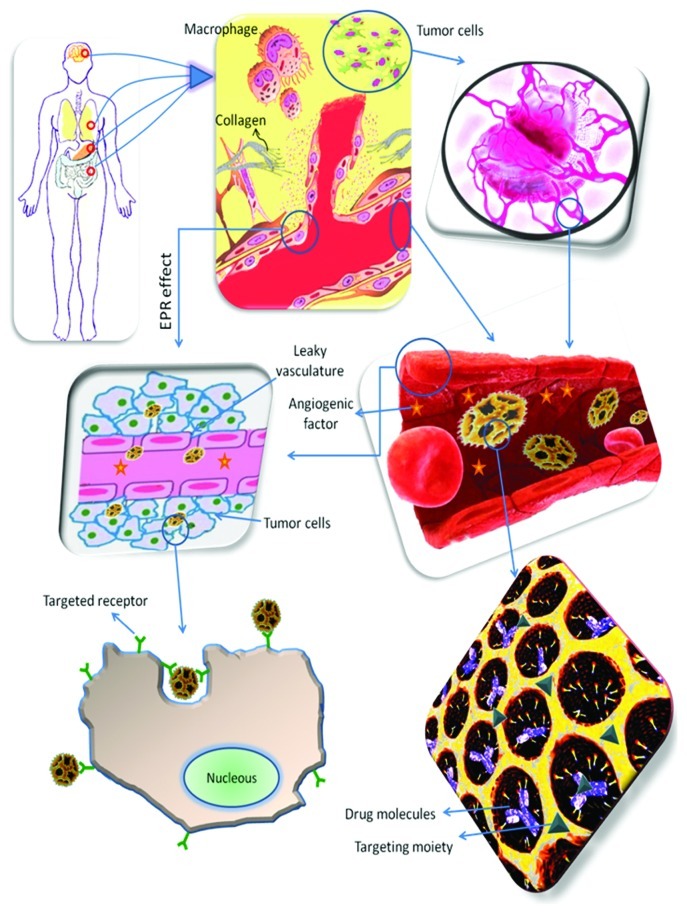
Figure 1. Schematic overview of the events taking place in cancer tissues and some of the strategies for providing a rational nanoparticulate drug delivery system with both passive and active targeting. Nanoparticulate delivery systems can be used to target and accumulate anticancer drugs to tumor tissues (e.g., brain, lung, stomach and intestine) by passive targeting; making use of the leaky vasculature and the EPR effect to reach the cancer cells. Alternatively, nanoparticulate delivery systems can also be used to target and accumulate anticancer drugs to tumor tissues by active targeting; making use of the targeting moieties attached to the surface of the nanoparticulate systems to deliver drugs to pathological sites or to cross biological barriers based on molecular recognition processes to target the receptors of the cancer cells.
None
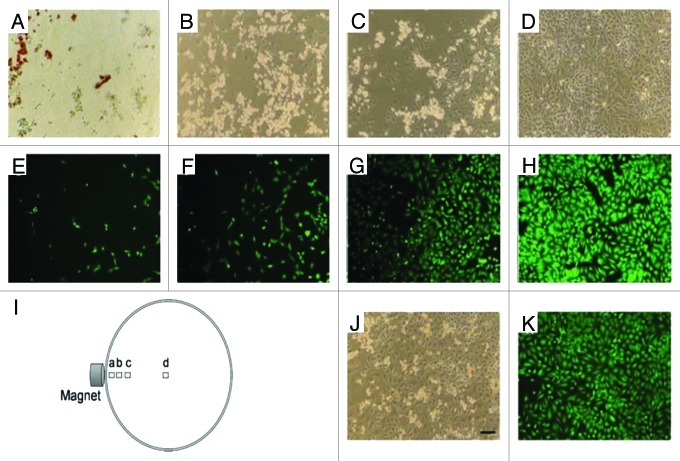
Figure 2. Phase contrast (A–D) and fluorescence (stained with Calcein AM) microscope images of HeLa cells incubated for 24 h with doxorubicin-loaded magnetic LiPSi, showing magnetically guided (H) and without guidance (J and K) delivery of doxorubicin. The position of each image relative to the external magnet is depicted in I). Scale bar for all images is 100 µm. Reprinted with permission from reference .
None
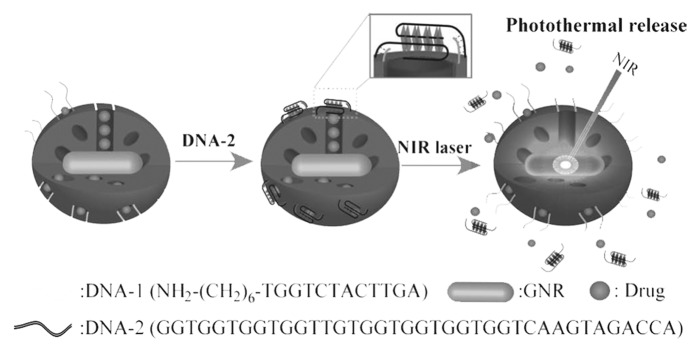
Figure 3. Schematic of a NIR light-triggered release of guest molecules from the pores of an aptamer-covered PSiO2-based nanovehicle. Reprinted with permission from reference .
None
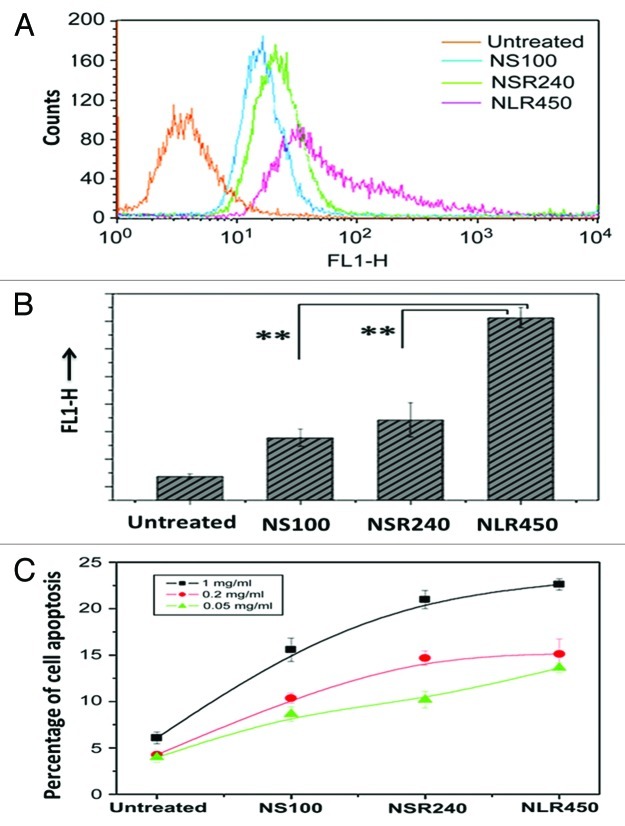
Figure 4. (A) Quantification of cellular uptake and apoptosis of different shaped PSiO2 by flow cytometry analysis of different prepared PSiO2 nanoparticles: sphere-shaped, NS (100 nm), short rod-shaped, NSR (240 nm) and long rod-shaped, NLR (450 nm). (B) Quantitative measurement (fluorescence) of particle numbers in cells (data are presented as mean ± s.d; statistical significance for the comparison of the number of internalized particles between different shaped particles, **p < 0.1). (C) Influence of different concentrations of shaped nanoparticles on early apoptosis of A375 cells. Reprinted with permission from reference .
None
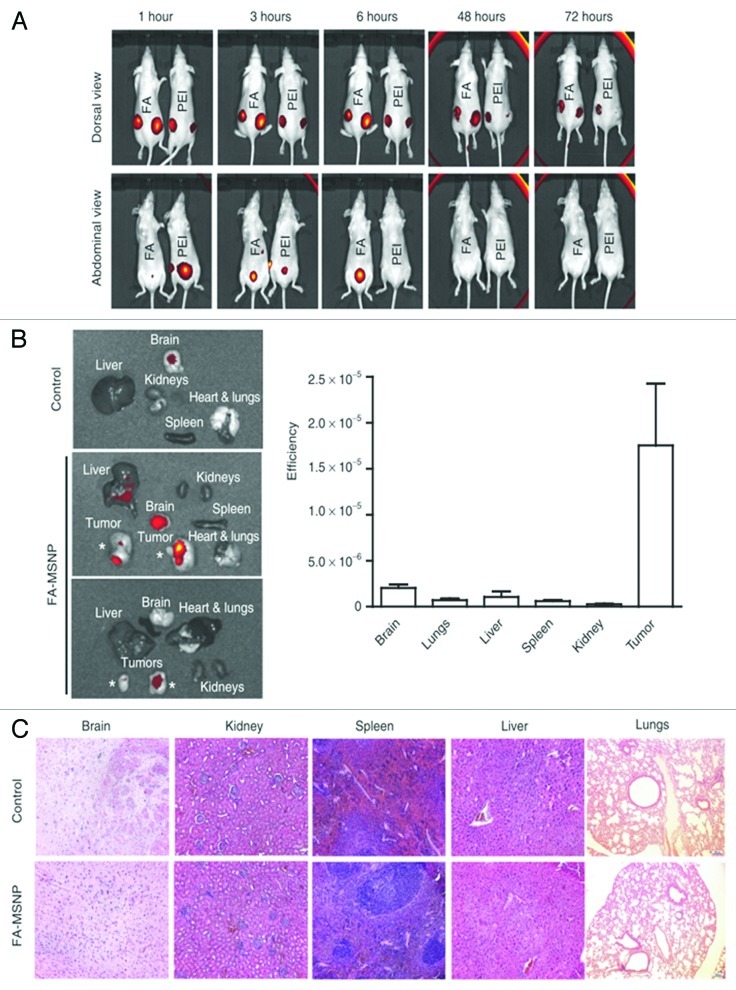
Figure 5. (A) In vivo imaging of mice injected peritumoral with poly(ethylene imine) (PEI)-PSiO2 nanoparticles ( = MSNPs) or FA-MSNPs. Images of the abdominal and dorsal area demonstrate accumulation of fluorescence in the bladder and in the tumors, respectively. Images of the abdominal area show elimination of fluorescence within 48 h after injections. (B) Ex vivo analyses (left) and quantification of fluorescence intensity (right) in organs from mice injected intravenous with FA-MSNPs. (C) Histological analysis of brain, kidney, spleen, liver, and lungs of untreated mice and FA-MSNPs-treated mice showed no morphological changes. PSiO2 nanoparticles accumulated in the tumors were biocompatible, biodegradable and eliminated through renal excretion. Reprinted with permission from reference .
None
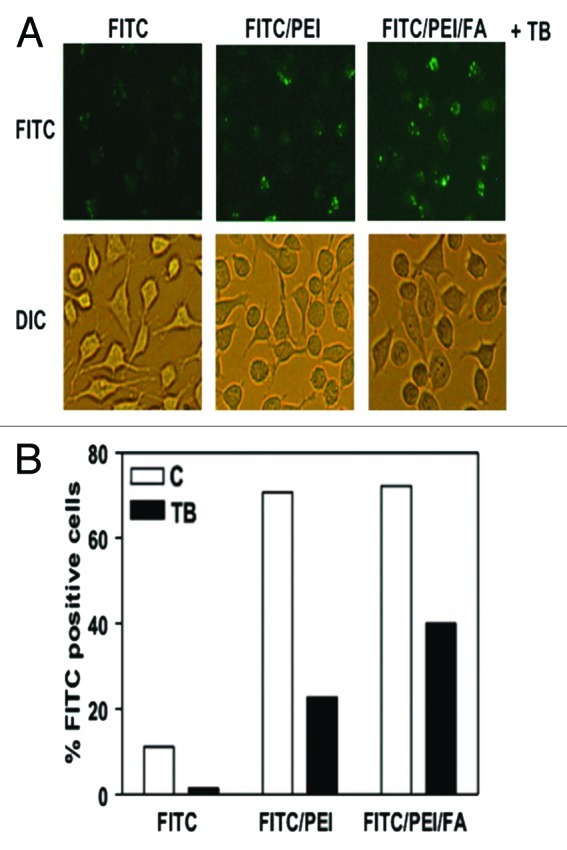
Figure 6. Conjugation of FA with PSiO2 nanoparticle showed improved endocytosis in HeLa cells. HeLa cells treated with PSiO2 nanoparticles at 10 µg/ml for 2 h and the extracellular binding of the nanoparticles was quenched with trypan blue (FITC, pristine FITC-labeled particle; FITC/PEI, PEI-functionalized FITC-labeled particle; FITC/PEI/FA, FA-conjugated PEI-functionalized FITC-labeled particle). Fluorescence microscopy was used to image FITC-labeled particles inside the cells and differential interference contrast microscopy for cellular morphology evaluations (A). Flow cytometry was used to detect the number of HeLa cells with endocytosed PSiO2 nanoparticles in control or trypan blue quenched cells (B). Reprinted with permission from reference .
None
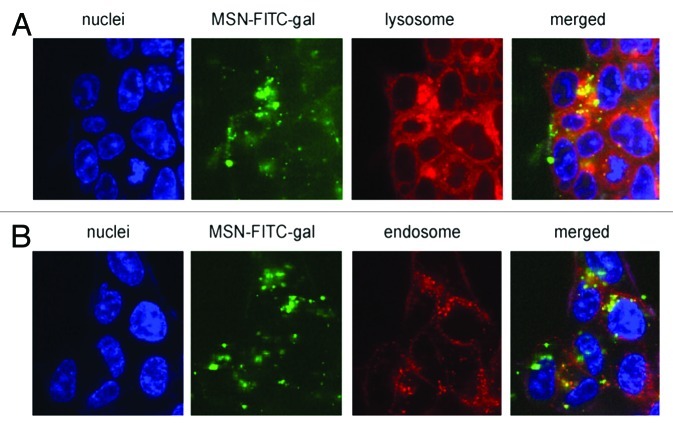
Figure 7. Confocal microscopy images after 6 h incubation of living HCT-116 colorectal cancer cells with FITC-galactose-modified PSiO2 nanoparticles ( = MSN-FITC-gal) at 37°C. Merged pictures of both section A and B indicated the co-localization (yellow) of FITC-nanoparticles (green) with lysosomal or endosomal markers, respectively. Reprinted with permission from reference .
None
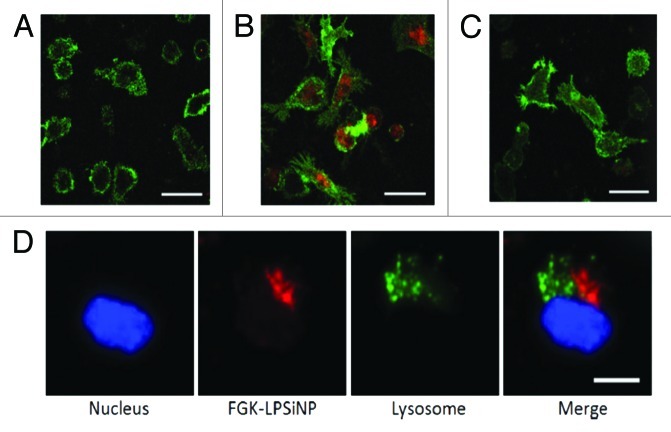
Figure 8. Fluorescence microscope images of mouse bone marrow derived dendritic cells treated with (A) LPSiNPs or (B) FGK-LPSiNPs for 1.5 h at 37°C. (C) 30 min pretreatment of the bone marrow-derived dendritic cells (green) with free FGK45 inhibits uptake of FGK-LPSiNPs incubated with the cells for 1.5 h at 37°C. FGK-LPSiNPs were detected by their intrinsic visible/near-infrared photoluminescence (red, λex = 405 nm and λem = 700 nm). The scale bars are 40 µm. (D) Distribution of FGK-LPSiNPs bone marrow-derived dendritic cells after 1.5 h incubation at 37°C. The lysosomes are stained in green (LysoTracker; Invitrogen), the nucleus in blue and FGK-LPSiNPs in red. The scale bar is 10 µm. Reprinted and modified with permission from reference .

References

    1. Jemal A, Bray F, Center MM, Ferlay J, Ward E, Forman D. Global cancer statistics. CA Cancer J Clin. 2011;61:69–90. doi: 10.3322/caac.20107. - DOI - PubMed
    1. Malvezzi M, Bertuccio P, Levi F, La Vecchia C, Negri E. European cancer mortality predictions for the year 2012. Ann Oncol. 2012;23:1044–52. doi: 10.1093/annonc/mds024. - DOI - PubMed
    1. Allen TM. Ligand-targeted therapeutics in anticancer therapy. Nat Rev Cancer. 2002;2:750–63. doi: 10.1038/nrc903. - DOI - PubMed
    1. Patil YB, Swaminathan SK, Sadhukha T, Ma L, Panyam J. The use of nanoparticle-mediated targeted gene silencing and drug delivery to overcome tumor drug resistance. Biomaterials. 2010;31:358–65. doi: 10.1016/j.biomaterials.2009.09.048. - DOI - PMC - PubMed
    1. Misra R, Acharya S, Sahoo SK. Cancer nanotechnology: application of nanotechnology in cancer therapy. Drug Discov Today. 2010;15:842–50. doi: 10.1016/j.drudis.2010.08.006. - DOI - PubMed

Publication types