


DXA estimates of fat in abdominal, trunk and hip regions varies by ethnicity in men
- PMID: 23507968
- PMCID: PMC3608895
- DOI: 10.1038/nutd.2013.5
DXA estimates of fat in abdominal, trunk and hip regions varies by ethnicity in men
Abstract
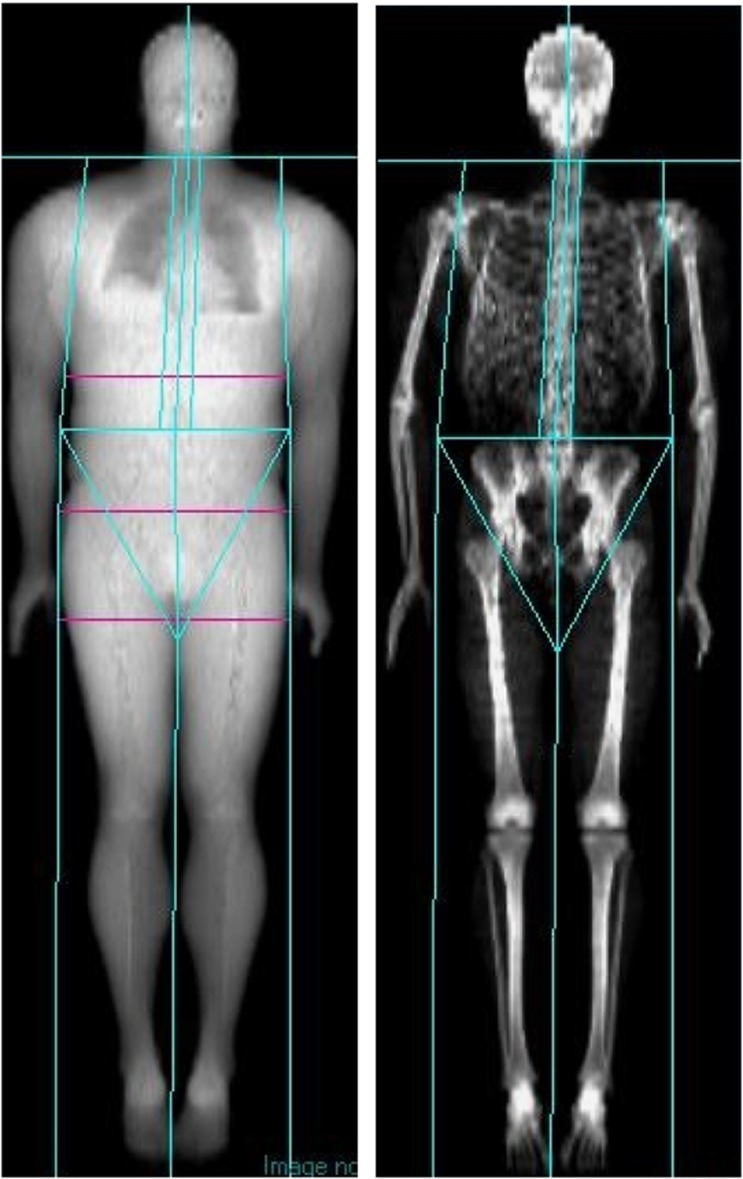
Objective: The aim of this study was to determine whether the quantity of fat is different across the central (that is, android, trunk) and peripheral (that is, arm, leg and gynoid) regions among young African-American (AA), Asian (AS), Hispanic (HI) and non-Hispanic White (NHW) men.
Subjects and methods: A cohort of 852 men (18-30 years; mean total body fat percent (TBF%)=18.8±7.9, range=3.7-45.4) were assessed for body composition in five body regions via dual-emission X-ray absorptiometry (DXA).
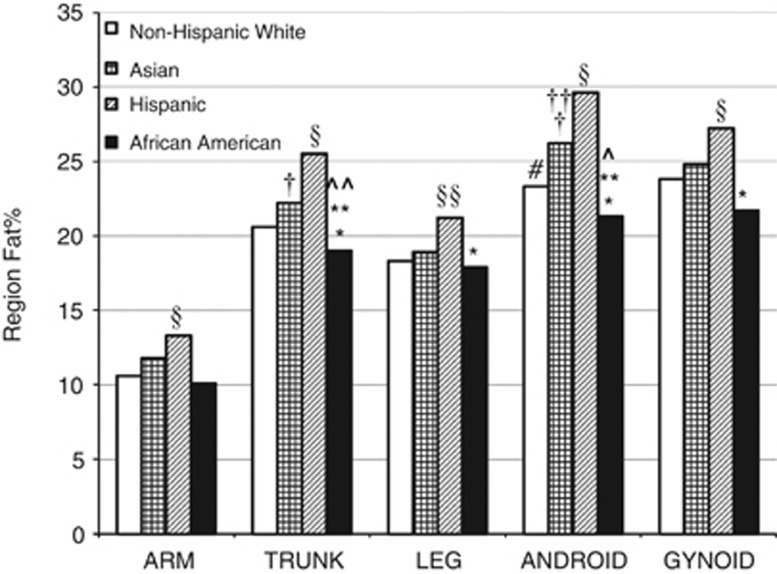
Results: HI men (21.8±8.3) had higher TBF% than AA (17.0±10.0), NHW (17.9±7.2) and AS (18.9±8.0) groups (P-values <0.0001). AS had a lower BMI (23.9±3.4) than all other groups, and NHW (24.7±3.2) had a lower BMI than HI (25.7±3.9) and AA (26.5±4.7; P-values<0.0001). A linear mixed model (LMM) revealed a significant ethnicity by region fat% interaction (P<0.0001). HI men had a greater fat% than NHW for every region (adjusted means (%); android: 29.6 vs 23.3; arm: 13.3 vs 10.6; gynoid: 27.2 vs 23.8; leg: 21.2 vs 18.3; trunk: 25.5 vs 20.6) and a greater fat% than AA for every region except the arm. In addition, in the android and trunk regions, HI had a greater fat% than AS, and AS had a higher fat% than AA. Finally, the android fat% for AS was higher than that of NHW. When comparing the region fat% within ethnicities, the android region was greater than the gynoid region for AS and HI, but did not differ for AA and NHW, and the arm region had the least fat% in all ethnicities.
Conclusions: Fat deposition and body fat patterning varies by ethnicity.
Figures
References
-
- Yusuf S, Hawken S, Ounpuu S, Bautista L, Franzosi MG, Commerford P, et al. Obesity and the risk of myocardial infarction in 27,000 participants from 52 countries: a case-control study. Lancet. 2005;366:1640–1649. - PubMed
-
- Lee CC, Glickman SG, Dengel DR, Brown MD, Supiano MA. Abdominal adiposity assessed by dual energy X-ray absorptiometry provides a sex-independent predictor of insulin sensitivity in older adults. J Gerontol Ser A-Biol Sci Med Sci. 2005;60:872–877. - PubMed
-
- Folsom AR, Kushi LH, Anderson KE, Mink PJ, Olson JE, Hong CP, et al. Associations of general and abdominal obesity with multiple health outcomes in older women—the Iowa women's health study. Arch Intern Med. 2000;160:2117–2128. - PubMed
-
- Manolopoulos KN, Karpe F, Frayn KN. Gluteofemoral body fat as a determinant of metabolic health. Int J Obes. 2010;34:949–959. - PubMed
LinkOut - more resources
Full Text Sources
Other Literature Sources
