. 2013 Mar 15:4:46.
doi: 10.3389/fphys.2013.00046. eCollection 2013.

Endosymbiotic bacteria in insects: guardians of the immune system?

Affiliations

Endosymbiotic bacteria in insects: guardians of the immune system?

Ioannis Eleftherianos et al. Front Physiol. .

Abstract

Insects have evolved obligate, mutualistic interactions with bacteria without further transmission to other eukaryotic organisms. Such long-term obligate partnerships between insects and bacteria have a profound effect on various physiological functions of the host. Here we provide an overview of the effects of endosymbiotic bacteria on the insect immune system as well as on the immune response of insects to pathogenic infections. Potential mechanisms through which endosymbionts can affect the ability of their host to resist an infection are discussed in the light of recent findings. We finally point out unresolved questions for future research and speculate how the current knowledge can be employed to design and implement measures for the effective control of agricultural insect pests and vectors of diseases.

Keywords: Spiroplasma; Wolbachia; endosymbiont; immunity; infection; insect.


Figures
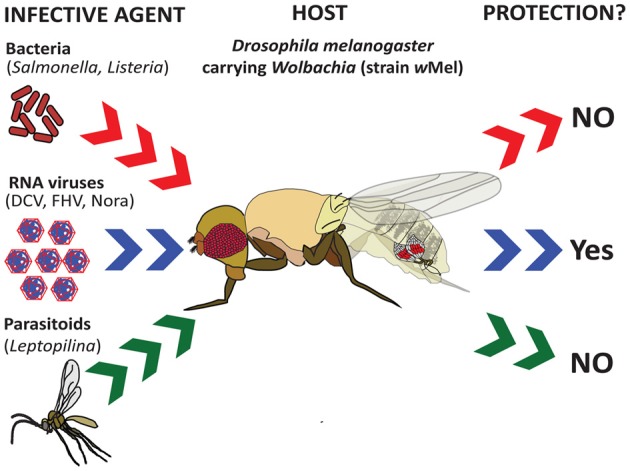
Figure 1
Figure 1
Effect of Wolbachia endosymbiotic bacteria on the ability of Drosophila to resist infection. Recent studies have shown that the presence of Wolbachia strain wMel in Drosophila melanogaster confers resistance to infection by various RNA viruses (Drosophila C Virus, Flock House Virus, and Nora virus) (Teixeira et al., 2008), but not by intracellular bacterial pathogens (Salmonella typhimurium and Listeria monocytogenes) (Rottschaefer and Lazzaro, 2012) or parasitoid wasps (Leptopilina boulardi) (Martinez et al., 2012).
Figure 2
Figure 2
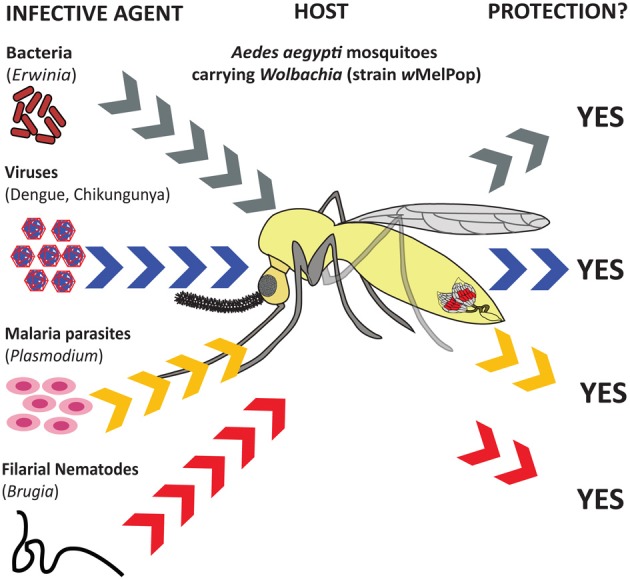
Influence of Wolbachia endosymbionts on inhibition/reduction in transmission capacity as well as protection of mosquitoes against infection. Aedes aegypti mosquitoes transinfected with the Wolbachia strain wMelPop are protected from infection by pathogenic bacteria (Erwinia carotovora) (Kambris et al., 2009), viruses (dengue and Chikungunya) (Moreira et al., 2009), malaria parasites (Plasmodium gallinaceum) (Moreira et al., 2009), and parasitic filarial nematodes (Brugia pahangi) (Kambris et al., 2009).

References

    1. Aksoy S., Rio R. V. (2005). Interactions among multiple genomes: tsetse, its symbionts and trypanosomes. Insect Biochem. Mol. Biol. 35, 691–698 10.1016/j.ibmb.2005.02.012 - DOI - PubMed
    1. Anbutsu H., Fukatsu T. (2010). Evasion, suppression and tolerance of Drosophila innate immunity by a male-killing Spiroplasma endosymbiont. Insect Mol. Biol. 19, 481–488 10.1111/j.1365-2583.2010.01008.x - DOI - PubMed
    1. Anselme C., Pérez-Brocal V., Vallier A., Vincent-Monegat C., Charif D., Latorre A., et al. (2008). Identification of the weevil immune genes and their expression in the bacteriome tissue. BMC Biol. 6:43 10.1186/1741-7007-6-43 - DOI - PMC - PubMed
    1. Anselme C., Vallier A., Balmand S., Fauvarque M.-O., Heddi A. (2006). Host PGRP gene expression and bacterial release in endosymbiosis of the weevil Sitophilus zeamais. Appl. Environ. Microbiol. 72, 6766–6772 10.1128/AEM.00942-06 - DOI - PMC - PubMed
    1. Balmand S., Lohs C., Aksoy S., Heddi A. (2012). Tissue distribution and transmission routes for the tsetse fly endosymbionts. J. Invertebr. Pathol. [Epub ahead of print]. 10.1016/j.jip.2012.04.002 - DOI - PMC - PubMed