


Affective trajectories before and after a quit attempt among smokers with current depressive disorders
- PMID: 23509093
- PMCID: PMC3790623
- DOI: 10.1093/ntr/ntt036
Affective trajectories before and after a quit attempt among smokers with current depressive disorders
Abstract
Background: Smoking cessation for individuals with depressive disorders represents an important clinical issue. It often has been hypothesized that smoking cessation worsens negative affect as part of the withdrawal process in this population. However, studies examining the impact of smoking cessation on changes in affect in smokers with depression are limited and equivocal.
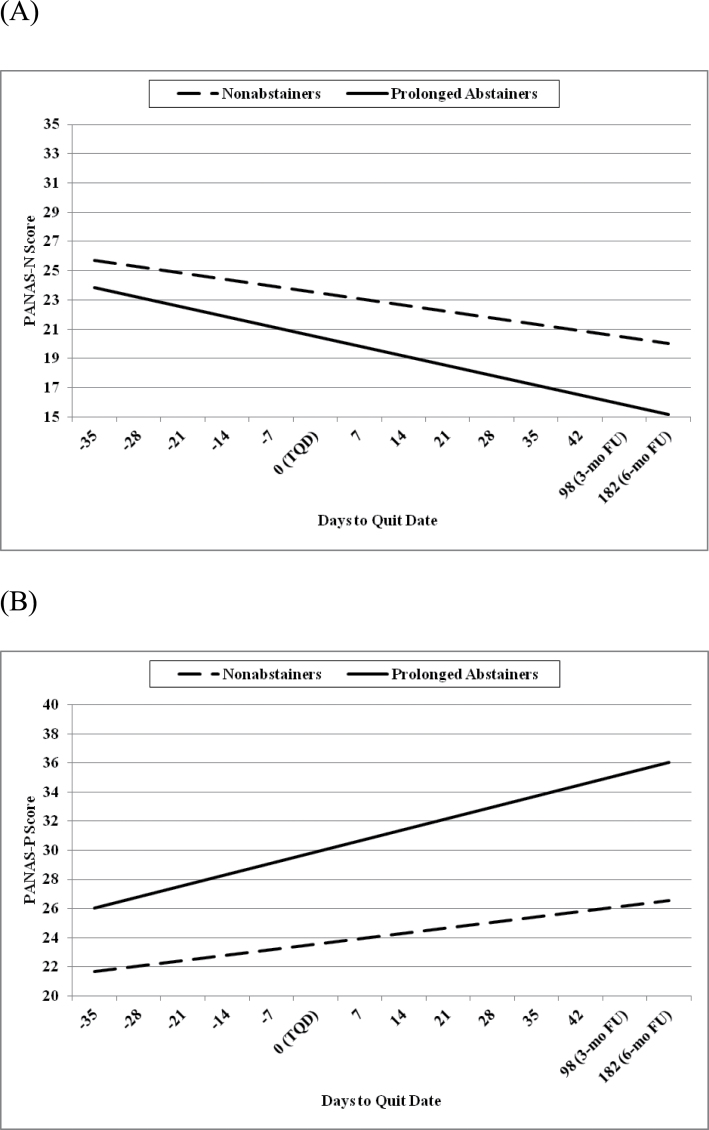
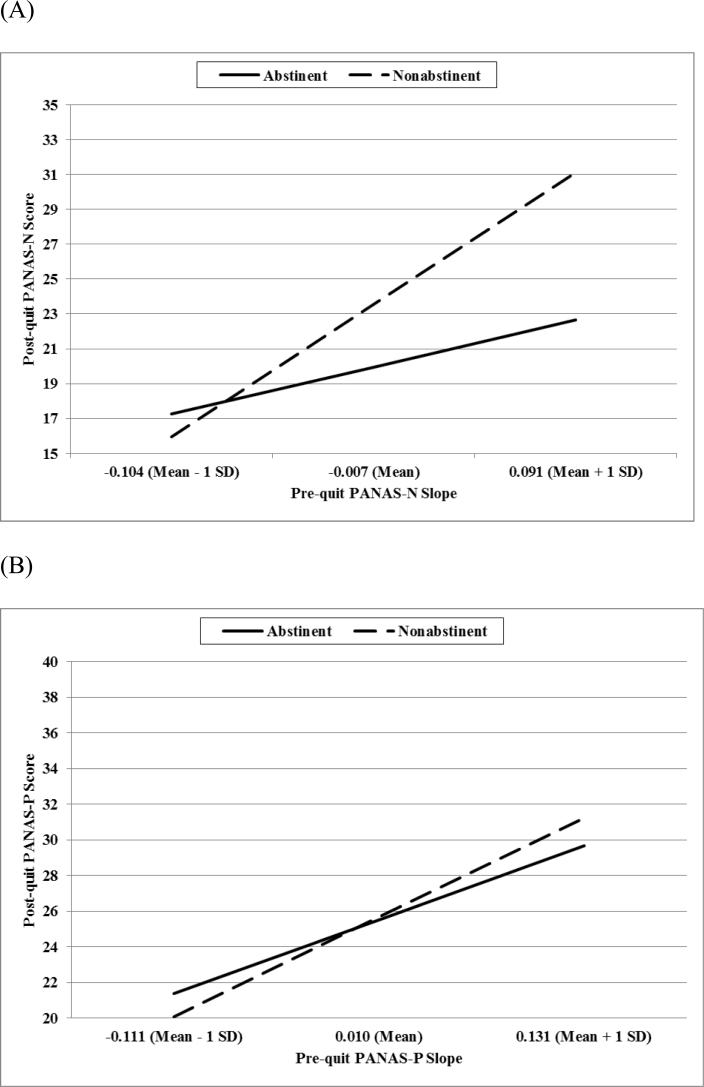
Methods: This study examines affective processes in smokers with depression undergoing a 12-week smoking cessation intervention (N = 49). We used the Positive and Negative Affect Scale to measure participants' positive affect (PA) and negative affect (NA) trajectories over the course of a quit attempt. We examined whether affective treatment response across the trial differed by prolonged smoking abstinence status and whether postquit affect differed by prequit affective treatment response, as well as the interaction of prequit affective response and abstinence status.
Results: Prolonged abstainers showed significant increases in PA over the course of a quit attempt compared with nonabstainers. Prequit affective trajectories significantly predicted postquit affect for measures of both PA and NA. Lastly, the interaction of prequit affective trajectory and abstinence significantly predicted postquit levels of NA but not PA.
Conclusions: This study adds to a burgeoning body of research demonstrating that significant improvements in psychological functioning can be observed among those who successfully quit smoking even in the most severe psychiatric group.
Figures
References
-
- Beck A. T., Steer R. A., Brown G. (1996). Beck Depression Inventory (2nd ed.). San Antonio, TX: Harcourt Brace Educational Measurement;
-
- Berlin I., Chen H., Covey L. S. (2010). Depressive mood, suicide ideation and anxiety in smokers who do and smokers who do not manage to stop smoking after a target quit day. Addiction (Abingdon, England), 105, 2209–2216.10.1111/j.1360-0443.2010.03109.x - PubMed
-
- Blalock J. A., Robinson J. D., Wetter D. W., Schreindorfer L. S., Cinciripini P. M. (2008). Nicotine withdrawal in smokers with current depressive disorders undergoing intensive smoking cessation treatment. Psychology of Addictive Behaviors, 22, 122–128.10.1037/0893-164X.22.1.122 - PubMed
-
- Brown R. A., Burgess E. S., Sales S. D., Evans D. M., Miller I. W. (1998). Reliability and validity of a smoking timeline follow-back interview. Psychology of Addictive Behaviors, 12, 101–112.10.1037/0893-164X.12.2.101
-
- Buhler M., Vollstadt-Klein S., Kobiella A., Budde H., Reed L. J., Braus D. F. … Smolka M. N. (2010). Nicotine dependence is characterized by disordered reward processing in a network driving motivation. Biological Psychiatry, 67, 745–752.10.1016/j.biopsych.2009.10.029 - PubMed
Publication types
MeSH terms
Grants and funding
LinkOut - more resources
Full Text Sources
Other Literature Sources
Medical
