


Predictors of poor outcome after both column acetabular fractures: a 30-year retrospective cohort study
- PMID: 23510122
- PMCID: PMC3606597
- DOI: 10.1186/1754-9493-7-9
Predictors of poor outcome after both column acetabular fractures: a 30-year retrospective cohort study
Abstract
Background and purpose: Acetabular fractures are often combined with associated injuries to the hip joint. Some of these associated injuries seem to be responsible for poor long-term results and these injuries seem to affect the outcome independent of the quality of the acetabular reduction. The aim of our study was to analyze the outcome of both column acetabular fractures and the influence of osseous cofactors such as initial fracture displacement, hip dislocation, femoral head lesions and injuries of the acetabular joint surface.
Methods: A retrospective cohort study in patients with both column acetabular fractures treated over a 30 year period was performed. Patients with a follow-up of more than two years were invited for a clinical and radiological examination. Displacement was analyzed on initial and postoperative radiographs. Contusion and impaction of the femoral head was grouped. Injuries of the acetabular joint surface consisting of impaction, contusion and comminution were recorded. The Merle d'Aubigné Score was documented and radiographs were analysed for arthritis (Helfet classification), femoral head avascular necrosis (Ficat/Arlet classification) and heterotopic ossifications (Brooker classification).
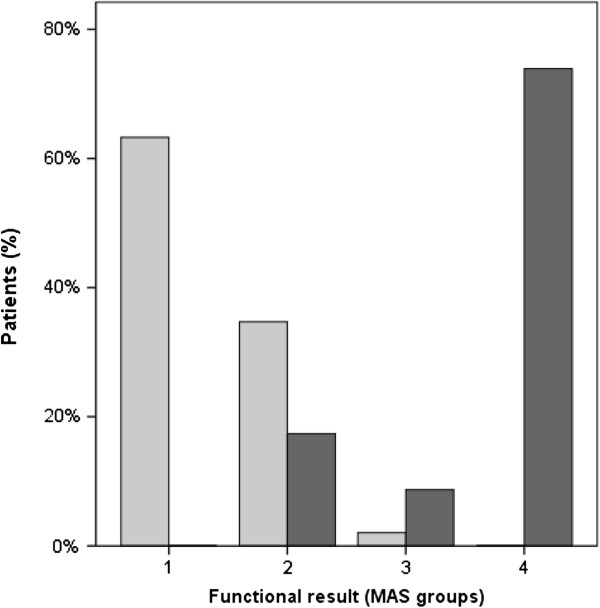
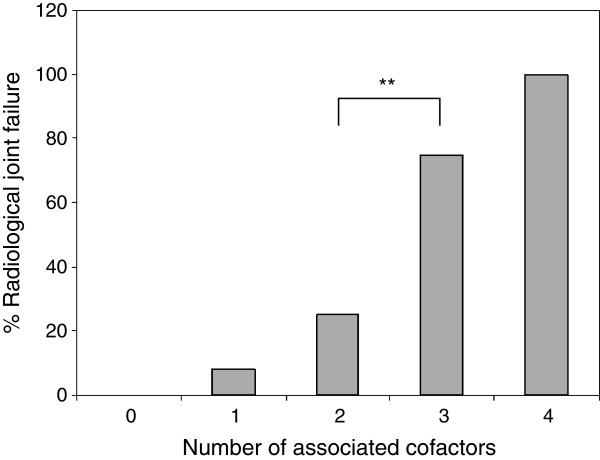
Results: 115 patients were included in the follow up examination. Anatomic reduction (malreduction ≤ 1mm) was associated with a significantly better clinical outcome than nonanatomical reduction (p = 0.001). Initial displacement of more than 10mm (p = 0.031) and initial intraarticular fragments (p = 0.041) were associated with worse outcome. Other associated injuries, such as the presence of a femoral head dislocation, femoral head injuries and injuries to the acetabular joint surface showed no significant difference in outcome individually, but in fractures with more than two associated local injuries the risk for joint degeneration was significant higher (p < 0.001) than in cases with less than two of them.In the subgroup of anatomically reconstructed fractures no significant influence of the analyzed cofactors could be observed.
Conclusion: Anatomical reduction appears to be an important parameter for a good clinical outcome in patients with both column acetabular fractures. Additional fracture characteristics such as the initial displacement and intraarticular fragments seem to influence the results. Patients should also be advised that both column acetabular fractures with more than two additional associated factors have a significantly higher risk of joint degeneration.
Figures
References
-
- Matta JM. Fractures of the acetabulum: accuracy of reduction and clinical results in patients managed operatively within three weeks after the injury. J Bone Joint Surg A. 1996;78:1632–1645. - PubMed
-
- Pohlemann T, Gansslen A, Hartung S. Hefte zu Der Unfallchirurg. Berlin, Heidelberg, Tokyo, New York: Springer; 1998. Beckenverletzungen: Ergebnisse einer prospektiven, multizentrischen Studie; pp. 1–402.
-
- Letournel E. The treatment of acetabular fractures through the ilioinguinal approach. Clin Orthop Relat Res. 1993;292:62–76. - PubMed
-
- Matta JM, Letournel E, Browner BD. Surgical management of acetabular fractures. Instr Course Lect. 1986;35:382–397. - PubMed
LinkOut - more resources
Full Text Sources
Other Literature Sources
