


Review
doi: 10.1186/cc12504.
Algorithm for the resuscitation of traumatic cardiac arrest patients in a physician-staffed helicopter emergency medical service
- PMID: 23510195
- PMCID: PMC3672499
- DOI: 10.1186/cc12504
Item in Clipboard
Review
Algorithm for the resuscitation of traumatic cardiac arrest patients in a physician-staffed helicopter emergency medical service
Crit Care.
.
Abstract
Survival rates following traumatic cardiac arrest (TCA) are known to be poor but resuscitation is not universally futile. There are a number of potentially reversible causes to TCA and a well-defined group of survivors. There are distinct differences in the pathophysiology between medical cardiac arrests and TCA. The authors present some of the key differences and evidence related to resuscitation in TCA, and suggest a separate algorithm for the management of out-of-hospital TCA attended by a highly trained physician and paramedic team.
Figures
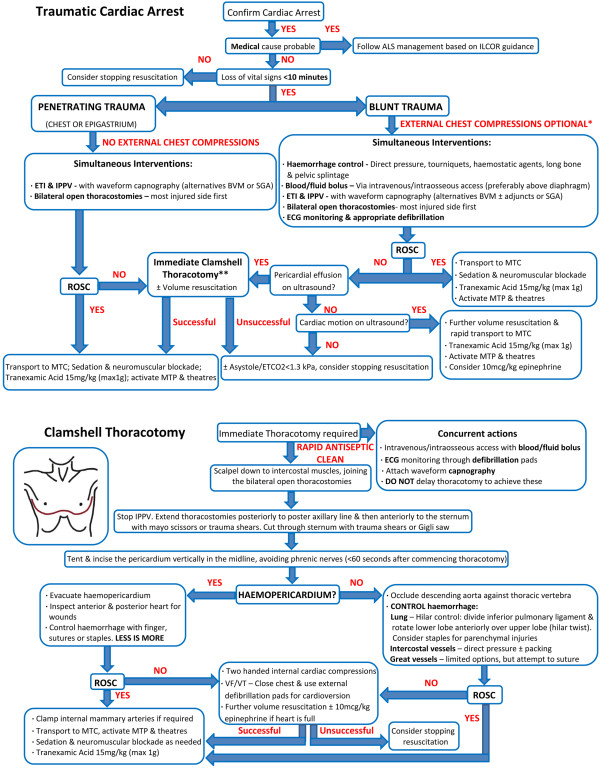
Traumatic cardiac arrest and thoracotomy algorithm. *If signs of exsanguination or chest injuries, external chest compressions unlikely to be effective, and possibly detrimental. **In blunt trauma involving complex pathology, pericardiocentesis maybe a reasonable intermediate step. If ROSC not achieved, proceed to immediate thoracotomy. ALS, advanced cardiac life support; BVM, bag valve mask; ECG, electrocardiogram; ETCO2, end-tidal carbon dioxide partial pressure; ETI, endotracheal intubation; ILCOR, International Liaison Committee on Resuscitation; IPPV, intermittent positive pressure ventilation; MTC, major trauma centre; MTP, massive transfusion policy; ROSC, return of spontaneous circulation; SGA, supra-glottic airway; VF, ventricular fibrillation; VT, ventricular tachycardia.
References
Publication types
MeSH terms
LinkOut - more resources
Full Text Sources
Other Literature Sources
Medical
