Review
. 2013 Mar 18;4(2):22.
doi: 10.1186/scrt170.

The uncertain role of unmodified mesenchymal stem cells in tumor progression: what master switch?

Review

The uncertain role of unmodified mesenchymal stem cells in tumor progression: what master switch?

Liyang Zhang et al. Stem Cell Res Ther. .

Abstract

Mesenchymal stem cells (MSCs) are emerging as promising gene vectors for cancer therapy because of their unique characteristics, including the ease of their expansion and genetic modification and their remarkable tumor-tropic properties. However, there remains a concern that MSCs may promote cancer progression. Surprisingly, there are conflicting reports within the literature describing both the promotion and inhibition of cancer progression by MSCs. The reasons for this discrepancy are still unknown. The surface markers, differentiation ability, and tumorigenic roles of MSCs, as well as their effect on immunoregulation, produce heterogeneity. In this review, we describe the heterogeneity of MSCs by the species from which they are derived, the methodology for their isolation and the context of their interactions with cancer cells. The conflicting roles of MSCs in tumor progression may be attributable to the bimodal effect of unmodified MSCs on immunoregulation. MSCs have been reported to suppress T-cell function and inhibit graft-versus-host disease (GVHD). On the other hand, MSCs elicit the graft-versus-tumor (GVT) effect in some cases. Selective allodepletion may be used to dissociate GVHD from the GVT effect. Understanding the conditions that balance GVHD and the GVT effect of MSCs may be crucial to advance cancer therapy research with respect to MSCs.


Figures

Figure 1
Figure 1
Heterogeneous mesenchymal stem cells hold multipotent potential. Less than 30% of MSCs contributed to cardiomyocyte differentiation. The MSCs that differentiate into cardiomyocytes express the early cardiac markers GATA4 and NKX2.5. The low-adherent subfraction of MSCs with a CD45(-)CD14(+)CD34(+) phenotype is capable of differentiating into endothelial cells enriched in angiogenic marker expression and exhibiting functional properties of endothelium. MSCs from synovial membranes, especially the CD105(+) subpopulation, have a superior chondrogenic capacity. CD73 was found to be expressed exclusively in osteogenesis but not in adipogenesis in murine MSCs. Increased tumor homing properties were found in a specific MSC subpopulation that exhibited enhanced multipotent capacity and increased cell surface expression of specific integrins (integrins alpha2, alpha3, and alpha5). The CD133-positive MSC fraction contains more MSCs with high proliferative potential.
Figure 2
Figure 2
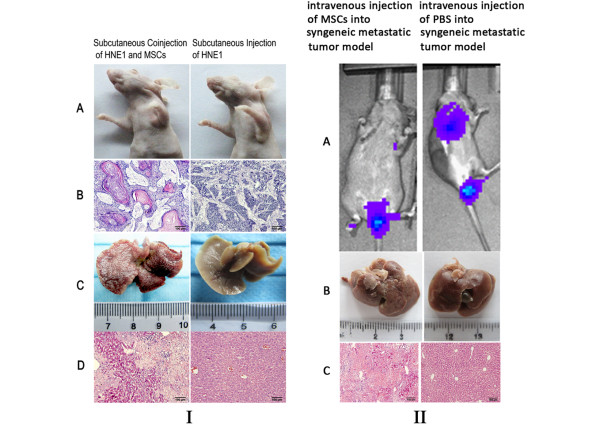
Xenotransplantation of mesenchymal stem cells in tumor-bearing mice resulted in graft-versus-host disease and the graft-versus-tumor effect. Tumors shrank after the xenograft transplantation of mesenchymal stem cells (MSCs) into immune-deficient nude mice and immunocompetent C3H/HeN mice. These same mice showed acute liver necrosis. I: (A) Nude mice were subcutaneously injected with the cancer cell line HNE1 or co-injected with HNE1 and MSCs. (B) Representative images of hematoxylin and Eosin staining of tumor sections. When MSCs were co-injected with HNE1 cells, a well-differentiated tumor was formed that showed well-differentiated nests and cords of squamous epithelium with keratin pearls. (C) Representative views of liver biopsies. The MSC xenotransplantation resulted in liver necrosis. (D) Representative images of hematoxylin and eosin staining of liver section from the MSC xenotransplantation group and the control group. II: (A) the IVIS imaging system was used to monitor metastatic sites in the syngeneic C3H/HeN tumor model. MSC xenotransplantation into the syngeneic tumor model resulted in tumor shrinkage. (B) Representative views of liver biopsies. MSC xenotransplantation led to liver necrosis. (C) Representative images of hematoxylin and eosin staining of liver section from the MSC xenotransplantation group and the control group. PBS, phosphate-buffered saline.
Figure 3
Figure 3
The conflicting roles of mesenchymal stem cells in tumor progression may be explained by their functional heterogeneity on immunoregulation. The differentiation potential of mesenchymal stem cells (MSCs) is affected by cytokines in the tumor environment. MSCs demonstrate a capacity for hematopoietic lineage differentiation in the tumor microenvironment. They may have the ability to differentiate into macrophages or cytokine-induced killer (CIK) cells. The roles of macrophages on tumor progression are also heterogeneous. MSCs represent a heterogeneous subset of cells, indicated by a distinct color. Some subsets of MSCs suppress graft-versus-host disease (GVHD) and the graft-versus-tumor (GVT) effect, while other subsets of MSCs elicit these. An important determinant that switches whether MSCs promote or inhibit tumor progression may be related to the immunoregulation of different subsets of MSCs. It will be important to balance the impact of MSCs on GVHD and the GVT effect. Selective allodepletion may be used to dissociate GVHD and the GVT effect before the advancement of MSCs as a vehicle for cancer therapy.
Figure 4
Figure 4
Selective allodepletion may be used to dissociate graft-versus-host disease from the graft-versus-tumor effect in mesenchymal stem cell-mediated cancer therapy. When mesenchymal stem cells (MSCs) are co-cultured with a host stimulator population, host allospecificity may be activated, causing the expression of different surface-specific markers and the population with specific markers can be depleted using negative selection by fluorescence-activated cell sorting (FACS). To elicit the graft-versus-tumor (GVT) effect, the subset of MSCs that are reactive against the tumor can be positively selected by FACS, following the co-culture of MSCs and tumor antigen. The sorted MSC population subsets can be used for cancer therapy.

References

    1. Sun XY, Nong J, Qin K, Warnock GL, Dai LJ. Mesenchymal stem cell-mediated cancer therapy: A dual-targeted strategy of personalized medicine. World J Stem Cells. 2011;3:96–103. doi: 10.4252/wjsc.v3.i11.96. - DOI - PMC - PubMed
    1. Shah K. Mesenchymal stem cells engineered for cancer therapy. Adv Drug Deliv Rev. 2011;64:739–748. - PMC - PubMed
    1. Zachos T, Diggs A, Weisbrode S, Bartlett J, Bertone A. Mesenchymal stem cell-mediated gene delivery of bone morphogenetic protein-2 in an articular fracture model. Mol Ther. 2007;15:1543–1550. doi: 10.1038/sj.mt.6300192. - DOI - PubMed
    1. Le Blanc K, Samuelsson H, Gustafsson B, Remberger M, Sundberg B, Arvidson J, Ljungman P, Lonnies H, Nava S, Ringden O. Transplantation of mesenchymal stem cells to enhance engraftment of hematopoietic stem cells. Leukemia. 2007;21:1733–1738. doi: 10.1038/sj.leu.2404777. - DOI - PubMed
    1. Liu M, Han ZC. Mesenchymal stem cells: biology and clinical potential in type 1 diabetes therapy. J Cell Mol Med. 2008;12:1155–1168. doi: 10.1111/j.1582-4934.2008.00288.x. - DOI - PMC - PubMed

Publication types

LinkOut - more resources