Review
. 2013 Sep-Oct;7(5):379-91.
doi: 10.4161/chan.24302. Epub 2013 Mar 19.

Emerging roles of store-operated Ca²⁺ entry through STIM and ORAI proteins in immunity, hemostasis and cancer

Affiliations
Review

Emerging roles of store-operated Ca²⁺ entry through STIM and ORAI proteins in immunity, hemostasis and cancer

Wolfgang Bergmeier et al. Channels (Austin). 2013 Sep-Oct.

Abstract

Store-operated Ca(2+) entry (SOCE) is an important Ca(2+) influx pathway, which is defined by the fact that depletion of intracellular Ca(2+) stores, mainly the endoplasmic reticulum (ER), triggers the opening of Ca(2+) channels in the plasma membrane. The best characterized SOC channel is the Ca(2+) release-activated Ca(2+) (CRAC) channel, which was first described in cells of the immune system but has since been reported in many different cell types. CRAC channels are multimers of ORAI family proteins, of which ORAI1 is the best characterized. They are activated by stromal interaction molecules (STIM) 1 and 2, which respond to the depletion of intracellular Ca(2+) stores with oligomerization and binding to ORAI proteins. The resulting SOCE is critical for the physiological function of many cell types including immune cells and platelets. Recent studies using cell lines, animal models and primary cells from human patients with defects in SOCE have highlighted the importance of this Ca(2+) entry mechanism in a variety of pathophysiological processes. This review focuses on the role of SOCE in immunity to infection, allergy, hemostasis and cancer.

Keywords: CRAC; Ca2+; ORAI1; STIM1; allergy; autoimmunity; calcium; cancer; hemostasis; immunodeficiency; lymphocytes; platelets; tumor,.


Figures
None
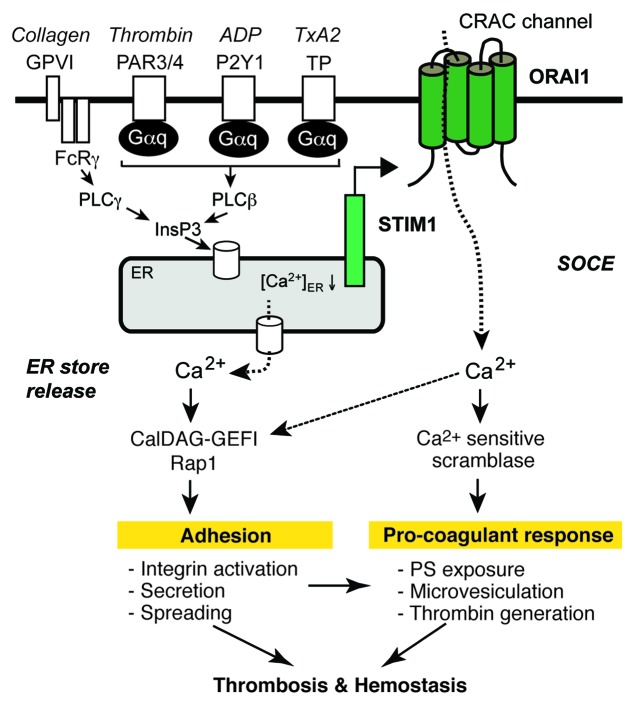
Figure 1. STIM1 and ORAI1 in platelet function. Stimulation of platelets with agonists such as thrombin, thromboxane A2, ADP, or collagen results in Ca2+ release from ER stores and SOCE. Ca2+ released from the ER activates the guanine nucleotide exchange factor, CalDAG-GEFI, which controls the activity of the small GTPase Rap1, a critical regulator of platelet responses such as integrin activation, secretion and spreading. STIM1 and ORAI1 are the major homologs mediating SOCE in platelets. Sustained elevated [Ca2+]i resulting from SOCE is essential for activation of the enzyme scramblase, which exposes phosphatidylserine (PS) on the outer surface of the cell membrane. PS exposure allows for the binding of coagulation factors on the platelet surface, thereby stimulating the generation of thrombin at sites of vascular injury. Both the adhesive and the pro-coagulant activity of platelets are critical for hemostasis and thrombosis.
None
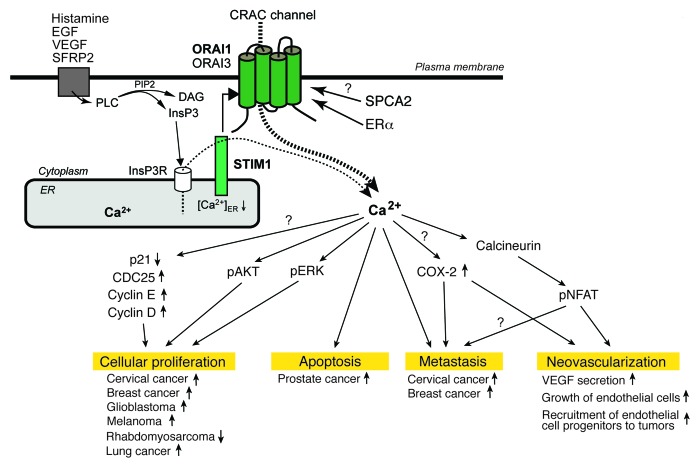
Figure 2. The role of ORAI and STIM proteins in carcinogenesis. The second messenger Ca2+ plays an important role in regulating many signaling pathways related to cancer development and progression. SOCE in tumor and endothelial cells results from the activation of cell surface receptors such as epidermal growth factor (EGF), vascular endothelial growth factor (VEGF) and secreted frizzled-related protein 2 (SFRP2). The subsequent activation of phospholipase C (PLC) leads to the production of InsP3 and release of Ca2+ from ER Ca2+ stores via the opening of InsP3 receptor channels. The reduced Ca2+ concentration in the ER, or [Ca2+]ER, is sensed by stromal interaction molecule (STIM) 1, which binds to ORAI1, the pore-forming subunit of the Ca2+ release-activated Ca2+ (CRAC) channel. Opening of CRAC channels results in Ca2+ influx and a sustained increase in intracellular Ca2+ levels, [Ca2+]i. Several cytoplasmic enzymes associated with cancer development and progression are regulated by Ca2+. ERK and AKT are phosphorylated in a Ca2+-dependent manner, whereas mRNA and protein levels of others molecules such as COX2 and cyclins are controlled by [Ca2+]i. SOCE has been linked to the regulation of cancer cell proliferation, apoptosis and metastasis as well as neovascularization of tumors. Abbreviations: SPCA2, secretory pathway Ca2+ ATPase 2; ERα, estrogen receptor-α.

References

    1. Prakriya M, Feske S, Gwack Y, Srikanth S, Rao A, Hogan PG. Orai1 is an essential pore subunit of the CRAC channel. Nature. 2006;443:230–3. doi: 10.1038/nature05122. - DOI - PubMed
    1. Vig M, Beck A, Billingsley JM, Lis A, Parvez S, Peinelt C, et al. CRACM1 multimers form the ion-selective pore of the CRAC channel. Curr Biol. 2006;16:2073–9. doi: 10.1016/j.cub.2006.08.085. - DOI - PMC - PubMed
    1. Yeromin AV, Zhang SL, Jiang W, Yu Y, Safrina O, Cahalan MD. Molecular identification of the CRAC channel by altered ion selectivity in a mutant of Orai. Nature. 2006;443:226–9. doi: 10.1038/nature05108. - DOI - PMC - PubMed
    1. Feske S, Gwack Y, Prakriya M, Srikanth S, Puppel SH, Tanasa B, et al. A mutation in Orai1 causes immune deficiency by abrogating CRAC channel function. Nature. 2006;441:179–85. doi: 10.1038/nature04702. - DOI - PubMed
    1. Vig M, Peinelt C, Beck A, Koomoa DL, Rabah D, Koblan-Huberson M, et al. CRACM1 is a plasma membrane protein essential for store-operated Ca2+ entry. Science. 2006;312:1220–3. doi: 10.1126/science.1127883. - DOI - PMC - PubMed

Publication types