Review
. 2013 Mar 19;65(2):849-71.
doi: 10.1124/pr.112.006387. Print 2013 Apr.

Chemical probes of endocannabinoid metabolism

Affiliations
Review

Chemical probes of endocannabinoid metabolism

Jacqueline L Blankman et al. Pharmacol Rev. .

Abstract

The endocannabinoid signaling system regulates diverse physiologic processes and has attracted considerable attention as a potential pharmaceutical target for treating diseases, such as pain, anxiety/depression, and metabolic disorders. The principal ligands of the endocannabinoid system are the lipid transmitters N-arachidonoylethanolamine (anandamide) and 2-arachidonoylglycerol (2-AG), which activate the two major cannabinoid receptors, CB1 and CB2. Anandamide and 2-AG signaling pathways in the nervous system are terminated by enzymatic hydrolysis mediated primarily by the serine hydrolases fatty acid amide hydrolase (FAAH) and monoacylglycerol lipase (MAGL), respectively. In this review, we will discuss the development of FAAH and MAGL inhibitors and their pharmacological application to investigate the function of anandamide and 2-AG signaling pathways in preclinical models of neurobehavioral processes, such as pain, anxiety, and addiction. We will place emphasis on how these studies are beginning to discern the different roles played by anandamide and 2-AG in the nervous system and the resulting implications for advancing endocannabinoid hydrolase inhibitors as next-generation therapeutics.


Figures
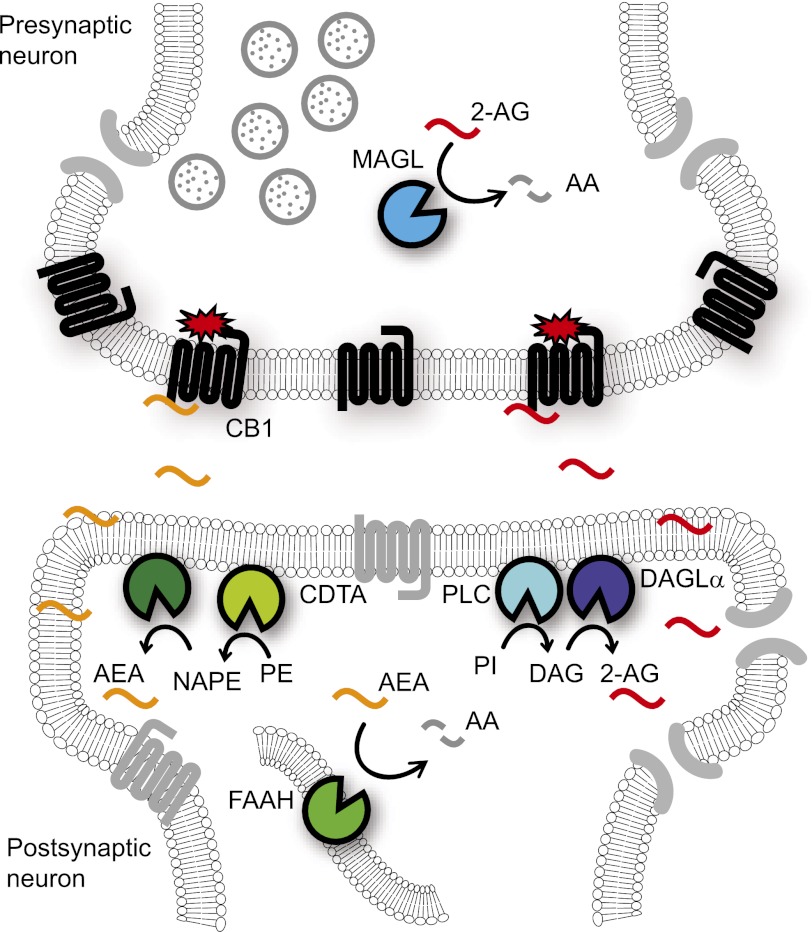
Fig. 1.
Fig. 1.
Schematic of retrograde endocannabinoid signaling in the nervous system. The endocannabinoid transmitters anandamide (AEA) and 2-AG are thought to be biosynthesized postsynaptically. Anandamide is produced from NAPE precursors, which are generated by a still uncharacterized CDTA enzyme. The release of anandamide from NAPEs is also an incompletely understood reaction pathway that likely involves one or more phospholipase A and/or D enzymes. 2-AG is synthesized from phosphatidylinositol (PI) lipid precursors by the sequential action of PLC and the DAGLα and DAGLβ enzymes. DAGLα is the major 2-AG biosynthetic enzyme in the brain. Following activity-dependent biosynthesis/mobilization, endocannabinoids traverse the synaptic cleft where they activate presynaptically localized CB1 receptors. CB1 signaling through Gi/o proteins eventually results in the inhibition of neurotransmitter release. Anandamide and 2-AG signaling is terminated by enzymatic hydrolysis, which, in the CNS, proceeds primarily through FAAH and MAGL.
Fig. 2.
Fig. 2.
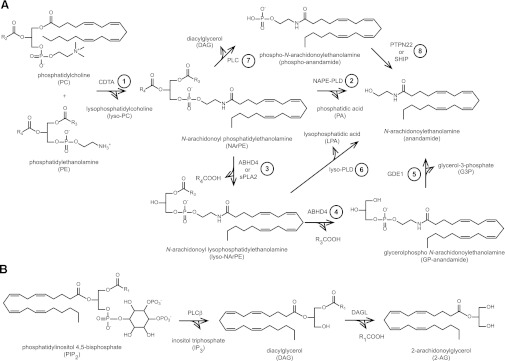
Endocannabinoid biosynthesis. (A) Anandamide biosynthesis begins with the formation of NArPE by the transfer of AA from phosphatidylcholine (PC) to the primary amine of PE by a molecularly uncharacterized CDTA enzyme (step 1). Multiple pathways have been postulated for the liberation of anandamide from NArPE (steps 2–8). (B) 2-AG is generated by hydrolysis of phosphatidylinositol 4,5-bisphosphate by PLCβ followed by cleavage of DAG by DAGLα and DAGLβ.
Fig. 3.
Fig. 3.
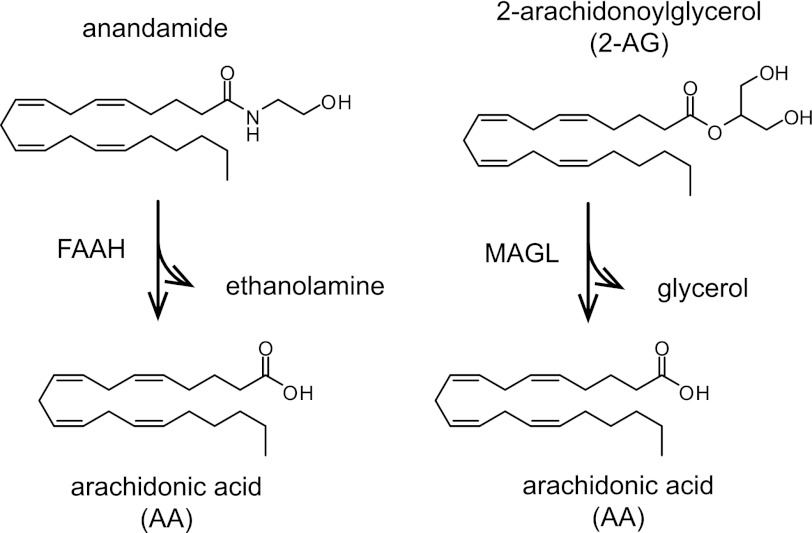
Endocannabinoid hydrolysis. In the nervous system, anandamide and 2-AG are degraded primarily by FAAH and MAGL, respectively.
Fig. 4.
Fig. 4.
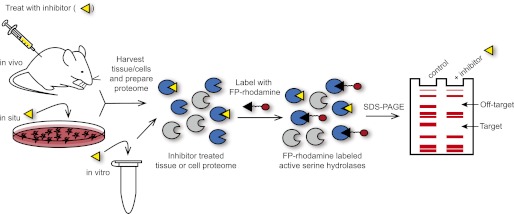
Competitive activity-based protein profiling (ABPP) serves as a chemoproteomic platform for assessing the potency and selectivity of endocannabinoid hydrolase inhibitors in vitro and in living systems. Animal models, cultured cells, or tissue/cell homogenates are treated with a small-molecule inhibitor (yellow triangle) for a specified time, and then proteomes are prepared and labeled with the activity-based probe fluorophosphonate (FP)-rhodamine, which reacts with active serine hydrolase enzymes. Serine hydrolases that are inactivated by the small-molecule inhibitor can be visualized by a loss of fluorescence signal following SDS-polyacrylamide gel electrophoresis analysis.
Fig. 5.
Fig. 5.
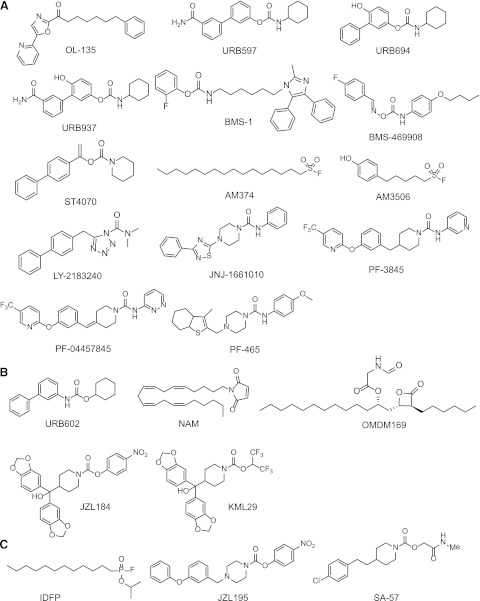
Structures of FAAH (A), MAGL (B), and dual FAAH/MAGL (C) inhibitors.
Fig. 6.
Fig. 6.
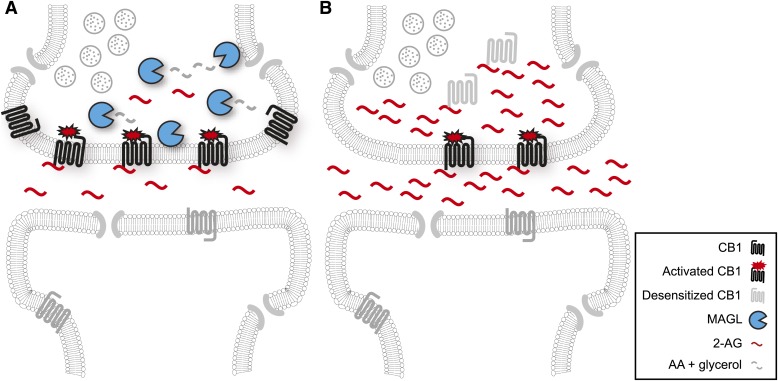
Chronic MAGL disruption causes functional antagonism of the central endocannabinoid system. (A) In a wild-type brain, MAGL serves to limit the magnitude and duration of 2-AG signaling at CB1 by hydrolyzing this lipid to arachidonic acid. (B) Chronic pharmacological or genetic MAGL inactivation results in prolonged elevations in 2-AG that in turn cause the desensitization and downregulation of CB1 receptors. The net result of these adaptations is functional antagonism or reduced CB1 signaling.
Fig. 7.
Fig. 7.
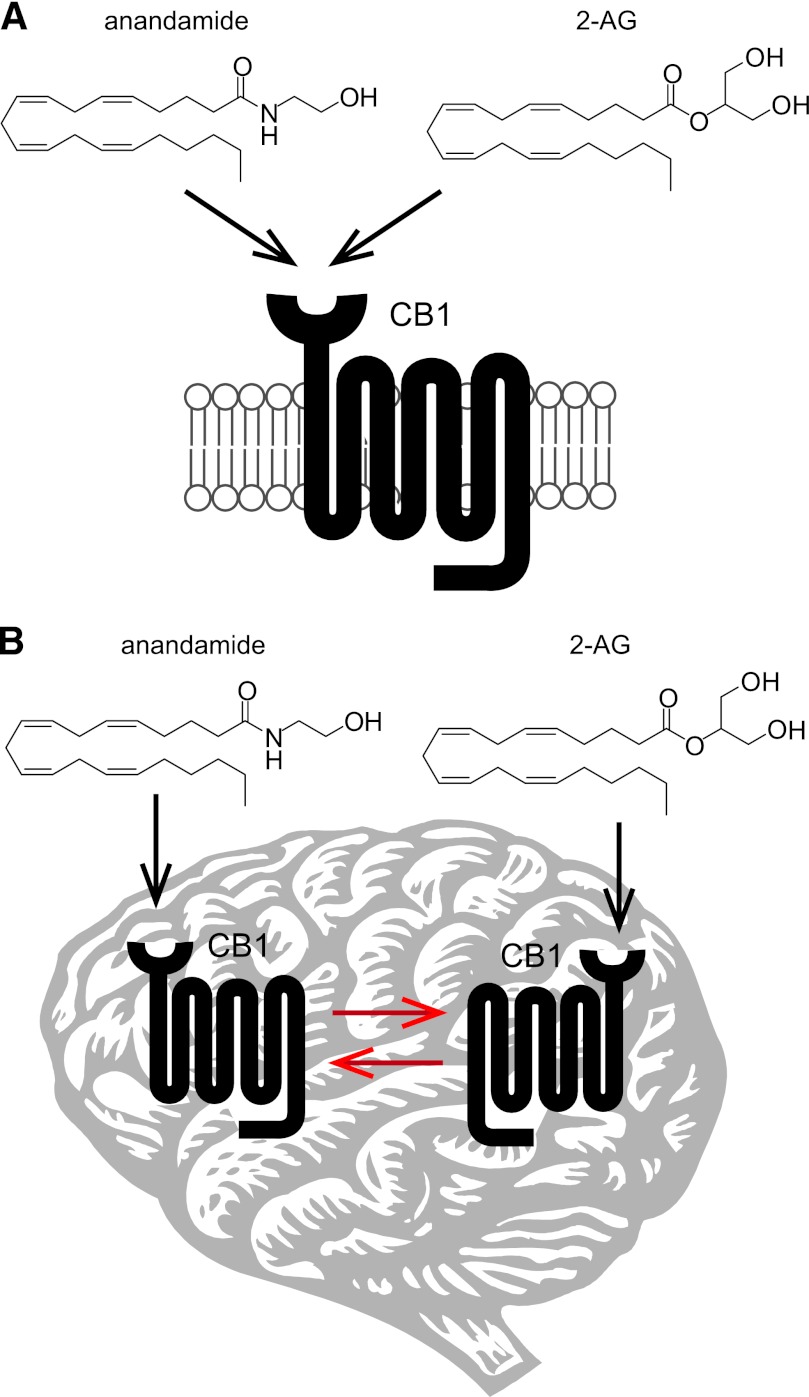
Potential mechanisms for anandamide and 2-AG cross-talk in the nervous system. Whether anandamide and 2-AG produce differential effects through distinct modes of activation of shared CB1 receptors (“intrasynaptic,” A) or by activating separate sets of CB1 receptors in the brain (“intersynaptic,” B) is unknown. It is also possible that both intra- and intersynaptic mechanisms occur in vivo.

References

    1. Abouabdellah A, Almario GA, Hoornaert C, Lardenois P, Marguet F. (2005) inventors; Sanofi-Aventis, assignee. Aryl- and heteroaryl-piperidinecarboxylate derivatives, their preparation and use as fatty acid amido hydrolase (FAAH) inhibitors for treating FAAH-related pathologies. World Patent WO 2005/090347. 2005 Sep 29.
    1. Ahn K, Johnson DS, Fitzgerald LR, Liimatta M, Arendse A, Stevenson T, Lund ET, Nugent RA, Nomanbhoy TK, Alexander JP, et al. (2007) Novel mechanistic class of fatty acid amide hydrolase inhibitors with remarkable selectivity. Biochemistry 46:13019–13030 - PubMed
    1. Ahn K, Johnson DS, Mileni M, Beidler D, Long JZ, McKinney MK, Weerapana E, Sadagopan N, Liimatta M, Smith SE, et al. (2009) Discovery and characterization of a highly selective FAAH inhibitor that reduces inflammatory pain. Chem Biol 16:411–420 - PMC - PubMed
    1. Ahn K, McKinney MK, Cravatt BF. (2008) Enzymatic pathways that regulate endocannabinoid signaling in the nervous system. Chem Rev 108:1687–1707 - PMC - PubMed
    1. Ahn K, Smith SE, Liimatta MB, Beidler D, Sadagopan N, Dudley DT, Young T, Wren P, Zhang Y, Swaney S, et al. (2011) Mechanistic and pharmacological characterization of PF-04457845: a highly potent and selective fatty acid amide hydrolase inhibitor that reduces inflammatory and noninflammatory pain. J Pharmacol Exp Ther 338:114–124 - PMC - PubMed

Publication types

MeSH terms