. 2014 May;9(5):661-70.
doi: 10.1093/scan/nst033. Epub 2013 Mar 19.

Neural evidence for an association between social proficiency and sensitivity to social reward

Affiliations

Neural evidence for an association between social proficiency and sensitivity to social reward

Anna Gossen et al. Soc Cogn Affect Neurosci. 2014 May.

Abstract

Data from developmental psychology suggests a link between the growth of socio-emotional competences and the infant's sensitivity to the salience of social stimuli. The aim of the present study was to find evidence for this relationship in healthy adults. Thirty-five participants were recruited based on their score above the 85th or below the 15th percentile of the empathy quotient questionnaire (EQ, Baron-Cohen and Wheelwright, 2004). Functional magnetic resonance imaging (fMRI) was used to compare neural responses to cues of social and non-social (monetary) reward. When compared to the high-EQ group, the low-EQ group showed reduced activity of the brain s reward system, specifically the right nucleus accumbens, in response to cues predictive of social reward (videos showing gestures of approval)-but increased activation in this area for monetary incentives. Our data provide evidence for a link between self-reported deficits in social proficiency and reduced sensitivity to the motivational salience of positive social stimuli.

Keywords: NAcc; autism; empathy; social interest; social reward.


Figures
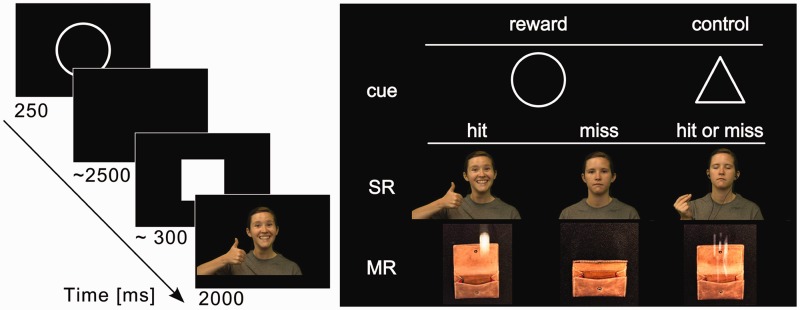
Fig. 1
Fig. 1
Experimental design. Cues (circle, triangle) determined the possible outcome of trials in the two outcome conditions: social reward (SR) or monetary reward (MR). If in a reward trial (circle), the response to the target (square) was fast enough (hit), the participant was presented with a video of a woman showing signs of social approval (SR condition) or of money falling into a wallet (MR condition). Misses in reward trials resulted in neutral outcome videos (SR: neutral face/ MR: empty wallet). In control trials (triangle), both hits and misses resulted in seeing a control video (SR: woman with eyes closed and listening to music/MR: confetti falling into a wallet).
Fig. 2
Fig. 2
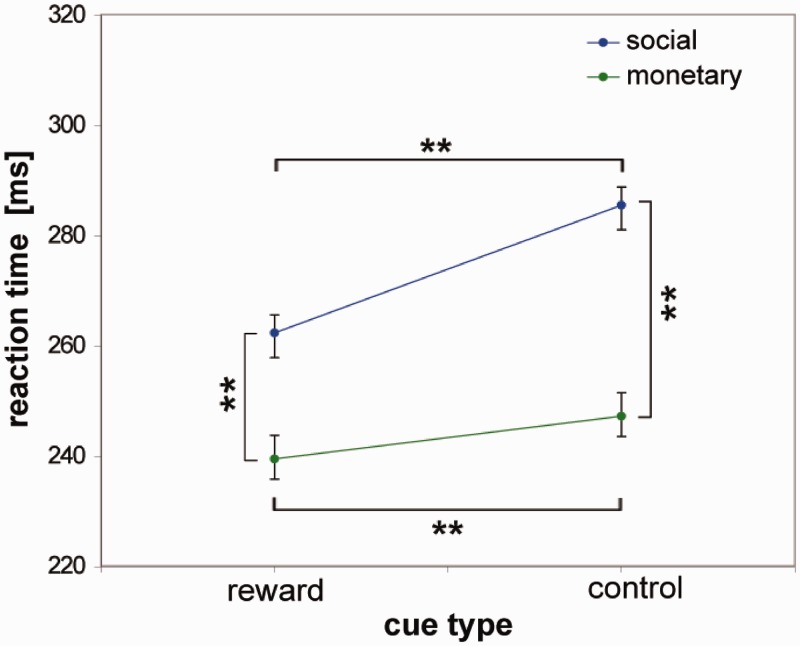
Reaction times. Responses in hit trials were faster in the monetary than the social condition, and in response to reward cues relative to control cues (**P < 0.01). An interaction of ‘condition × cue type’ indicated that reaction time differences of reward and control cued trials were more pronounced for the SR than the MR condition.
Fig. 3
Fig. 3
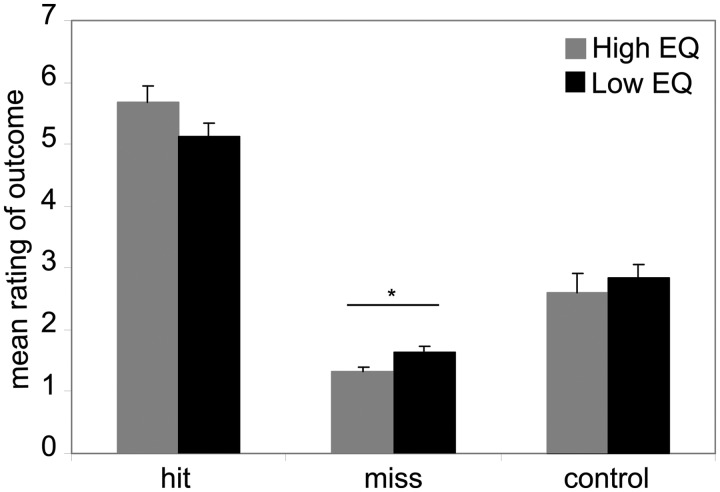
Mean rating (+ SEM) of subjectively perceived reward value of the outcome options ‘hit’, ‘miss’ and ‘control’ for both conditions for each group (high EQ = gray, low EQ = black). The interaction effect of ‘group × outcome’ [F(2, 66) = 3.54, P = 0.035 < 0.05] originates from a significantly different rating score between groups only for the miss videos [*P (two-sided) < 0.05].
Fig. 4
Fig. 4
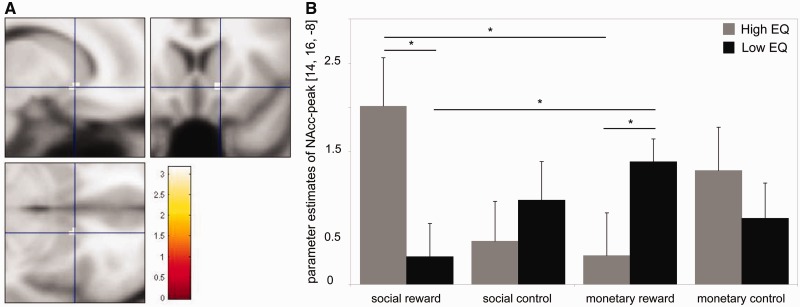
Interaction of ‘group × condition × cue type’ shows right NAcc reactivity for anticipated social reward vs. anticipated monetary reward between groups. (A) NAcc activation in ‘high-EQ vs. low-EQ, (social reward – social control) vs. (monetary reward – monetary control)’ axial, coronal and sagittal views [ROI-corrected, P (FWE) < 0.05]. (B) Parameter estimates derived from NAcc peak activation show significant differences between anticipation of social and monetary reward within and between groups (*P < 0.05).
Fig. 5
Fig. 5
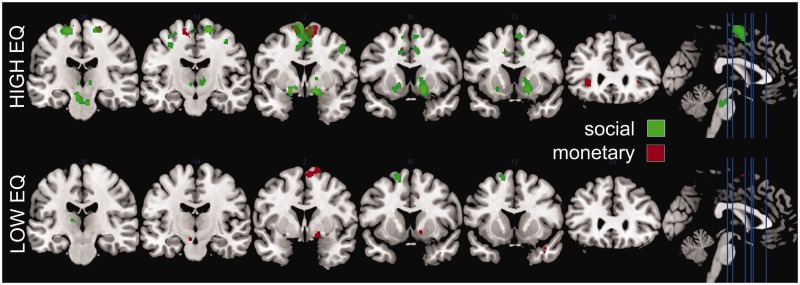
Contrasts of reward anticipation (vs. control) for the high-EQ (top) and the low-EQ (bottom) group on whole-brain level (P < 0.001, uncorrected).

References

    1. Aharon I, Etcoff N, Ariely D, Chabris CF, O'Connor E, Breiter HC. Beautiful faces have variable reward value: fMRI and behavioral evidence. Neuron. 2001;32(3):537–51. - PubMed
    1. Ashburner J, Friston KJ. Unified segmentation. Neuroimage. 2005;26(3):839–51. - PubMed
    1. Bagby RM, Parker JD, Taylor GJ. The twenty-item Toronto Alexithymia Scale–I. Item selection and cross-validation of the factor structure. Journal of Psychosomatic Research. 1994;38(1):23–32. - PubMed
    1. Banissy MJ, Garrido L, Kusnir F, Duchaine B, Walsh V, Ward J. Superior facial expression, but not identity recognition, in mirror-touch synesthesia. Journal of Neuroscience. 2011;31(5):1820–4. - PMC - PubMed
    1. Baron-Cohen S, Wheelwright S. The empathy quotient: an investigation of adults with Asperger syndrome or high functioning autism, and normal sex differences. Journal of Autism and Developmental Disorders. 2004;34(2):163–75. - PubMed

Publication types

MeSH terms