Case Reports
doi: 10.1128/JCM.00252-13.
Epub 2013 Mar 20.
Cache valley virus in a patient diagnosed with aseptic meningitis
Affiliations
- PMID: 23515536
- PMCID: PMC3716113
- DOI: 10.1128/JCM.00252-13
Item in Clipboard
Case Reports
Cache valley virus in a patient diagnosed with aseptic meningitis
J Clin Microbiol.
2013 Jun.
Abstract
Cache Valley virus was initially isolated from mosquitoes and had been linked to central nervous system-associated diseases. A case of Cache Valley virus infection is described. The virus was cultured from a patient's cerebrospinal fluid and identified with real-time reverse transcription-PCR and sequencing, which also yielded the complete viral coding sequences.
Figures
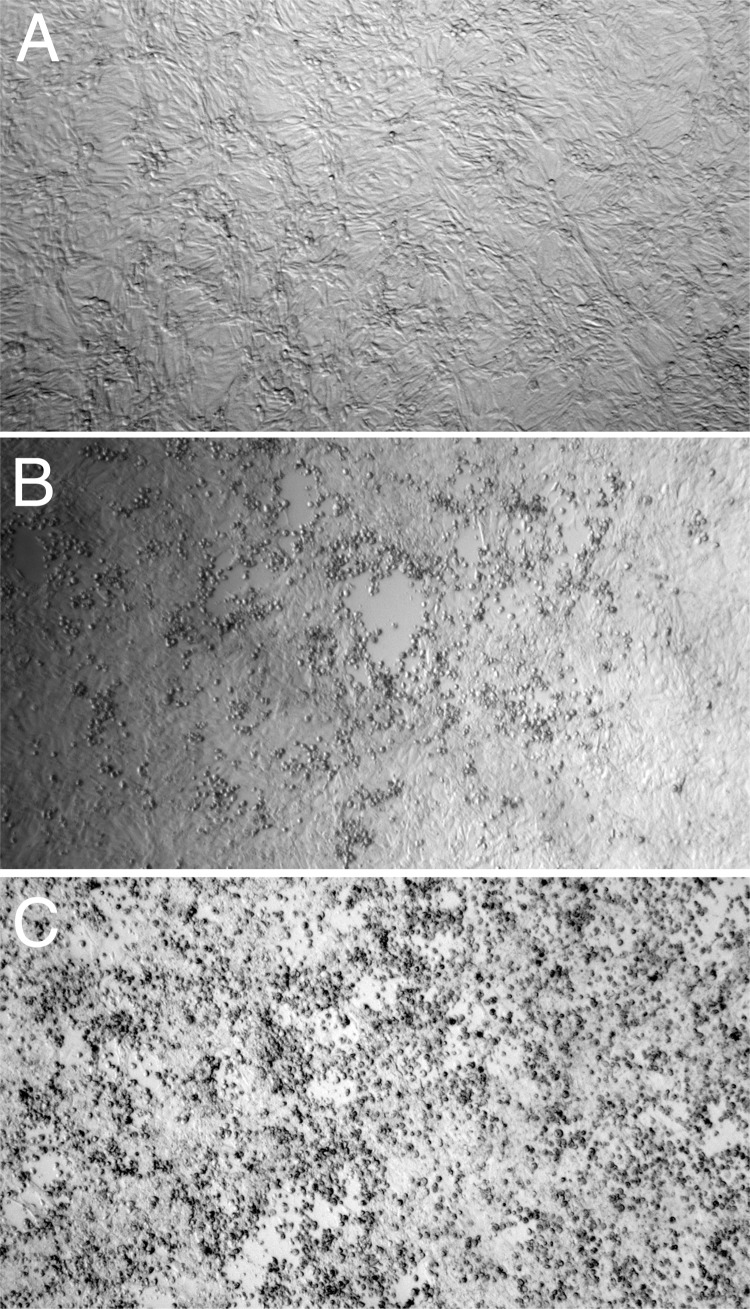
Cytopathic effect of the CVV-infected Vero cells. Vero cells were seeded in a 24-well plate and grown to 90% confluence and were either mock infected (A) or infected at a multiplicity of infection (MOI) of 0.3 (B) or at an MOI of 30 (C) with the MNZ-92011 strain, which was harvested from BGMK cells, amplified, and titrated in Vero cells. Photographs were taken on day 4 postinfection, using a Spot RT-KE monochrome camera connected to a Nikon Diaphot TMD microscope at ×40 magnification and Spot 5.0 Basic software.
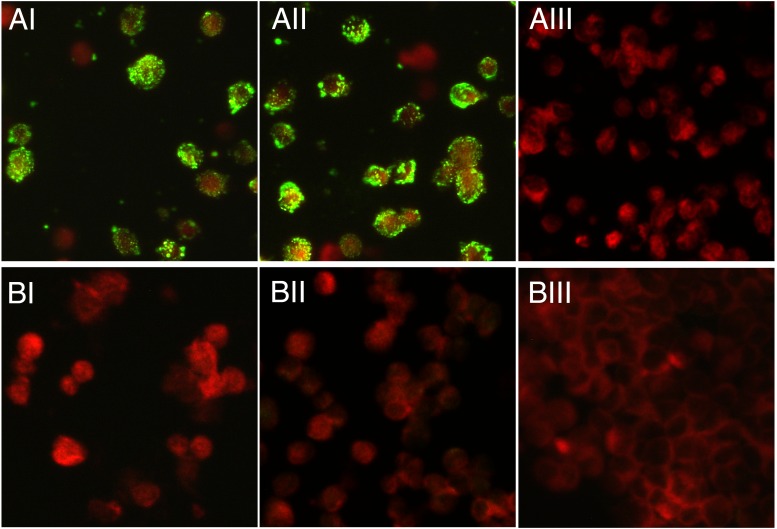
Detection of anti-CVV antibodies in the patient's convalescent-phase serum. The results of an IFA of the patient's 24-day convalescent-phase serum (I), an anti-CVV mouse hyperimmune serum (II), and an anti-La Crosse virus human convalescent-phase serum (III), using Caco2 cells that were mock infected (BI to BIII) or at day 2 postinfection with the MNZ-92011 strain (AI to AIII), are shown. Fluorescein isothiocyanate (FITC)-conjugated dual anti-human/anti-mouse IgG goat antibody (Focus Diagnostics, Cypress, CA) was used as a secondary antibody. Images were taken with a Zeiss AxioCam MRc camera attached to AxioImager A1 microscope at ×400 magnification, using Zeiss AxioVision 3.1 software. All sera were at a dilution of 1:16, with the exception of the anti-CVV mouse serum represented in panels AII and BII, where the serum was diluted 1:1,024.
References
-
- Dupuis M, Hull R, Wang H, Nattanmai S, Glasheen B, Fusco H, Dzigua L, Markey K, Tavakoli NP. 2011. Molecular detection of viral causes of meningitis and encephalitis in New York State. J. Med. Virol. 83:2172–2181 - PubMed
-
- Holden P, Hess AD. 1959. Cache Valley virus, a previously undescribed mosquito-borne agent. Science 130:1187–1188 - PubMed
-
- Neitzel DF, Grimstad PR. 1991. Serological evidence of California group and Cache Valley virus infection in Minnesota white-tailed deer. J. Wildl. Dis. 27:230–237 - PubMed
Publication types
MeSH terms
Substances
Associated data
- Actions
- Actions
- Actions
Grants and funding
LinkOut - more resources
Full Text Sources
Other Literature Sources
Molecular Biology Databases