


Ten-year outcome of serum metal ion levels after primary total hip arthroplasty: a concise follow-up of a previous report*
- PMID: 23515985
- PMCID: PMC3748974
- DOI: 10.2106/JBJS.L.00471
Ten-year outcome of serum metal ion levels after primary total hip arthroplasty: a concise follow-up of a previous report*
Abstract
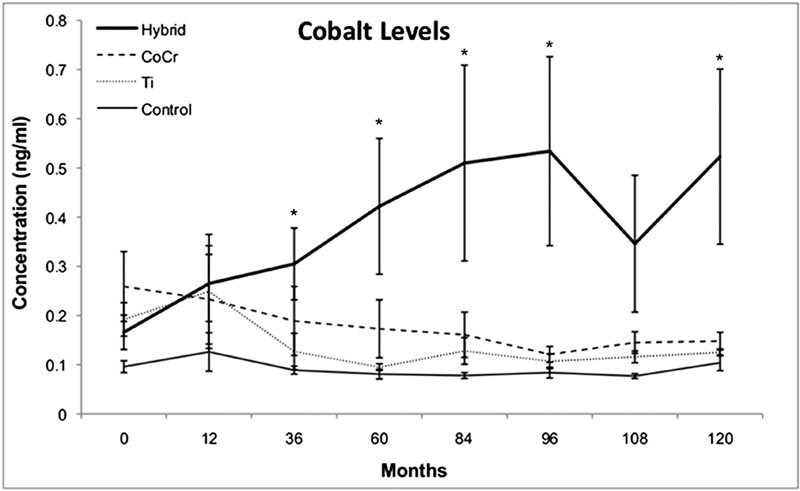
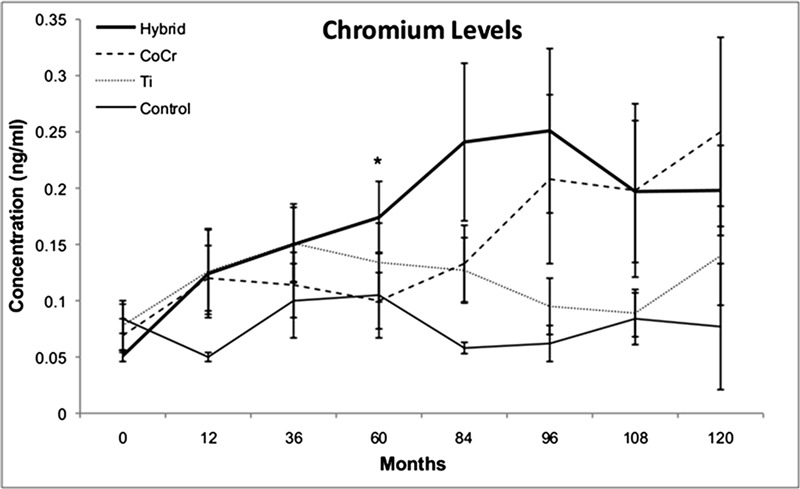
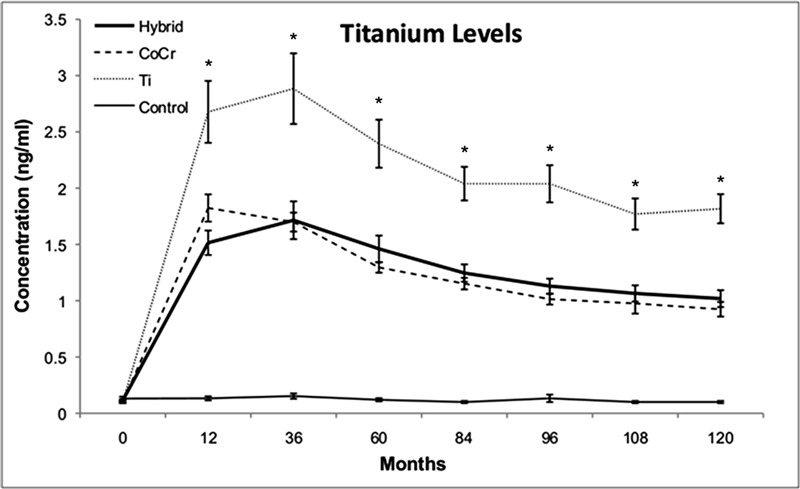
We previously reported on the metal ion concentrations of cobalt, chromium, and titanium that were found in the serum of patients three years after they had undergone primary total hip arthroplasty as compared with the concentrations found in the serum of control patients who did not have an implant. This study is a concise update on the serum metal levels found in a cohort of these patients ten years after the time of hip implantation. Of the original seventy-five subjects, metal ion levels were available for forty patients (53%). Ten patients (hybrid group) had received a hybrid total hip replacement that consisted of a modular cobalt-alloy femoral stem with a cobalt-alloy femoral head that had been inserted with cement and a titanium acetabular socket that had been inserted without cement. Nine patients (cobalt-chromium [CoCr] group) had received an implant with an extensively porous-coated modular cobalt-alloy femoral stem and femoral head along with a titanium acetabular socket; the femoral and acetabular components had each been inserted without cement. Eight patients (titanium group) had undergone insertion of a proximally porous-coated modular titanium-alloy femoral stem with a cobalt-alloy femoral head and a titanium acetabular socket; the femoral and acetabular components had each been inserted without cement. Thirteen patients (control group) from the original control group of patients who had not received an implant served as control subjects. Serum metal levels were measured with use of high-resolution sector field inductively coupled plasma mass spectrometry. The hybrid total hip arthroplasty group had mean cobalt levels that were 3.2 times higher at 120 months than they were at baseline, and the cobalt levels in that group were significantly higher than those in the titanium total hip arthroplasty group at thirty-six, sixty, eighty-four, ninety-six, and 120 months (p < 0.01). The hybrid group had mean chromium levels that were 3.9 times higher at 120 months than they were at baseline, and the CoCr total hip arthroplasty group had chromium levels that were 3.6 times higher at 120 months than they were at baseline. The serum titanium levels were higher in the titanium group at all follow-up time intervals as compared with the levels in all other groups, and the level in the titanium group at 120 months was eighteen times higher than it was at baseline (p < 0.01). Patients with well-functioning primary metal-on-polyethylene total hip replacements had elevated serum metal levels for as many as ten years postoperatively. Furthermore, metal release at the modular femoral head-neck junctions, rather than passive dissolution from porous ingrowth surfaces, was likely the dominant source of serum cobalt and chromium.
Figures
Comment in
-
Tapering our focus to the causes and correction of metallosis in primary total hip arthroplasty: commentary on an article by Brett R. Levine, MD, MS, et al.: "ten-year outcome of serum metal ion levels after primary total hip arthroplasty. A concise follow-up of a previous report".J Bone Joint Surg Am. 2013 Mar 20;95(6):e391-2. doi: 10.2106/JBJS.L.01687. J Bone Joint Surg Am. 2013. PMID: 23515998 No abstract available.
References
-
- Agins HJ, Alcock NW, Bansal M, Salvati EA, Wilson PD, Jr, Pellicci PM, Bullough PG. Metallic wear in failed titanium-alloy total hip replacements. A histological and quantitative analysis. J Bone Joint Surg Am. 1988;70(3):347-56 - PubMed
-
- Black J, Sherk H, Bonini J, Rostoker WR, Schajowicz F, Galante JO. Metallosis associated with a stable titanium-alloy femoral component in total hip replacement. A case report. J Bone Joint Surg Am. 1990;72(1):126-30 - PubMed
-
- Jacobs JJ, Shanbhag A, Glant TT, Black J, Galante JO. Wear Debris in Total Joint Replacements. J Am Acad Orthop Surg. 1994;2(4):212-20 - PubMed
-
- Jacobs JJ, Skipor AK, Black J, Urban R, Galante JO. Release and excretion of metal in patients who have a total hip-replacement component made of titanium-base alloy. J Bone Joint Surg Am. 1991;73(10):1475-86 - PubMed
-
- Hsu AR, Kim JD, Fabi D, Levine BR. Adverse reactions in metal-on-metal total hip arthroplasty: two cases presenting as pseudoseptic acetabular component loosening. Am J Orthop (Belle Mead NJ). 2011;40(10):509-13 - PubMed
Publication types
MeSH terms
Substances
Grants and funding
LinkOut - more resources
Full Text Sources
Other Literature Sources
Medical
