


Assessing the stability of human locomotion: a review of current measures
- PMID: 23516062
- PMCID: PMC3645408
- DOI: 10.1098/rsif.2012.0999
Assessing the stability of human locomotion: a review of current measures
Erratum in
- J R Soc Interface. 2014 Jan 6;11(90):N20130900
-
Correction to: 'Assessing the stability of human locomotion: a review of current measures' (2013) by Bruijn et al.J R Soc Interface. 2023 May;20(202):20230207. doi: 10.1098/rsif.2023.0207. Epub 2023 May 3. J R Soc Interface. 2023. PMID: 37132230 Free PMC article. No abstract available.
Abstract
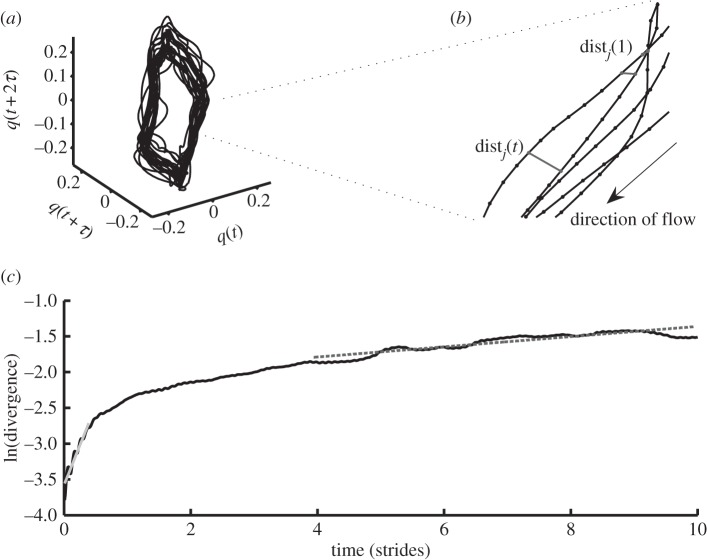
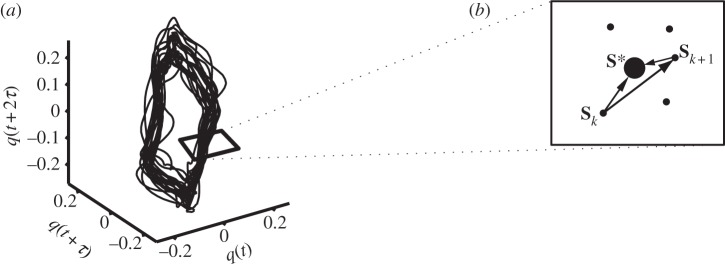
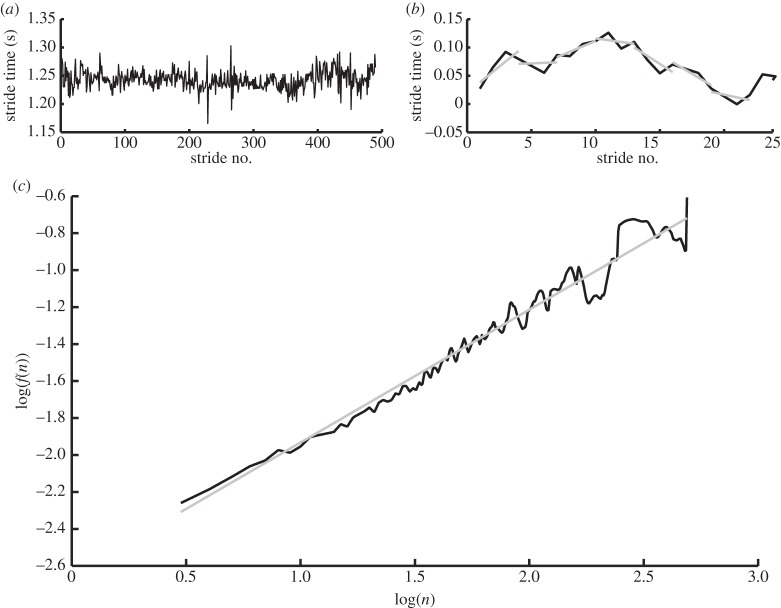
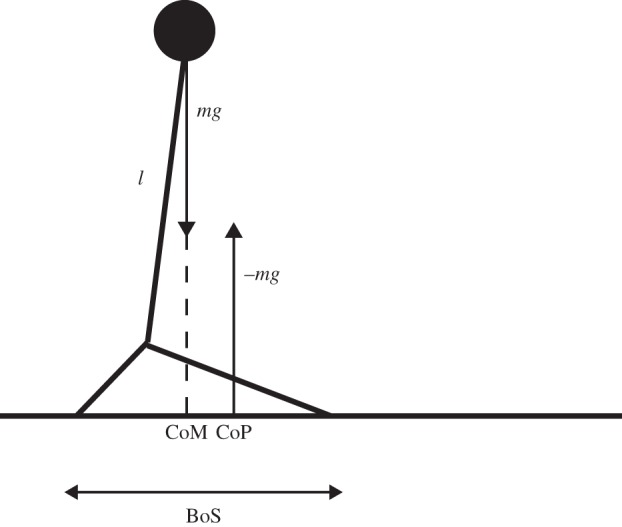
Falling poses a major threat to the steadily growing population of the elderly in modern-day society. A major challenge in the prevention of falls is the identification of individuals who are at risk of falling owing to an unstable gait. At present, several methods are available for estimating gait stability, each with its own advantages and disadvantages. In this paper, we review the currently available measures: the maximum Lyapunov exponent (λS and λL), the maximum Floquet multiplier, variability measures, long-range correlations, extrapolated centre of mass, stabilizing and destabilizing forces, foot placement estimator, gait sensitivity norm and maximum allowable perturbation. We explain what these measures represent and how they are calculated, and we assess their validity, divided up into construct validity, predictive validity in simple models, convergent validity in experimental studies, and predictive validity in observational studies. We conclude that (i) the validity of variability measures and λS is best supported across all levels, (ii) the maximum Floquet multiplier and λL have good construct validity, but negative predictive validity in models, negative convergent validity and (for λL) negative predictive validity in observational studies, (iii) long-range correlations lack construct validity and predictive validity in models and have negative convergent validity, and (iv) measures derived from perturbation experiments have good construct validity, but data are lacking on convergent validity in experimental studies and predictive validity in observational studies. In closing, directions for future research on dynamic gait stability are discussed.
Figures

References
-
- Calandre L, Conde I, Bermejo Pareja F. 2005. Gait and stability disorders of the elderly. Clinical analysis of a series of 259 patients older than 70 years. Neurologia 20, 232–239 - PubMed
-
- Lockhart TE, Liu J. 2008. Differentiating fall-prone and healthy adults using local dynamic stability. Ergonomics 51, 1860–1872 10.1080/00140130802567079 (doi:10.1080/00140130802567079) - DOI - PMC - PubMed
-
- Herman T, Giladi N, Gurevich T, Hausdorff JM. 2005. Gait instability and fractal dynamics of older adults with a ‘cautious’ gait: why do certain older adults walk fearfully? Gait Posture 21, 178–185 10.1016/j.gaitpost.2004.01.014 (doi:10.1016/j.gaitpost.2004.01.014) - DOI - PubMed
-
- Pijnappels M, Van der Burg JCE, Reeves ND, van Dieen JH. 2008. Identification of elderly fallers by muscle strength measures. Eur. J. Appl. Physiol. 102, 585–592 10.1007/s00421-007-0613-6 (doi:10.1007/s00421-007-0613-6) - DOI - PMC - PubMed
-
- Pavol MJ, Owings TM, Foley KT, Grabiner MD. 2002. Influence of lower extremity strength of healthy older adults on the outcome of an induced trip. J. Am. Geriatr. Soc. 50, 256–262 10.1046/j.1532-5415.2002.50056.x (doi:10.1046/j.1532-5415.2002.50056.x) - DOI - PubMed
Publication types
MeSH terms
LinkOut - more resources
Full Text Sources
Other Literature Sources
Medical
