


Treatment for sleep apnea by continuous positive airway pressure improves levels of inflammatory markers - a meta-analysis
- PMID: 23518041
- PMCID: PMC3637233
- DOI: 10.1186/1476-9255-10-13
Treatment for sleep apnea by continuous positive airway pressure improves levels of inflammatory markers - a meta-analysis
Abstract
Background: Obstructive sleep apnea (OSA) is associated with coronary artery disease (CAD). Intermittent hypoxia associated with OSA increases sympathetic activity and may cause systemic inflammation, which may contribute to CAD in patients with OSA. Treatment with continuous positive airway pressure (CPAP) has been shown to change levels of inflammatory markers. We analyzed data from published studies by a systematic meta-analysis.
Objective: To asses if treatment for sleep apnea by CPAP will affect levels of inflammatory markers.
Data resources: PubMed, Embase and Cochrane library.
Methods: Study eligibility criteria full text English studies of adult, human subjects, addressing values of at least one of the inflammatory markers before and after CPAP treatment. We used the definition of OSA as an apnea-hypopnea index (AHI) of ≥ 5/h, reported values in mean and standard deviation or median with range.
Participants: Adult, human.
Interventions: CPAP treatment for OSA.
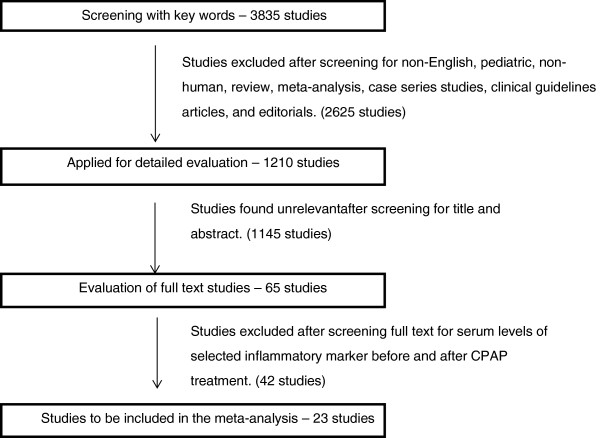
Study appraisal and synthesis method: A total of 3835 studies were reviewed for inclusion, while 23 studies pooled for analysis. A total of 14 studies with 771 patients were pooled for C-reactive protein (CRP); 9 studies with 209 patients were pooled for tumor necrosis factor-alpha (TNF-α); and 8 studies with 165 patients were pooled for interleukin-6 (IL-6).
Endpoint definitions: THE FOLLOWING INFLAMMATORY MARKERS WERE CHOSEN: CRP, TNF-α, and IL-6.
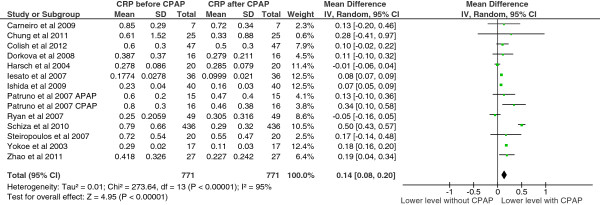
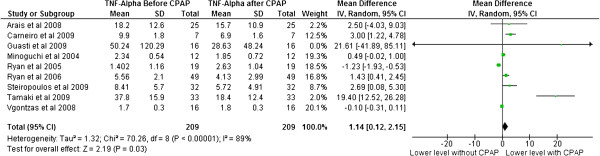
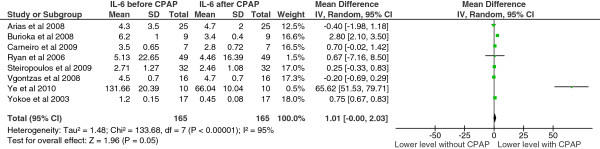
Results: C-reactive protein: Study level means ranged from 0.18 to 0.85 mg/dl before CPAP treatment and 0.10 to 0.72 mg/dl after CPAP treatment. Mean differences, at a study level, ranged from -0.05 to 0.50. The pooled mean difference was 0.14 [95% confidence interval 0.08 to 0.20, p < 0.00001]. There was heterogeneity in this endpoint (df = 13, p < 0.00001, I(2) = 95%). Tumor necrosis factor-α: Study level means ranged from 1.40 to 50.24 pg/ml before CPAP treatment and 1.80 to 28.63 pg/ml after CPAP treatment. Mean differences, at a study level, ranged from -1.23 to 21.61. The pooled mean difference was 1.14 [95% confidence interval 0.12 to 2.15, p = 0.03]. There was heterogeneity in this endpoint (df = 8, p < 0.00001, I2 = 89%). Interleukin-6: Study level means ranged from 1.2 to 131.66 pg/ml before CPAP treatment and 0.45 to 66.04 pg/ml after CPAP treatment. Mean differences, at a study level, ranged from -0.40 to 65.62. The pooled mean difference was 1.01 [95% confidence interval -0.00 to 2.03, p = 0.05]. There was heterogeneity in this endpoint (df = 7, p < 0.00001, I(2) = 95%).
Limitations: Only published data. Studies pooled were mainly small, non-randomized trials.
Conclusion: Sleep apnea treatment with CPAP improves levels of inflammatory markers.
Keywords: AHI (apnea-hypopnea index); BMI (body mass index); CPAP (continuous positive airway pressure); CRP (C-reactive protein); IL-6 (interleukin-6); ODI (oxygen desaturation index); OSA (obstructive sleep apnea); TNF-α (tumor necrosis factor-alpha).
Figures
References
-
- Young T, Palta M, Dempsey J, Skatrud J, Weber S, Badr S. The occurrence of sleep-disordered breathing among middle-aged adults. N Engl J Med. 1993;32:1230–1235. - PubMed
LinkOut - more resources
Full Text Sources
Other Literature Sources
Medical
Research Materials
Miscellaneous
