Association of maternal vitamin D status during pregnancy with bone-mineral content in offspring: a prospective cohort study
- PMID: 23518316
- PMCID: PMC3691477
- DOI: 10.1016/S0140-6736(12)62203-X
Association of maternal vitamin D status during pregnancy with bone-mineral content in offspring: a prospective cohort study
Erratum in
- Lancet. 2013 Aug 24;382(9893):684
- Lancet. 2013 Jun 22;381(9884):2166
Abstract
Background: Maternal vitamin D status in pregnancy is a suggested determinant of bone-mineral content (BMC) in offspring, but has been assessed in small studies. We investigated this association in a large prospective study.
Methods: Eligible participants were mother-and-singleton-offspring pairs who had participated in the Avon Longitudinal Study of Parents and Children, and in which the mother had recorded measurements of 25(OH)D concentration in pregnancy and the offspring had undergone dual-energy x-ray absorptiometry at age 9-10 years. 25(OH)D concentrations in pregnancy were assessed per 10·0 nmol/L and classified as sufficient (more than 50·00 nmol/L), insufficient (49·99-27·50 nmol/L), or deficient (lower than 27·50 nmol/L). Associations between maternal serum 25(OH)D concentrations and offspring total body less head (TBLH) and spinal BMC were assessed by trimester.
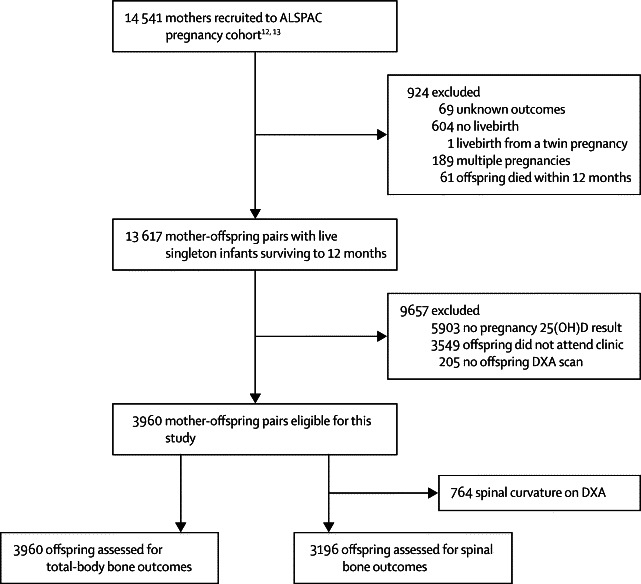
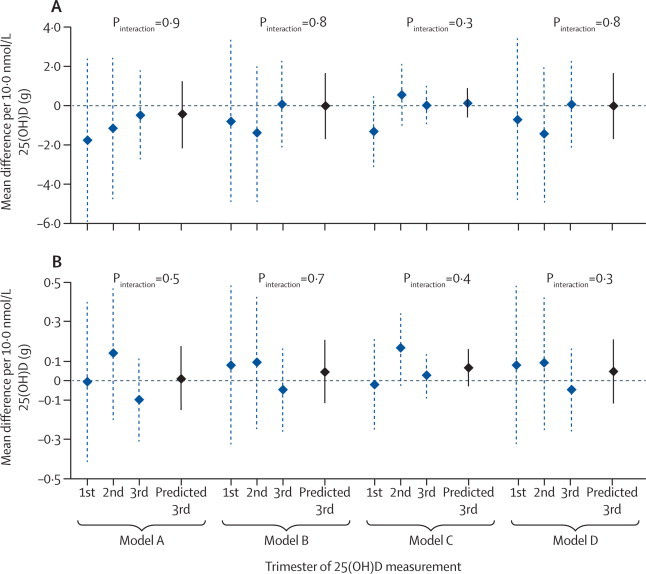
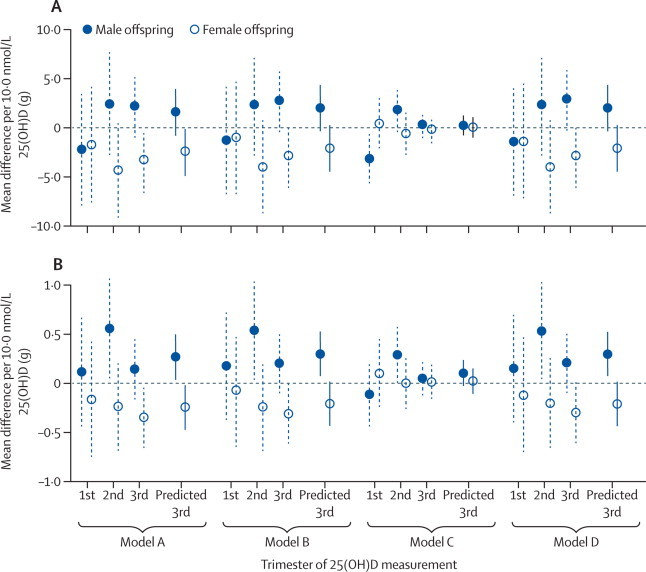
Results: 3960 mother-and-offspring pairs, mainly of white European origin, were assessed (TBLH BMC n=3960, spinal BMC n=3196). Mean offspring age was 9·9 years. 2644 (67%) mothers had sufficient, 1096 (28%) insufficient, and 220 (6%) deficient 25(OH)D concentrations in pregnancy, but TBLH and spinal BMC did not differ between offspring of mothers in the lower two groups versus sufficient 25(OH)D concentration. No associations with offspring BMC were found for any trimester, including the third trimester, which is thought to be most relevant (TBLH BMC confounder-adjusted mean difference -0·03 g per 10·0 nmol/L, 95% CI -1·71 to 1·65; spinal BMC 0·04 g per 10·0 nmol/L, 95% CI -0·12 to 0·21).
Conclusions: We found no relevant association between maternal vitamin D status in pregnancy and offspring BMC in late childhood.
Funding: UK Medical Research Council, Wellcome Trust, and University of Bristol.
Copyright © 2013 Elsevier Ltd. All rights reserved.
Figures
Comment in
-
Is vitamin D supplementation in pregnancy advisable?Lancet. 2013 Jun 22;381(9884):2143-5. doi: 10.1016/S0140-6736(13)60098-7. Epub 2013 Mar 19. Lancet. 2013. PMID: 23518315 No abstract available.
-
Hype um vitamin D? Nicht während der schwangerschaft.Praxis (Bern 1994). 2013 Jul 3;102(14):879-80. doi: 10.1024/1661-8157/a001336. Praxis (Bern 1994). 2013. PMID: 23823689 German. No abstract available.
-
Maternal vitamin D status during pregnancy and bone-mineral content in offspring.Lancet. 2013 Aug 31;382(9894):766. doi: 10.1016/S0140-6736(13)61827-9. Lancet. 2013. PMID: 23993185 Free PMC article. No abstract available.
-
Maternal vitamin D status during pregnancy and bone-mineral content in offspring.Lancet. 2013 Aug 31;382(9894):766-7. doi: 10.1016/S0140-6736(13)61828-0. Lancet. 2013. PMID: 23993186 No abstract available.
-
Maternal vitamin D status during pregnancy and bone-mineral content in offspring.Lancet. 2013 Aug 31;382(9894):767. doi: 10.1016/S0140-6736(13)61829-2. Lancet. 2013. PMID: 23993187 No abstract available.
-
Maternal vitamin D status during pregnancy and bone-mineral content in offspring - Authors' reply.Lancet. 2013 Aug 31;382(9894):767-8. doi: 10.1016/S0140-6736(13)61830-9. Lancet. 2013. PMID: 23993188 No abstract available.
References
-
- Weaver CM. Vitamin D, calcium homeostasis, and skeleton accretion in children. J Bone Miner Res. 2007;22:V45–V49. - PubMed
-
- Gartner LM, Greer FR. Prevention of rickets and vitamin D deficiency: new guidelines for vitamin D intake. Pediatrics. 2003;111:908–910. - PubMed
-
- Chung M, Lee J, Terasawa T, Lau J, Trikalinos TA. Vitamin D with or without calcium supplementation for prevention of cancer and fractures: an updated meta-analysis for the U.S. Preventive Services Task Force. Ann Intern Med. 2011;155:827–838. - PubMed
-
- Javaid MK, Crozier SR, Harvey NC. Maternal vitamin D status during pregnancy and childhood bone mass at age 9 years: a longitudinal study. Lancet. 2006;367:36–43. - PubMed
-
- Dror DK, Allen LH. Vitamin F inadequacy in pregnancy: biology, outcomes and interventions. Nutrition Rev. 2012;68:465–477. - PubMed
Publication types
MeSH terms
Substances
Grants and funding
LinkOut - more resources
Full Text Sources
Other Literature Sources
Medical