


Antifungal activity of Thymus vulgaris L. essential oil and its constituent phytochemicals against Rhizopus oryzae: interaction with ergosterol
- PMID: 23519243
- PMCID: PMC6268362
- DOI: 10.3390/molecules171214418
Antifungal activity of Thymus vulgaris L. essential oil and its constituent phytochemicals against Rhizopus oryzae: interaction with ergosterol
Abstract
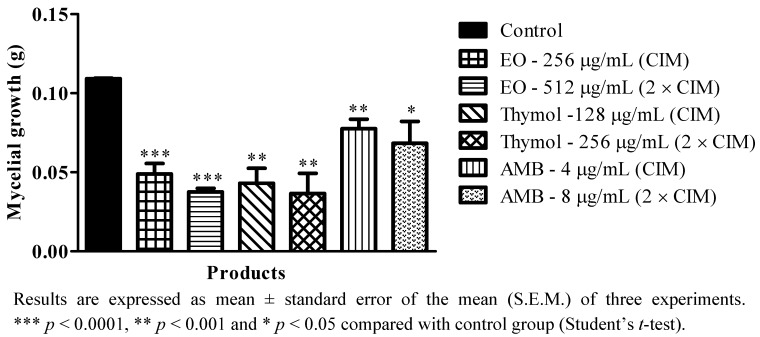
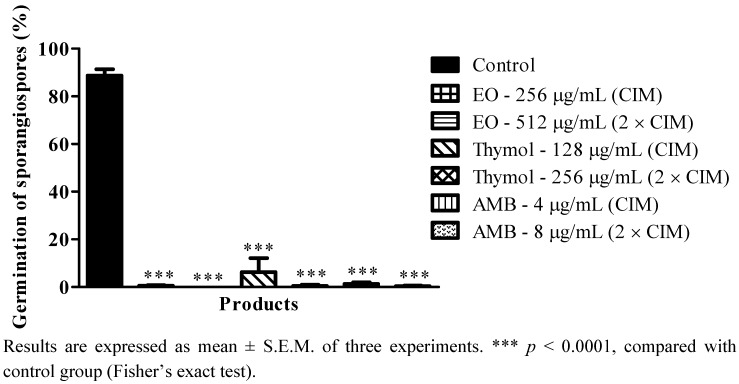
Mucormycoses are emerging infections that have high rates of morbidity and mortality. They show high resistance to antifungal agents, and there is a limited therapeutic arsenal currently available, therefore, there is a great need to give priority to testing therapeutic agents for the treatment of mucormycosis. Along this line, the use of essential oils and phytoconstituents has been emphasized as a new therapeutic approach. The objective of this work was to investigate the antifungal activity of the essential oil (EO) of Thymus vulgaris, and its constituents thymol and p-cymene against Rhizopus oryzae, through microbiological screening, determination of minimal inhibitory concentration (MICs) and minimal fungicidal concentration (MFCs), effects on mycelial growth and germination of sporangiospores and interaction with ergosterol. The MIC of EO and thymol varied 128-512 µg/mL, but the MFC of EO and thymol varied 512-1024 µg/mL and 128-1024 µg/mL, respectively. The results also showed that EO and thymol significantly inhibited mycelial development and germination of sporangiospores. Investigation of the mechanism of antifungal action showed that EO and thymol interact with ergosterol. These data indicate that EO of T. vulgaris and thymol possess strong antifungal activity, which can be related to their interaction with ergosterol, supporting the possible use of these products in the treatment of mucormycosis.
Figures
References
-
- Hennequin C. Épidemiologie des mycoses invasives. L’expérience d’un centre hospitalo-universitaire parisien. Rev. Med. Interne. 1996;17:754–760. - PubMed
Publication types
MeSH terms
Substances
LinkOut - more resources
Full Text Sources
