. 2012 Dec 13;17(12):14918-27.
doi: 10.3390/molecules171214918.

Hydroxysafflor yellow A (HSYA) from flowers of Carthamus tinctorius L. and its vasodilatation effects on pulmonary artery

Affiliations

Hydroxysafflor yellow A (HSYA) from flowers of Carthamus tinctorius L. and its vasodilatation effects on pulmonary artery

Yuhua Bai et al. Molecules. .

Abstract

Flowers of Carthamus tinctorius L. are traditionally used in China to treat cerebrovascular and cardiovascular diseases. Hydroxysafflor yellow A (HSYA), the main constituent of Carthamus tinctorius L. flowers, is known for its multiple biological activities. In the present study, HSYA was isolated from Carthamus tinctorius L. flowers by a macroporous resin adsorption chromatography method coupled with a Waters high-throughput auto-purification system and it's vasodilatation effects on pulmonary artery (PA) were explored by an assay of tension study on rat pulmonary artery (PA) rings. Results suggest that HSYA possesses vascular relaxation effects on rat PA by activating the KV channel in pulmonary vascular smooth muscle cells (PVSMCs).


Figures
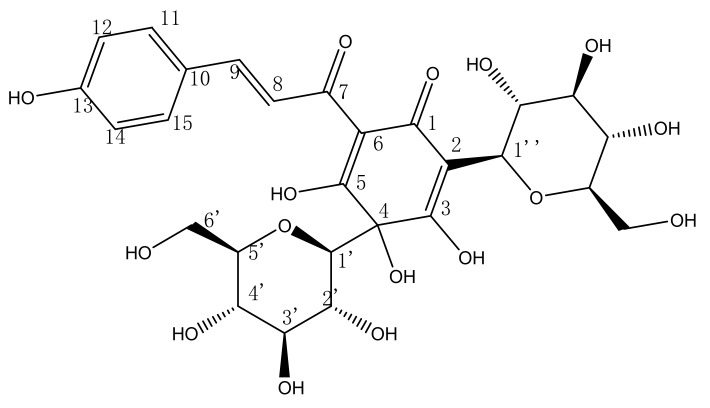
Figure 1
Figure 1
The chemical structure of HSYA.
Figure 2
Figure 2
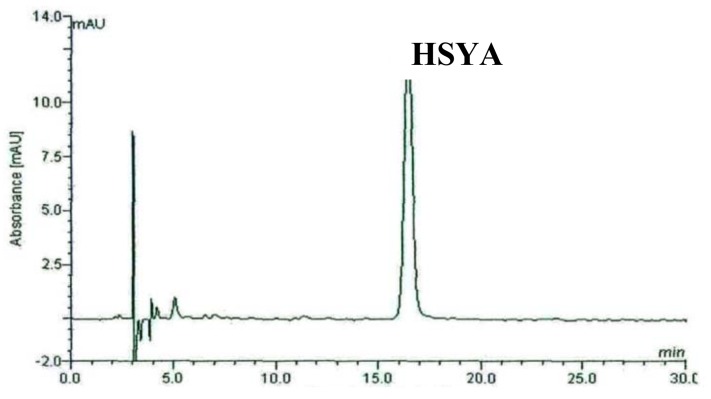
The HPLC chromatograph of the second fraction (F2) of crude extract from Carthamus tinctorius L. flowers obtained from a macroporous resin column. Conditions: column: ODS C18 (250 mm × 4.6 mm I.D., 5 μm); mobile phase: 0.2% formic acid in water (A), acetonitrile (B) and methanol (C) (A:B:C = 62:2:36) in isocratic elution mode for 30 min. The flow rate was 1 mL/min, aliquots of 10 µL were injected and the absorbance was recorded at 403 nm.
Figure 3
Figure 3
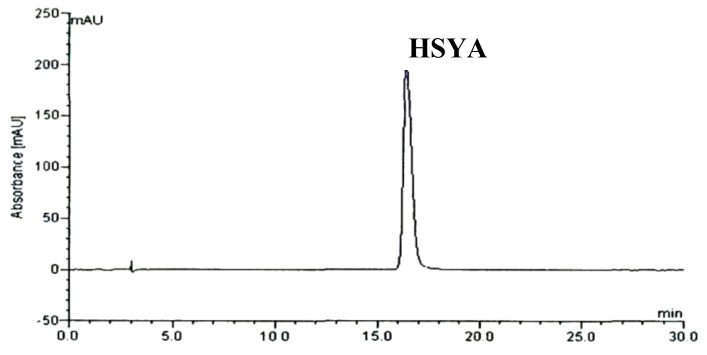
HPLC chromatograph of the separated HSYA. Conditions: same as Figure 2.
Figure 4
Figure 4
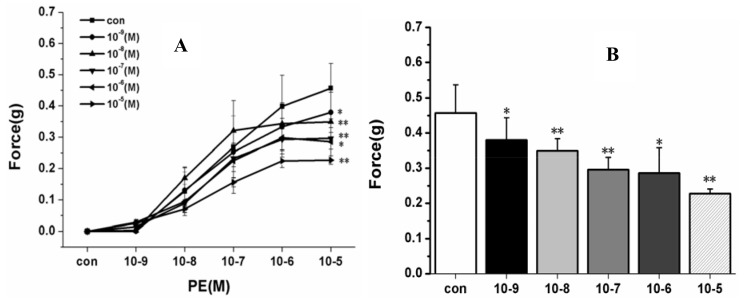
Vascular effect of HSYA on PE-induced constriction in rat PA rings with different concentration (10−9 M–10−5 M). * p < 0.05 compared with control; ** p < 0.01 compared with control.
Figure 5
Figure 5
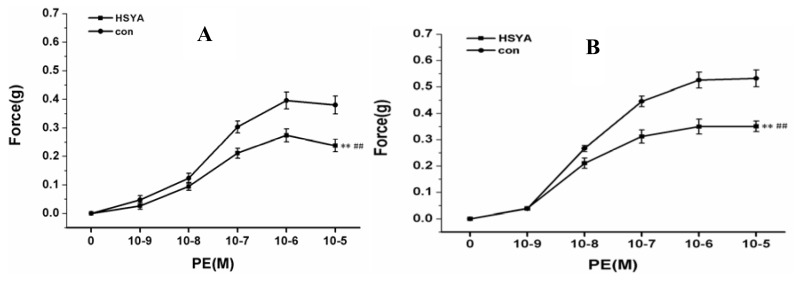
Vascular effect of HSYA on rat PA rings. (A) Vascular effect of HSYA on PE-induced vascular constriction in endothelium-intact rat PA rings; (B) Vascular effect of HSYA on PE-induced vascular constriction in endothelium-denuded rat PA rings. ** indicates the result has statistical significance (p < 0.01, compared with Normal). ## p < 0.01 compared with PE.
Figure 6
Figure 6
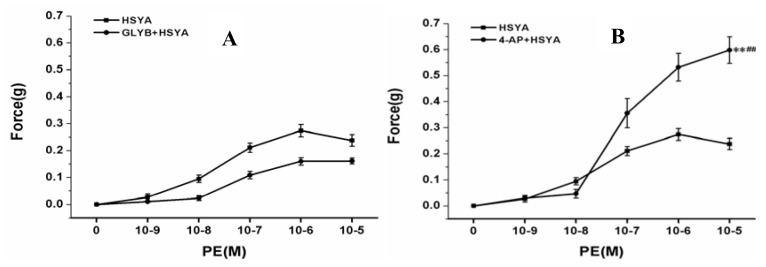
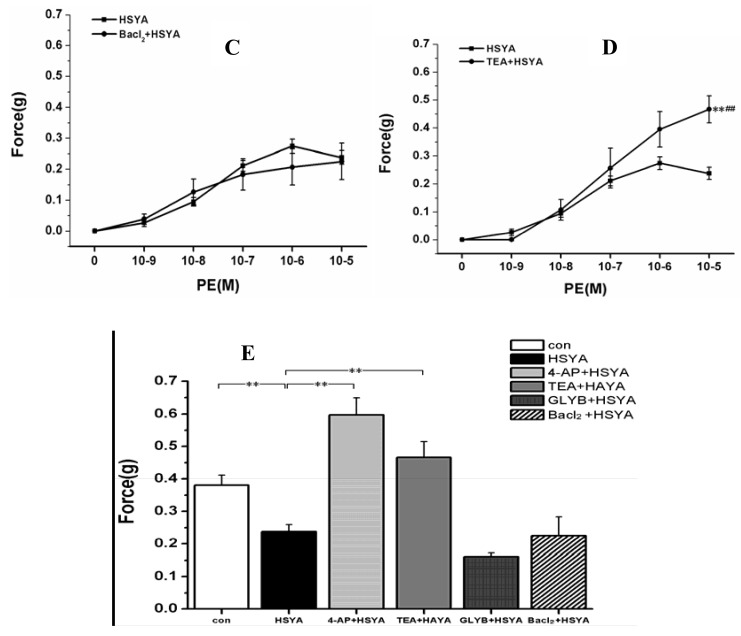
Vascular effect of HSYA after blocking K+ channels of PVSMCs. (A) Vascular effect of HSYA after pretreatment with GLYB; (B) Vascular effect of HSYA after pretreatment with 4-AP; (C) Vascular effect of HSYA after pretreatment with Bacl2; (D) Vascular effect of HSYA after pretreatment with TEA; (E) Bar graph shows the vascular effect of HSYA after blocking the different K+ channels of PVSMCs. ** indicates the result has statistical significance (p < 0.01, compared with Control). ## p < 0.01 compared with HSYA.
Figure 6
Figure 6
Vascular effect of HSYA after blocking K+ channels of PVSMCs. (A) Vascular effect of HSYA after pretreatment with GLYB; (B) Vascular effect of HSYA after pretreatment with 4-AP; (C) Vascular effect of HSYA after pretreatment with Bacl2; (D) Vascular effect of HSYA after pretreatment with TEA; (E) Bar graph shows the vascular effect of HSYA after blocking the different K+ channels of PVSMCs. ** indicates the result has statistical significance (p < 0.01, compared with Control). ## p < 0.01 compared with HSYA.

References

    1. Barst R.J., McGoon M., Torbicki A., Sitbon O., Krowka M.J., Olschewski H., Gaine S. Diagnosis and differential assessment of pulmonary arterial hypertension. J. Am. Coll. Cardiol. 2004;43:40S–47S. doi: 10.1016/j.jacc.2004.02.032. - DOI - PubMed
    1. Galie N., Hoeper M.M., Humbert M., Torbicki A., Vachiery J.L., Barbera J.A., Beghetti M., Corris P., Gaine S. Guidelines for the diagnosis and treatment of pulmonary hypertension: the Task Force for the Diagnosis and Treatment of Pulmonary Hypertension of the European Society of Cardiology (ESC) and the European Respiratory Society (ERS), endorsed by the International Society of Heart and Lung Transplantation (ISHLT) Eur. Heart J. 2009;30:2493–2537. - PubMed
    1. Benza R.L., Miller D.P., Gomberg-Maitland M., Frantz R.P., Foreman A.J., Coffey C.S. Predicting survival in pulmonary arterial hypertension: Insights from the Registry to Evaluate Early and Long-Term Pulmonary Arterial Hypertension Disease Management (REVEAL) Circulation. 2010;122:164–172. doi: 10.1161/CIRCULATIONAHA.109.898122. - DOI - PubMed
    1. Humbert M., Sitbon O., Chaouat A., Bertocchi M., Habib G., Gressin V., Yaici A., Weitzenblum E. Survival in patients with idiopathic, familial, and anorexigen-associated pulmonary arterial hypertension in the modern management era. Circulation. 2010;122:156–163. doi: 10.1161/CIRCULATIONAHA.109.911818. - DOI - PubMed
    1. Galie N., Black C.M., Keogh A., Pulido T., Frost A., Roux S., Leconte I., Landzberg M. Bosentan therapy for pulmonary arterial hypertension. N. Engl. J. Med. 2002;346:896–903. - PubMed

Publication types

MeSH terms

LinkOut - more resources