


The effect of a smoking ban on hospitalization rates for cardiovascular and respiratory conditions in Prince Edward Island, Canada
- PMID: 23520450
- PMCID: PMC3592861
- DOI: 10.1371/journal.pone.0056102
The effect of a smoking ban on hospitalization rates for cardiovascular and respiratory conditions in Prince Edward Island, Canada
Abstract
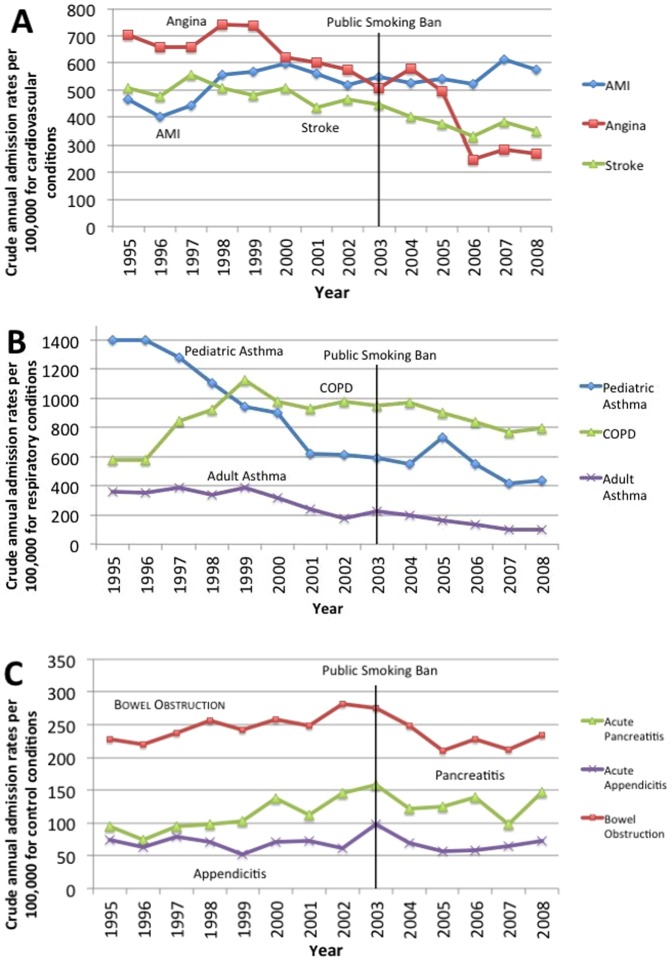
Background: This is the first study to have examined the effect of smoking bans on hospitalizations in the Atlantic Canadian socio-economic, cultural and climatic context. On June 1, 2003 Prince Edward Island (PEI) enacted a province-wide smoking ban in public places and workplaces. Changes in hospital admission rates for cardiovascular (acute myocardial infarction, angina, and stroke) and respiratory (chronic obstructive pulmonary disease and asthma) conditions were examined before and after the smoking ban.
Methods: Crude annual and monthly admission rates for the above conditions were calculated from April 1, 1995 to December 31, 2008 in all PEI acute care hospitals. Autoregressive Integrated Moving Average time series models were used to test for changes in mean and trend of monthly admission rates for study conditions, control conditions and a control province after the comprehensive smoking ban. Age- and sex-based analyses were completed.
Results: The mean rate of acute myocardial infarctions was reduced by 5.92 cases per 100,000 person-months (P = 0.04) immediately after the smoking ban. The trend of monthly angina admissions in men was reduced by -0.44 cases per 100,000 person-months (P = 0.01) in the 67 months after the smoking ban. All other cardiovascular and respiratory admission changes were non-significant.
Conclusions: A comprehensive smoking ban in PEI reduced the overall mean number of acute myocardial infarction admissions and the trend of angina hospital admissions.
Conflict of interest statement
Figures

References
-
- WHO (2009) Report on the Global Tobacco Epidemic, 2009: Implementing Smoke-Free Environments. Geneva, Switzerland: World Health Organization. 568p.
-
- Barnoya J (2005) Cardiovascular Effects of Secondhand Smoke: Nearly as Large as Smoking. Circulation 111: 2684–2698 doi:10.1161/CIRCULATIONAHA.104.492215. - DOI - PubMed
-
- U.S. Department of Health and Human Services (2006) The Health Consequences of Involuntary Exposure to Tobacco Smoke: A Report of the Surgeon General. Atlanta, GA: Centers for Disease Control and Prevention, Coordinating Center for Health Promotion, National Center for Chronic Disease Prevention and Health Promotion, Office on Smoking and Health. 727p. - PubMed
-
- Meyers DG, Neuberger JS, He J (2009) Cardiovascular effect of bans on smoking in public places: a systematic review and meta-analysis. J Am Coll Cardiol 54: 1249–1255 doi:10.1016/j.jacc.2009.07.022. - DOI - PubMed
-
- Panagiotakos DB, Chrysohoou C, Pitsavos C, Papaioannou I, Skoumas J, et al. (2002) The association between secondhand smoke and the risk of developing acute coronary syndromes, among non-smokers, under the presence of several cardiovascular risk factors: The CARDIO 2000 case-control study. BMC Public Health 2: 9–14. - PMC - PubMed
Publication types
MeSH terms
LinkOut - more resources
Full Text Sources
Other Literature Sources
Medical
Miscellaneous
