


Contextual social cognition impairments in schizophrenia and bipolar disorder
- PMID: 23520477
- PMCID: PMC3592887
- DOI: 10.1371/journal.pone.0057664
Contextual social cognition impairments in schizophrenia and bipolar disorder
Abstract
Background: The ability to integrate contextual information with social cues to generate social meaning is a key aspect of social cognition. It is widely accepted that patients with schizophrenia and bipolar disorders have deficits in social cognition; however, previous studies on these disorders did not use tasks that replicate everyday situations.
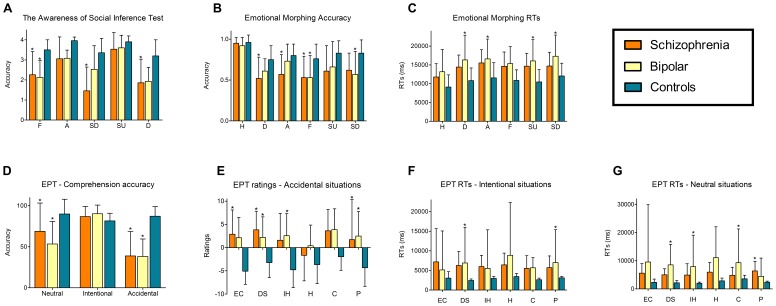
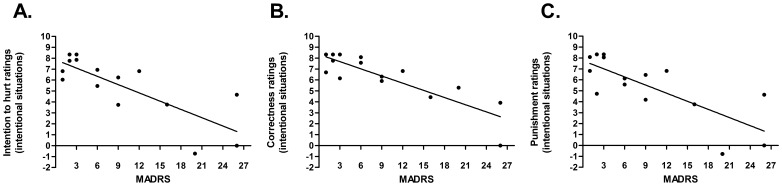
Methodology/principal findings: This study evaluates the performance of patients with schizophrenia and bipolar disorders on social cognition tasks (emotional processing, empathy, and social norms knowledge) that incorporate different levels of contextual dependence and involvement of real-life scenarios. Furthermore, we explored the association between social cognition measures, clinical symptoms and executive functions. Using a logistic regression analysis, we explored whether the involvement of more basic skills in emotional processing predicted performance on empathy tasks. The results showed that both patient groups exhibited deficits in social cognition tasks with greater context sensitivity and involvement of real-life scenarios. These deficits were more severe in schizophrenic than in bipolar patients. Patients did not differ from controls in tasks involving explicit knowledge. Moreover, schizophrenic patients' depression levels were negatively correlated with performance on empathy tasks.
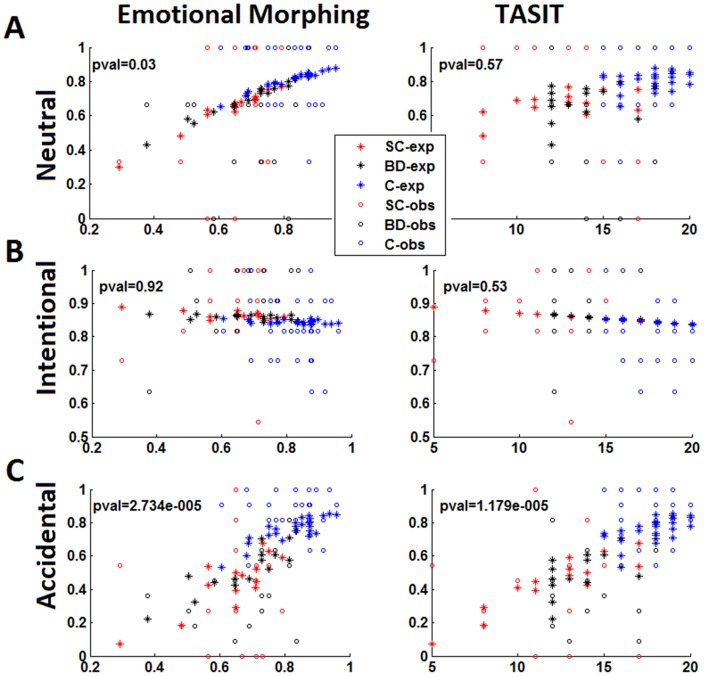
Conclusions/significance: Overall performance on emotion recognition predicted performance on intentionality attribution during the more ambiguous situations of the empathy task. These results suggest that social cognition deficits could be related to a general impairment in the capacity to implicitly integrate contextual cues. Important implications for the assessment and treatment of individuals with schizophrenia and bipolar disorders, as well as for neurocognitive models of these pathologies are discussed.
Conflict of interest statement
Figures
References
-
- Bora E, Gokcen S, Veznedaroglu B (2008) Empathic abilities in people with schizophrenia. Psychiatry Res 160: 23–29. - PubMed
-
- Linden SC, Jackson MC, Subramanian L, Wolf C, Green P, et al. (2010) Emotion-cognition interactions in schizophrenia: Implicit and explicit effects of facial expression. Neuropsychologia 48: 997–1002. - PubMed
-
- Marwick K, Hall J (2008) Social cognition in schizophrenia: a review of face processing. Br Med Bull 88: 43–58. - PubMed
Publication types
MeSH terms
LinkOut - more resources
Full Text Sources
Other Literature Sources
Medical
