


The BEACH is hot: a LYST of emerging roles for BEACH-domain containing proteins in human disease
- PMID: 23521701
- PMCID: PMC3761935
- DOI: 10.1111/tra.12069
The BEACH is hot: a LYST of emerging roles for BEACH-domain containing proteins in human disease
Abstract
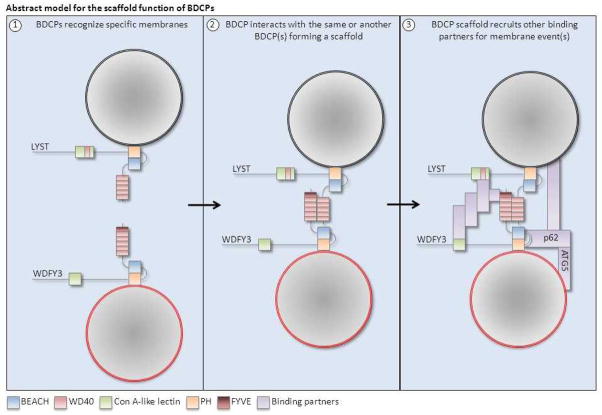
BEACH (named after 'Beige and Chediak-Higashi') is a conserved ∼280 residue domain, present in nine human BEACH domain containing proteins (BDCPs). Most BDCPs are large, containing a PH-like domain for membrane association preceding their BEACH domain, and containing WD40 and other domains for ligand binding. Recent studies found that mutations in individual BDCPs cause several human diseases. BDCP alterations affect lysosome size (LYST and NSMAF), apoptosis (NSMAF), autophagy (LYST, WDFY3, LRBA), granule size (LYST, NBEAL2, NBEA) or synapse formation (NBEA). However, the roles of each BDCP in these membrane events remain controversial. After reviewing studies on individual BDCPs, we propose a unifying hypothesis that BDCPs act as scaffolding proteins that facilitate membrane events, including both fission and fusion, determined by their binding partners. BDCPs may also bind each other, enabling fusion or fission of vesicles that are not necessarily of the same type. Such mechanisms explain why different BDCPs may have roles in autophagy; each BDCP is specific for the cell type or the cargo, but not necessarily specific for attaching to the autophagosome. Further elucidation of these mechanisms, preferably carrying out the same experiment on multiple BDCPs, and possibly using patients' cells, may identify potential targets for therapy.
© 2013 John Wiley & Sons A/S. Published by John Wiley & Sons Ltd.
Figures
References
-
- Ponting CP, Russell RR. The natural history of protein domains. Annu Rev Biophys Biomol Struct. 2002;31:45–71. - PubMed
-
- Nagle DL, Karim MA, Woolf EA, Holmgren L, Bork P, Misumi DJ, McGrail SH, Dussault BJ, Jr, Perou CM, Boissy RE, Duyk GM, Spritz RA, Moore KJ. Identification and mutation analysis of the complete gene for Chediak-Higashi syndrome. Nat Genet. 1996;14:307–311. - PubMed
-
- Perou CM, Moore KJ, Nagle DL, Misumi DJ, Woolf EA, McGrail SH, Holmgren L, Brody TH, Dussault BJ, Jr, Monroe CA, Duyk GM, Pryor RJ, Li L, Justice MJ, Kaplan J. Identification of the murine beige gene by YAC complementation and positional cloning. Nat Genet. 1996;13:303–308. - PubMed
-
- Wang J-W, Gamsby JJ, Highfill SL, Mora LB, Bloom GC, Yeatman TJ, Pan TC, Ramne AL, Chodosh LA, Cress WD, Chen J, Kerr WG. Deregulated expression of LRBA facilitates cancer cell growth. Oncogene. 2004;23:4089–4097. - PubMed
Publication types
MeSH terms
Substances
Grants and funding
LinkOut - more resources
Full Text Sources
Other Literature Sources
Molecular Biology Databases
Miscellaneous
