


Caveolin-1 as a promoter of tumour spreading: when, how, where and why
- PMID: 23521716
- PMCID: PMC3823014
- DOI: 10.1111/jcmm.12030
Caveolin-1 as a promoter of tumour spreading: when, how, where and why
Abstract
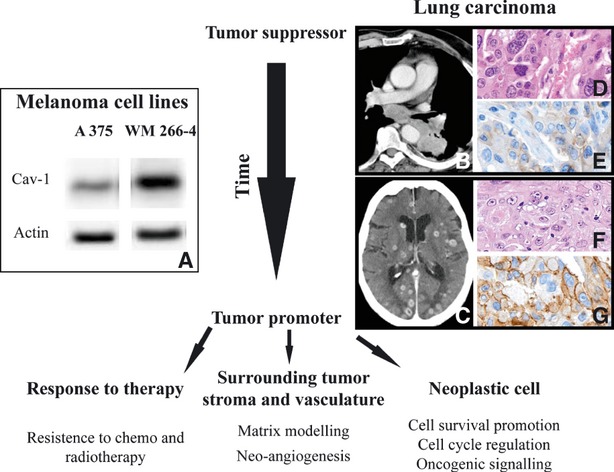
Caveolae are non-clathrin invaginations of the plasma membrane in most cell types; they are involved in signalling functions and molecule trafficking, thus modulating several biological functions, including cell growth, apoptosis and angiogenesis. The major structural protein in caveolae is caveolin-1, which is known to act as a key regulator in cancer onset and progression through its role as a tumour suppressor. Caveolin-1 can also promote cell proliferation, survival and metastasis as well as chemo- and radioresistance. Here, we discuss recent findings and novel concepts that support a role for caveolin-1 in cancer development and its distant spreading. We also address the potential application of caveolin-1 in tumour therapy and diagnosis.
© 2013 The Authors. Published by Foundation for Cellular and Molecular Medicine/Blackwell Publishing Ltd.
Figures
References
-
- Burgermeister E, Liscovitch M, Röcken C, et al. Caveats of caveolin-1 in cancer progression. Cancer Lett. 2008;268:187–201. - PubMed
-
- Goetz JG, Lajoie P, Wiseman SM, et al. Caveolin-1 in tumor progression: the good, the bad and the ugly. Cancer Metastasis Rev. 2008;27:715–35. - PubMed
-
- Carver LA, Schnitzer JE. Caveolae: mining little caves for new cancer targets. Nat Rev Cancer. 2003;3:571–81. - PubMed
Publication types
MeSH terms
Substances
LinkOut - more resources
Full Text Sources
Other Literature Sources
