


Learning styles and approaches to learning among medical undergraduates and postgraduates
- PMID: 23521845
- PMCID: PMC3620557
- DOI: 10.1186/1472-6920-13-42
Learning styles and approaches to learning among medical undergraduates and postgraduates
Abstract
Background: The challenge of imparting a large amount of knowledge within a limited time period in a way it is retained, remembered and effectively interpreted by a student is considerable. This has resulted in crucial changes in the field of medical education, with a shift from didactic teacher centered and subject based teaching to the use of interactive, problem based, student centered learning. This study tested the hypothesis that learning styles (visual, auditory, read/write and kinesthetic) and approaches to learning (deep, strategic and superficial) differ among first and final year undergraduate medical students, and postgraduates medical trainees.
Methods: We used self administered VARK and ASSIST questionnaires to assess the differences in learning styles and approaches to learning among medical undergraduates of the University of Colombo and postgraduate trainees of the Postgraduate Institute of Medicine, Colombo.
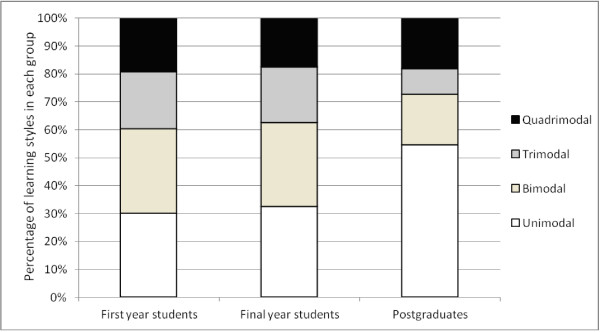
Results: A total of 147 participated: 73 (49.7%) first year students, 40 (27.2%) final year students and 34(23.1%) postgraduate students. The majority (69.9%) of first year students had multimodal learning styles. Among final year students, the majority (67.5%) had multimodal learning styles, and among postgraduates, the majority were unimodal (52.9%) learners.Among all three groups, the predominant approach to learning was strategic. Postgraduates had significant higher mean scores for deep and strategic approaches than first years or final years (p < 0.05). Mean scores for the superficial approach did not differ significantly between groups.
Conclusions: The learning approaches suggest a positive shift towards deep and strategic learning in postgraduate students. However a similar difference was not observed in undergraduate students from first year to final year, suggesting that their curriculum may not have influenced learning methodology over a five year period.
Figures
References
-
- Lubawy WC. Evaluating teaching using the best practices model. Am J Pharm Educ. 2003;67(3):87. doi: 10.5688/aj670387. - DOI
-
- Peers IS, Johnston M. Influence of learning context on the relationship between A-level attainment and final degree performance: a meta-analytic review. Br J Educ Psychol. 1994;64:1–17. doi: 10.1111/j.2044-8279.1994.tb01081.x. - DOI
MeSH terms
LinkOut - more resources
Full Text Sources
Other Literature Sources
