


doi: 10.1039/C2MD20291C.
Epub 2012 Nov 29.
A structure-activity relationship study on multi-heterocyclic molecules: two linked thiazoles are required for cytotoxic activity
Affiliations
- PMID: 23524379
- PMCID: PMC3601786
- DOI: 10.1039/C2MD20291C
Item in Clipboard
A structure-activity relationship study on multi-heterocyclic molecules: two linked thiazoles are required for cytotoxic activity
Medchemcomm.
.
Abstract
We report the synthesis, cytotoxicity, and phenotypic analysis of oxazole and thiazole containing fragments. Evaluating the optimal size and heterocycle for growth inhibition and apoptosis showed that activity required at least two thiazoles sequentially connected. This is the first detailed comparison of biological activity between multi-heterocyclic containing fragments.
Figures

Three approved drugs: Azaepothilone B, Ritonavir and bleomycin) and one expected to enter phase I testing (Telomestatin) that contain oxazoles and thiazoles
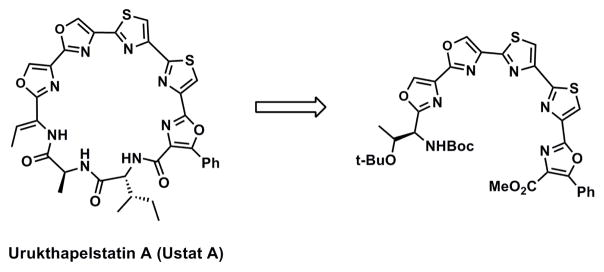
Truncated heterocyclefragment of Ustat A.
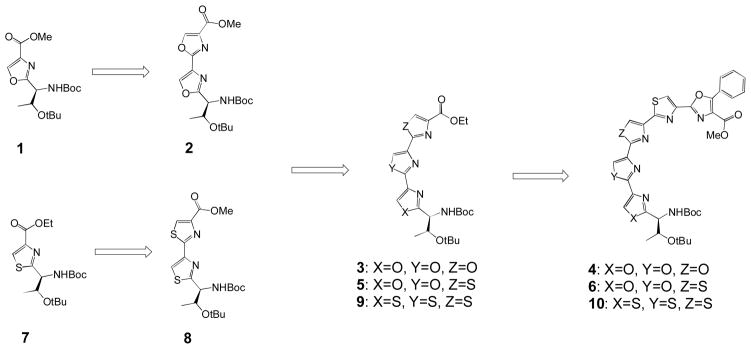
Evolution of heterocyclic moieties

Growth inhibition of compounds at 40 μM. Percentage growth inhibition of treated HCT-116 cells was measured using a CCK8 assay. Data represents results for compounds 1, 2, 3, 4, 5, 6, 7, 8, 9 and 10 each at 40uM concentration. Data is from 3 separate experiments performed in quadruplicate and the error bars are the standard errors of the mean (SEM).
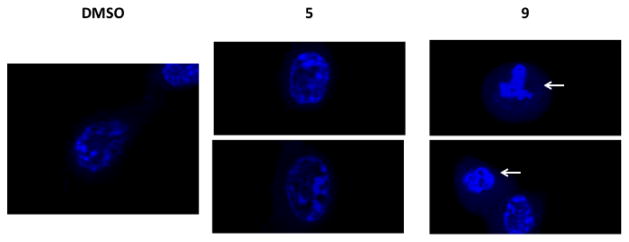
Visualization of HCT-116 cells treated with DMSO (24 hr; 1%), 5 (24 hr; 10 μM) or 9 (24 hr; 10 μM). Nuclei are stained with Hoechst 33342 dye and visualized with a 100X objective. White arrows indicate chromosome condensation (pyknosis).

Synthesis of trioxazole-thiazole fragment (4) Conditions: a) TMSCH2N2, Benzene/MeOH (3:1), 98%; b) Ser(Bzl)-OMe, TBTU, iPr2NEt, CH2Cl2, 2 steps yield: 90% for 1, 95% for 2, and 92% for 3; c) H2, Pd/C, EtOH; d) DAST, CH2Cl2 / K2CO3; e) DBU, BrCCl3, CH2Cl2, 3 steps yield: 85% for 1 and 2, 70% for 3; f) LiOH, MeOH; g) NH4OH, MeOH, ultrasound; h) Lawesson’s reagent, DME, 55%, 2 steps; i) Bromoketo Phenyloxazole, KHCO3, DME; j) TFAA, pyridine, DME, 72%, 2 steps
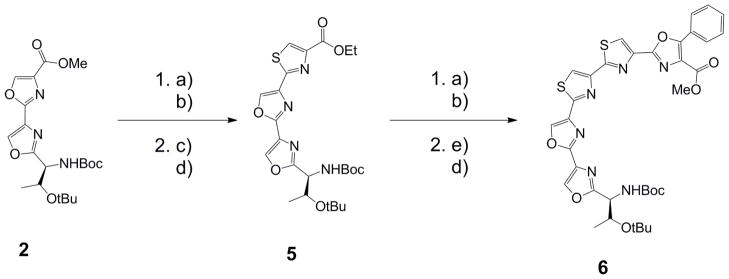
Synthesis of dioxazole-dithiazole fragment (6) Conditions: a) NH4OH, MeOH, ultrasound; b) Lawesson’s reagent, DME, 2 steps yield: 77% for 5, 70% for 6; c) BrCH2COCO2Et, KHCO3, DME; d) TFAA, pyridine, DME, 2 steps yield: 77% for 5, 69% for 6; e) Bromoketo Phenyloxazole, KHCO3, DME
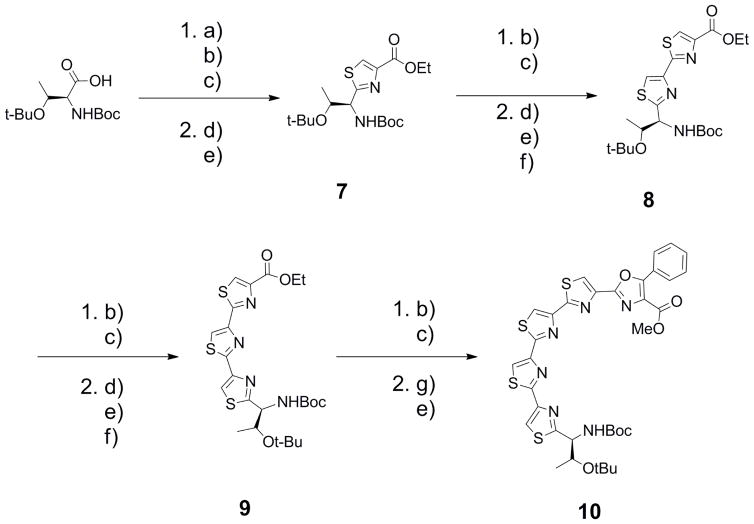
Synthesis of tetrathiazole fragment (10) Conditions: a) TMSCH2N2l Benzene/MeOH (3:1); b) NH4OH, MeOH, ultrasound; c) Lawesson’s reagent, DME, 2 steps yield: 60% for 7, 53% for 8, 73% for 9 and 73% for 10; d) BrCH2COCO2Et, KHCO3, DME; e) TFAA, pyridine, DME, 2 steps yield: 78% for 7, 88% for 10; f) NaOEt, EtOH, 3 steps yield: 97% for 8, 87% for 9; g) Bromoketo Phenyloxazole, KHCO3, DME
References
-
- Baumann M, Bazendale IR, Ley SV, Nikbin N. Beilstein J Org Chem. 2011;7:422–495. - PMC - PubMed
- Boger DL. Patent application: PCT/US2007/019471/ US2010/0075931 A1. 2012;12:310, 474.
- Dang Q, Yan L, Cashion DK, Kasibhatla SR, Jiang T, Taplin F, Jacintho JD, Li H, Sun Z, Fan Y, DaRe J, Tian F, Li W, Gibson T, Lemus R, van Poelje PD, Potter SC, Erion MD. J Med Chem. 2011;54:153–165. - PubMed
- Dosa PI, Ruble JC, Fu GC. J Org Chem. 1997;62:444–445. - PubMed
- Duchler M. J Drug Target. 2012;20:389–400. - PubMed
- Hughes RA, Moody CJ. Angewandte Chemie International Edition. 2007;46:7930–7954. - PubMed
- Wagner B, Schumann D, Linne U, Koert U, Marahiel MA. J Am Chem Soc. 2006;128:10513–10520. - PubMed
- Sivonen K, Leikoski N, Fewer DP, Jokela J. Appl Microbiol Biotechnol. 2012;86:1213–1225. - PMC - PubMed
-
- Smith RA, Barbosa J, Blum CL, Bobko MA, Caringal YV, Dally R, Johnson JS, Katz ME, Kennure N, Kingery-Wood J, Lee W, Lowinger TB, Lyons J, Marsh V, Rogers DH, Swartz S, Walling T, Wild H. Bioorg Med Chem Lett. 2001;11:2775–2778. - PubMed
- Davis MR, Singh EK, Wahyudi H, Alexander LD, Kunicki J, Nazarova LA, Fairweather KA, Giltrap AM, Jolliffe KA, McAlpine SR. Tetrahedron. 2012;68:1029–1051. - PMC - PubMed
- Singh E, Ramsey DM, McAlpine SR. Org Lett. 2012;14:1198–1201. - PubMed
-
- Biron E, Chatterjee J, Kessler H. Organic Letters. 2006;8:2417–2420. - PubMed
-
- Haberhauer G, Drosdow E, Oeser T, Rominger F. Tetrahedron. 2008;64:1853–1859.
-
- Ma M, Cheng Y, Xu Z, Xu P, Qu H, Fang Y, Xu T, Wen L. European Journal of Medicinal Chemistry. 2007;42:93–98. - PubMed
Grants and funding
LinkOut - more resources
Full Text Sources
Other Literature Sources
