. 2013 May;12(5):761-74.
doi: 10.1128/EC.00073-13. Epub 2013 Mar 22.

The transcriptional response of Cryptococcus neoformans to ingestion by Acanthamoeba castellanii and macrophages provides insights into the evolutionary adaptation to the mammalian host

Affiliations

The transcriptional response of Cryptococcus neoformans to ingestion by Acanthamoeba castellanii and macrophages provides insights into the evolutionary adaptation to the mammalian host

Lorena da S Derengowski et al. Eukaryot Cell. 2013 May.

Abstract

Virulence of Cryptococcus neoformans for mammals, and in particular its intracellular style, was proposed to emerge from evolutionary pressures on its natural environment by protozoan predation, which promoted the selection of strategies that allow intracellular survival in macrophages. In fact, Acanthamoeba castellanii ingests yeast cells, which then can replicate intracellularly. In addition, most fungal factors needed to establish infection in the mammalian host are also important for survival within the amoeba. To better understand the origin of C. neoformans virulence, we compared the transcriptional profile of yeast cells internalized by amoebae and murine macrophages after 6 h of infection. Our results showed 656 and 293 genes whose expression changed at least 2-fold in response to the intracellular environments of amoebae and macrophages, respectively. Among the genes that were found in both groups, we focused on open reading frame (ORF) CNAG_05662, which was potentially related to sugar transport but had no determined biological function. To characterize its function, we constructed a mutant strain and evaluated its ability to grow on various carbon sources. The results showed that this gene, named PTP1 (polyol transporter protein 1), is involved in the transport of 5- and 6-carbon polyols such as mannitol and sorbitol, but its presence or absence had no effect on cryptococcal virulence for mice or moth larvae. Overall, these results are consistent with the hypothesis that the capacity for mammalian virulence originated from fungus-protozoan interactions in the environment and provide a better understanding of how C. neoformans adapts to the mammalian host.


Figures
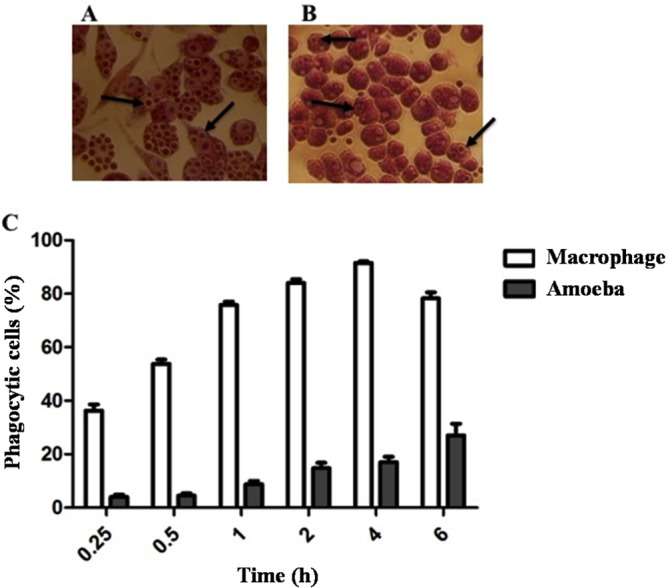
Fig 1
Fig 1
Kinetics of C. neoformans phgocytosis by amoeba and murine macrophages over 6 h. Yeast cells were incubated with amoebae (28°C) or macrophages (37°C and 5% CO2 atmosphere) in a ratio of five C. neoformans yeast cells per host cell. Microphotographs (×40) representing results 6 h postinfection of macrophages (A) and amoebae (B) with C. neoformans are shown above the histogram. The arrows show internalized fungal yeast cells. (C) Percentages of macrophages (white bars) and amoebae (gray bars) containing internalized C. neoformans. These experiments were performed in quadruplicate (mean ± standard error of the mean [SEM]).
Fig 2
Fig 2
Classification of C. neoformans genes modulated after intracellular residence in A. castellanii and murine macrophages. C. neoformans genes induced (A) or repressed (B) after internalization by A. castellanii. C. neoformans genes induced (C) or repressed (D) after internalization by murine macrophages.
Fig 3
Fig 3
Validation of microarray data by real-time PCR. C. neoformans gene expression after 6 h interaction with A. castellanii (A) and murine macrophages (B). The products of the genes shown are as follows: THS, trehalose synthase; CAT3, catalase 3; GBE, 1,4-α-glucan branching enzyme; PLC, phosphoryl inositol sphingolipid phospholipase C; MLS, malate synthase; PTP1, polyol transporter protein 1; ERG11, lanosterol 14 α-demethylase; ERG3, C-5 sterol desaturase; and AOX, alternative oxidase.
Fig 4
Fig 4
C. neoformans reprogramming of carbon metabolism in response to phagocytosis by amoeba and macrophages. The metabolic pathway scheme shows the differential modulation of several transcripts of enzymes active in gluconeogenesis, glyoxylate cycle, and β-oxidation after C. neoformans internalization by amoebae (A) and macrophages (M).
Fig 5
Fig 5
Growth rate of KN99α (wild type [W/T]), mutant (Mut), and complemented (Rec) strains of C. neoformans in media with different polyols as sole carbon sources. Yeast cells were cultivated at 30°C for 72 h, and the growth rate was verified by monitoring for color change in the wells and by measuring the variation of optical density at 492 nm as described for the phenotype microarray assay. The t test was performed using GraphPad Prism 5. *, P < 0.05.
Fig 6
Fig 6
Capsule diameter of C. neoformans KN99α (wild-type [W/T]) and mutant (Mut) strains grown in glucose or mannitol as unique carbon sources. The capsule diameter was calculated as the difference between the whole-cell size and the cell body size. The capsule size of 150 yeast cells was measured for each condition. The t test was performed using GraphPad Prism 5. *, P < 0.05.
Fig 7
Fig 7
Assessment of in vivo virulence of the ptp1Δ mutant strain. (A) Survival curve of mice infected with KN99α (wild-type [W/T]) and mutant (Mut) strains of C. neoformans. BALB/c mice (10 per group) were intratracheally infected with 106 yeast cells, and mortality was monitored daily. No statistical difference was found by comparing the curves for wild-type and mutant strains. (B and C) Survival curves of Galleria mellonella infected with the KN99α (W/T) and mutant (Mut) strains of C. neoformans. Larvae were infected with 104 yeast cells and maintained at 25°C (A) or 37°C (B). (D and E) Tissue burden of C. neoformans wild-type (W/T) and mutant (Mut) strains. BALB/c mice (five per group) were infected with 106 cells intratracheally, and organs were removed after 10 days of infection. Serial dilutions were plated to determine the number of yeast cells present in the tissue homogenates, expressed by CFU per gram of lung (D) or brain (E).

References

    1. Ellis DH, Pfeiffer TJ. 1990. Ecology, life cycle, and infectious propagule of Cryptococcus neoformans. Lancet 336:923–925 - PubMed
    1. Hogan LH, Klein BS, Levitz SM. 1996. Virulence factors of medically important fungi. Clin. Microbiol. Rev. 9:469–488 - PMC - PubMed
    1. Alanio A, Desnos-Ollivier M, Dromer F. 9 August 2011. Dynamics of Cryptococcus neoformans-macrophage interactions reveal that fungal background influences outcome during cryptococcal meningoencephalitis in humans. mBio 2(4):e00158-11 doi:10.1128/mBio.00158-11 - DOI - PMC - PubMed
    1. Fan W, Kraus PR, Boily MJ, Heitman J. 2005. Cryptococcus neoformans gene expression during murine macrophage infection. Eukaryot. Cell 4:1420–1433 - PMC - PubMed
    1. Levitz SM, Nong SH, Seetoo KF, Harrison TS, Speizer RA, Simons ER. 1999. Cryptococcus neoformans resides in an acidic phagolysosome of human macrophages. Infect. Immun. 67:885–890 - PMC - PubMed

MeSH terms