


Dynamic TIMI risk score for STEMI
- PMID: 23525425
- PMCID: PMC3603245
- DOI: 10.1161/JAHA.112.003269
Dynamic TIMI risk score for STEMI
Abstract
Background: Although there are multiple methods of risk stratification for ST-elevation myocardial infarction (STEMI), this study presents a prospectively validated method for reclassification of patients based on in-hospital events. A dynamic risk score provides an initial risk stratification and reassessment at discharge.
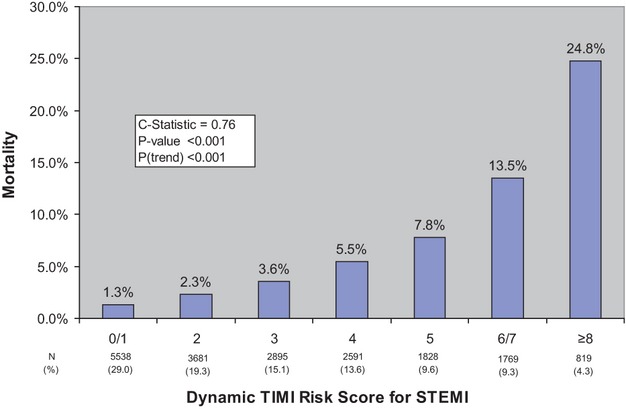
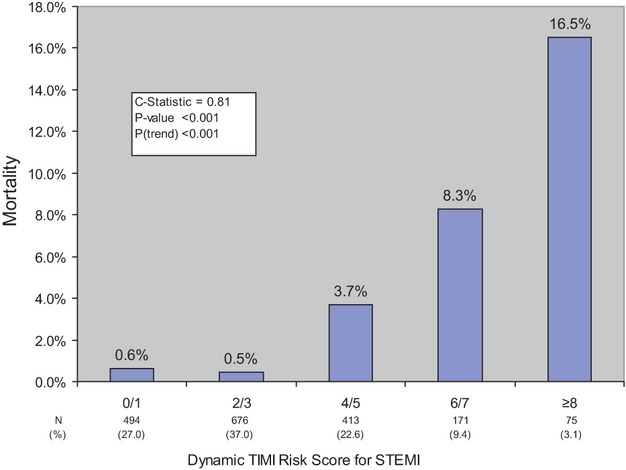
Methods and results: The dynamic TIMI risk score for STEMI was derived in ExTRACT-TIMI 25 and validated in TRITON-TIMI 38. Baseline variables were from the original TIMI risk score for STEMI. New variables were major clinical events occurring during the index hospitalization. Each variable was tested individually in a univariate Cox proportional hazards regression. Variables with P<0.05 were incorporated into a full multivariable Cox model to assess the risk of death at 1 year. Each variable was assigned an integer value based on the odds ratio, and the final score was the sum of these values. The dynamic score included the development of in-hospital MI, arrhythmia, major bleed, stroke, congestive heart failure, recurrent ischemia, and renal failure. The C-statistic produced by the dynamic score in the derivation database was 0.76, with a net reclassification improvement (NRI) of 0.33 (P<0.0001) from the inclusion of dynamic events to the original TIMI risk score. In the validation database, the C-statistic was 0.81, with a NRI of 0.35 (P=0.01).
Conclusions: This score is a prospectively derived, validated means of estimating 1-year mortality of STEMI at hospital discharge and can serve as a clinically useful tool. By incorporating events during the index hospitalization, it can better define risk and help to guide treatment decisions.
Figures
References
-
- Rouleau JL, Talajic M, Sussex B, Potvin L, Warnica W, Davies RF, Gardner M, Stewart D, Plante S, Dupuis R, Lauzon C, Ferguson J, Mikes E, Balnozan V, Savard P. Myocardial infarction patients in the 1990s—their risk factors, stratification and survival in Canada: the Canadian Assessment of Myocardial Infarction (CAMI) Study. J Am Coll Cardiol. 1996; 27:1119-1127 - PubMed
-
- Becker RC, Burns M, Gore JM, Spencer FA, Ball SP, French W, Lambrew C, Bowlby L, Hilbe J, Rogers WJ. Early assessment and in‐hospital management of patients with acute myocardial infarction at increased risk for adverse outcomes: a nationwide perspective of current clinical practice. The National Registry of Myocardial Infarction (NRMI‐2) Participants. Am Heart J. 1998; 135:786-796 - PubMed
-
- Morrow DA, Antman EM, Charlesworth A, Cairns R, Murphy SA, de Lemos JA, Giugliano RP, McCabe CH, Braunwald E. TIMI risk score for ST‐elevation myocardial infarction: a convenient, bedside, clinical score for risk assessment at presentation: an intravenous nPA for treatment of infarcting myocardium early II trial substudy. Circulation. 2000; 102:2031-2037 - PubMed
-
- Granger CB, Goldberg RJ, Dabbous O, Pieper KS, Eagle KA, Cannon CP, Van De Werf F, Avezum A, Goodman SG, Flather MD, Fox KA. Predictors of hospital mortality in the global registry of acute coronary events. Arch Intern Med. 2003; 163:2345-2353 - PubMed
-
- De Luca G, Suryapranata H, van ‘t Hof AW, de Boer MJ, Hoorntje JC, Dambrink JH, Gosselink AT, Ottervanger JP, Zijlstra F. Prognostic assessment of patients with acute myocardial infarction treated with primary angioplasty: implications for early discharge. Circulation. 2004; 109:2737-2743 - PubMed
Publication types
MeSH terms
LinkOut - more resources
Full Text Sources
Other Literature Sources
Medical
