


Chitinolytic assay of indigenous Trichoderma isolates collected from different geographical locations of Chhattisgarh in Central India
- PMID: 23526575
- PMCID: PMC3602610
- DOI: 10.1186/2193-1801-1-73
Chitinolytic assay of indigenous Trichoderma isolates collected from different geographical locations of Chhattisgarh in Central India
Abstract
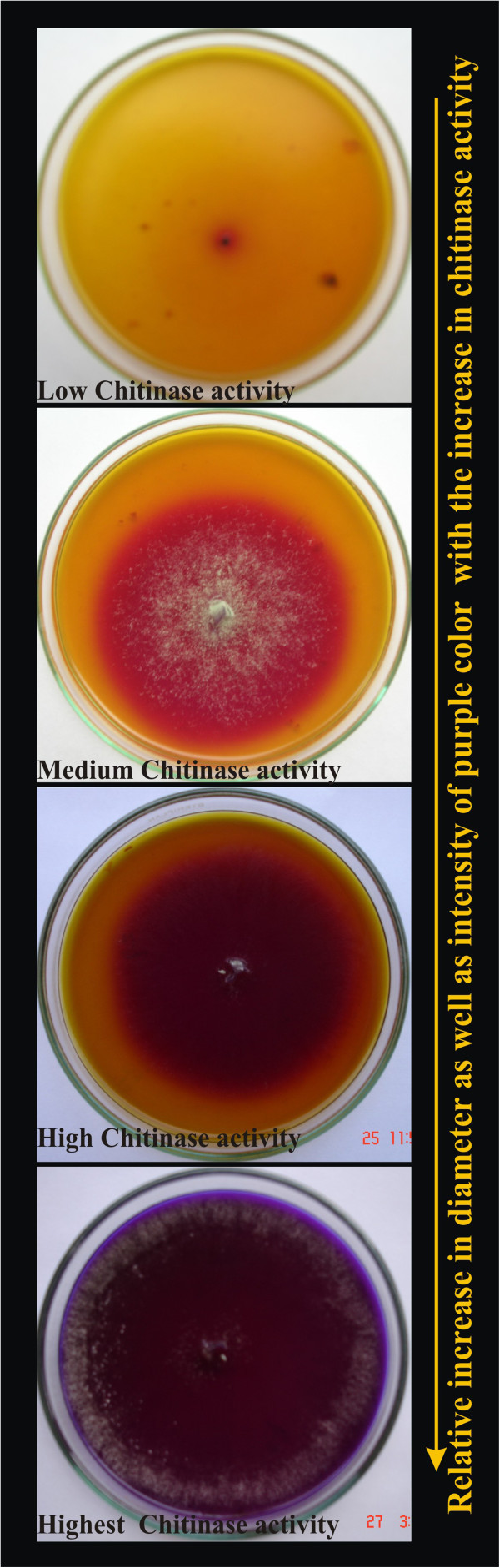
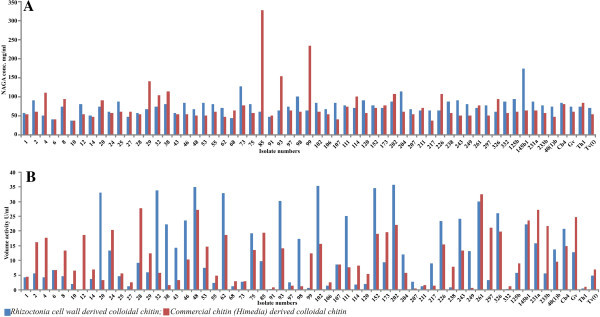
Chitin is the second most abundant polymer in nature after cellulose and plays a major role in fungal cell walls. As a producer of variety of chitinase enzymes Trichoderma has become an important means of biological control of fungal diseases. A simple and sensitive method based on the use of basal medium with colloidal chitin as sole carbon source supplemented with Bromo cresol purple (pH indicator dye) is proposed to evaluate large populations of Trichoderma for chitinase activity. The soluble substrate with pH indicator dye (Bromo cresol purple, BCP) for the assay of chitinase activity on solid media is sensitive, easy, reproducible semi-quantitative enzyme diffusion plate assay and economic option to determine chitinases. Colloidal chitin derived from Rhizoctonia cell wall and commercial chitin included as a carbon source in broth also allowed selection and comparison of chitinolytic and exochitinase activity in Trichoderma spectrophotometrically. Released N-acetyl-β--D-glucosamine (NAGA) ranged from 37.67 to 174.33 mg/ml and 37.67 to 327.67 mg/ml and p-nitrophenol (pNP) ranged from 0.17 to 35.78 X 10(-3) U/ml and 0.62 to 32.6 X 10(-3) U/ml) respectively with Rhizoctonia cell wall and commercial chitin derived colloidal chitin supplemented broth.
Keywords: Bromo cresol purple; Chitin; N-acetyl-β-D-glucosamine; Trichoderma; Volume activity; p-nitrophenol.
Figures
References
-
- Harman GE, Hayes CK, Lorito M, Broadway RM, Di Pietro A, Tronsmo A. Chitinolytic enzymes of Trichoderma harzianum: purification of chitobiosidase and endochitinase. Phytopathol. 1993;83:313–318. doi: 10.1094/Phyto-83-313. - DOI
-
- Samuels GJ. Trichoderma: a review of biology and systematics of the genus. Mycol Res. 1996;100:923–935. doi: 10.1016/S0953-7562(96)80043-8. - DOI
-
- Spiegel Y, Chet I. Evaluation of Trichoderma spp. as a biocontrol agent against soil borne fungi and plant–parasitic nematodes in Israel. Int Pest Manag Rev. 1998;3:169–175. doi: 10.1023/A:1009625831128. - DOI
-
- Kubicek CP, Mach RL, Peterbauer CK, Lorito M. Trichoderma: from genes to biocontrol. J Plant Path. 2001;83:11–23.
LinkOut - more resources
Full Text Sources
Miscellaneous
