


Community participation and sustainability--evidence over 25 years in the Västerbotten Intervention Programme
- PMID: 23528041
- PMCID: PMC3525921
- DOI: 10.3402/gha.v5i0.19166
Community participation and sustainability--evidence over 25 years in the Västerbotten Intervention Programme
Abstract
Background: Selection bias and declining participation rates are of concern in many long-term epidemiological studies. The Västerbotten Intervention Programme (VIP) was launched in 1985 as a response to alarming reports on elevated cardiovascular disease (CVD) mortality in Västerbotten County in Northern Sweden. The VIP invites women and men to a health examination and health counselling during the year of their 40th, 50th, and 60th birthdays.
Objective: To evaluate trends in participation rates and determinants of participation in the VIP from 1990 to 2006.
Design: Registry data on socio-economic status from Statistics Sweden, and mortality and hospitalisation data from the National Board of Health and Welfare, both covering the whole Swedish population, were linked to the VIP and analysed for participants and non-participants.
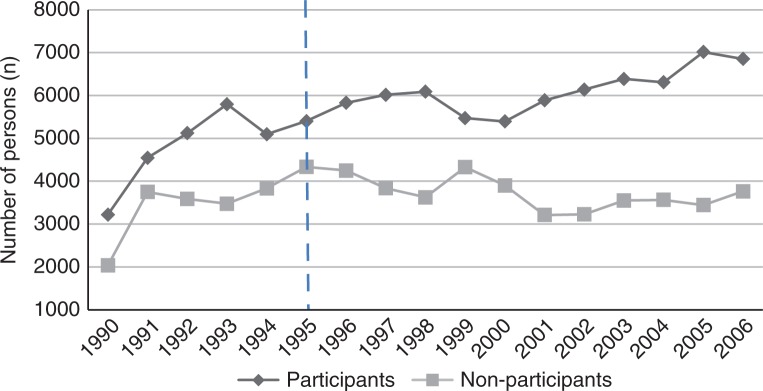
Results: During 1990-2006, 117,710 individuals were eligible to participate in the VIP, and 40,472 of them were eligible to participate twice. There were 96,560 observations for participants and 61,622 for non-participants. The overall participation rate increased from 56 to 65%. Participants and non-participants had minimal differences in education and age. Initial small differences by sex and degree of urban residence decreased over time. Despite an increasing participation rate in all groups, those with low income or who were single had an approximately 10% lower participation rate than those with high or medium-income or who were married or cohabitating.
Conclusion: Sustainability of the VIP is based on organisational integration into primary health care services and targeting of the entire middle-aged population. This enables the programme to meet population expectations of health promotion and to identify high-risk individuals who are then entered into routine preventive health care services. This has the potential to increase participation rates, to minimise social selection bias, and to reinforce other community-based interventions.
Keywords: community participation; health surveys; intervention; primary health care; selection bias.
Figures
References
-
- Beaglehole R, Ebrahim S, Reddy S, Voute J, Leeder S. Prevention of chronic diseases: a call to action. Lancet. 2007;370:2152–7. - PubMed
-
- WHO. Cardiovascular diseases fact sheet N 317. 2011. Available from: http://www.who.int/mediacentre/factsheets/fs317/en/index.html [cited 20 June 2012]
-
- Mackenbach JP, Kunst AE, Cavelaars AE, Groenhof F, Geurts JJ. Socioeconomic inequalities in morbidity and mortality in western Europe. The EU Working Group on Socioeconomic Inequalities in Health. Lancet. 1997;349:1655–9. - PubMed
-
- The National Board of Health and Wellfare. Statistical databases – causes of death statistics [database on the Internet] 2011. Available from: http://www.socialstyrelsen.se/publikationer2011/2011-7-6 [cited 20 June 2012]
-
- Wall S, Rosen M, Nystrom L. The Swedish mortality pattern: a basis for health planning? Int J Epidemiol. 1985;14:285–92. - PubMed
Publication types
MeSH terms
LinkOut - more resources
Full Text Sources
Medical
