. 2013 May;33(4):575-85.
doi: 10.1007/s10571-013-9931-x. Epub 2013 Mar 26.

Endothelial transient receptor potential conical channel (TRPC)-3 activation induces vasogenic edema formation in the rat piriform cortex following status epilepticus

Affiliations

Endothelial transient receptor potential conical channel (TRPC)-3 activation induces vasogenic edema formation in the rat piriform cortex following status epilepticus

Hea Jin Ryu et al. Cell Mol Neurobiol. 2013 May.

Abstract

Transient receptor potential canonical channel (TRPC) is a nonselective cation channel permeable to Ca(2+), which express in many cell types, including neurons. However the alterations in TRPC receptor expressions in response to status epilepticus (SE) have not been explored. Therefore, the present study was designated to elucidate the roles of TRPC3 in neuronal death and vasogenic edema within the rat piriform cortex (PC) following SE. In non-SE animals, TRPC3 immunoreactivity was abundantly detected in the PC. Following SE, TRPC3 immunoreactivity was increased in neurons. Furthermore, TRPC3 expression was detected in endothelial cells that did not contain it in non-SE animals. Loss of SMI-71 (a blood-brain barrier antigen) immunoreactivity was also observed in TRPC3 positive endothelial cells. In addition, FJB positive neurons and vasogenic edema were noticeably detected in the PC. To directly determine whether TRPC3 activation is correlated to SE-induced vasogenic edema formation and neuronal damages in the PC, the effect of Pyr-3 (a TRPC3 antagonist) on SE-induced insults were investigated. Pyr-3 infusion effectively attenuated vasogenic edema in the PC as compared to the vehicle. Therefore, our findings indicate that TRPC3 activation/overexpression induced by SE may involve BBB disruption and neuronal damages in the rat PC following SE. Therefore, the present study was TRPC3 may play an important role in SE-induced vasogenic edema formation through BBB disruptions in the rat PC.


Figures
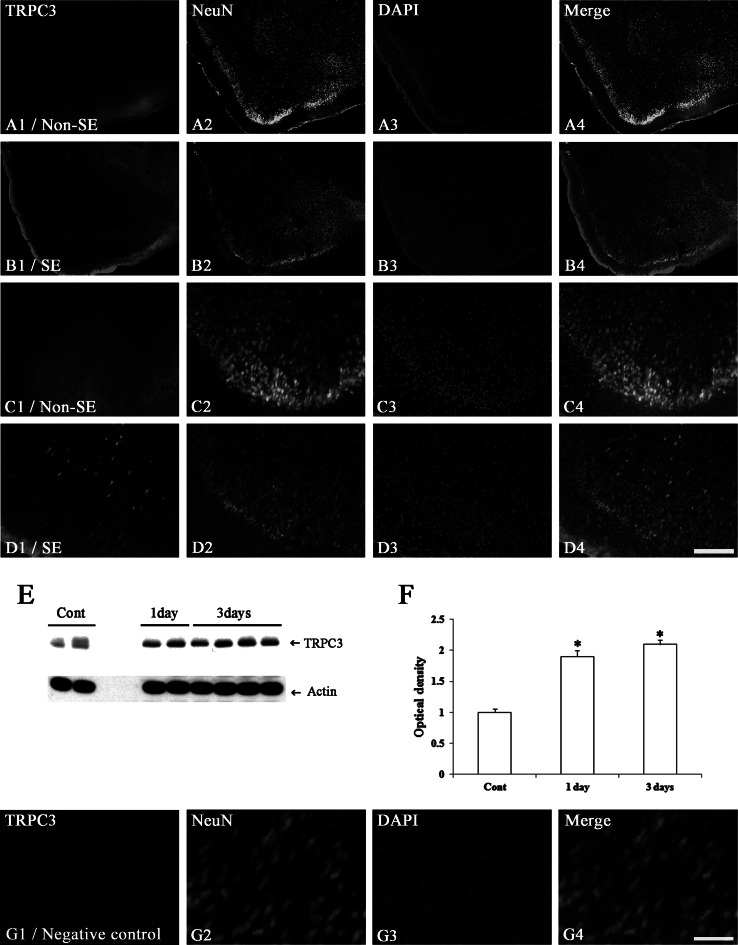
Fig. 1
Fig. 1
TRPC3 expression in PC following SE. As compared to non-SE animals (a, c), SE animals increase TRPC3 expression in the PC at 3 days after SE (b, d). c and d are high magnification of (a) and (b), respectively. Panels 1, 2, 3, and 4 are TRPC3, NeuN, DAPI, and merge images, respectively. Bar = 400 (a, c) and 50 μm (b, d). Western blot data are consistent with immunohistochemical studies (e). f Quantitative analysis of TRPC3 protein expression in the PC following SE (mean ± S.E.M). Significant differences from vehicle-treated animals (*p < 0.05). g Negative controls data for TRPC3 antibody. Pre-incubation with control peptide results in the absence of immunoreactivity in any structures Bar = 12.5 μm (b, d)
Fig. 2
Fig. 2
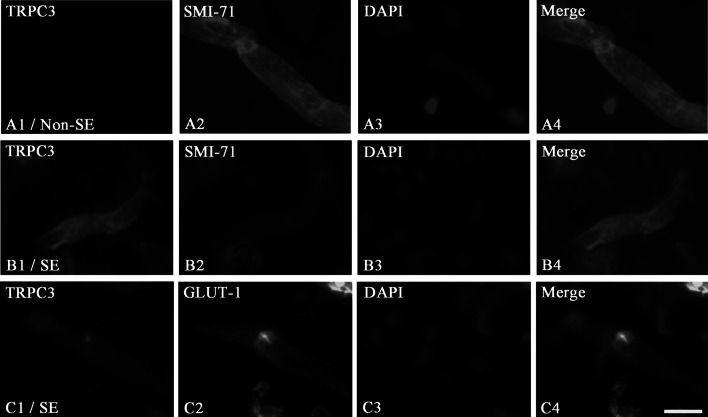
TRPC3 expression in endothelial cells at 3 days after SE. As compared to non-SE animals (a), SE increases endothelial TRPC3 expression, but reduces SMI-71 immunoreactivity (b, c). Panels 1, 2, 3, and 4 are TRPC3, SMI-71 (or GLUT-1 in (c)), DAPI counterstaining, and merge images, respectively. Bar = 12.5 μm
Fig. 3
Fig. 3
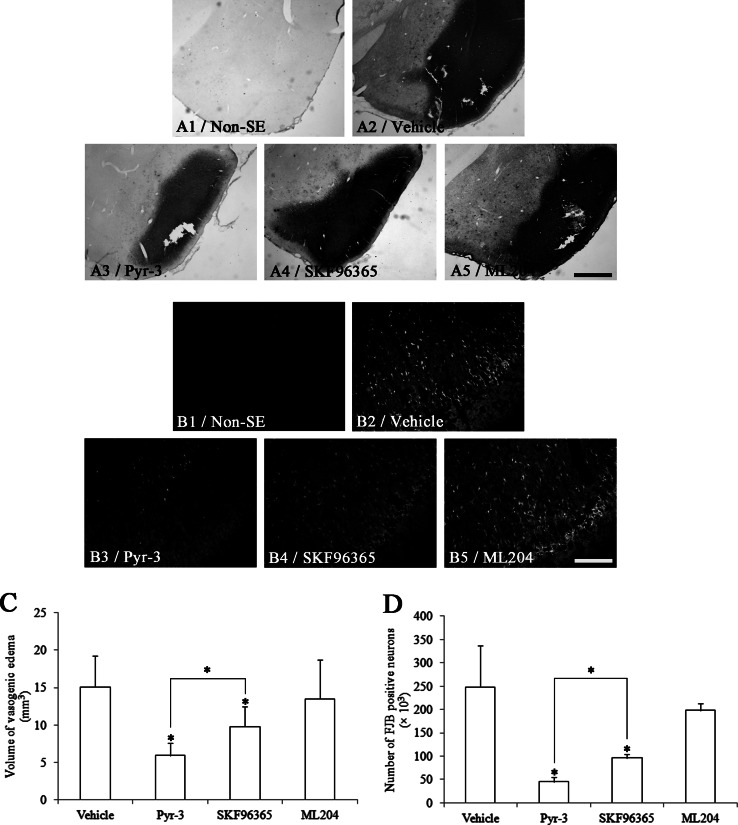
Effects of Pyr-3, SKF96365 and ML204 on vasogenic edema (a, c) and neuronal death (b, d) in the PC at 3 days after SE. a Representative photos showing the effects of Pyr-3, SKF96365 and ML204 on vasogenic edema. Bar = 400 μm. b Representative photos showing the effects of Pyr-3, SKF96365 and ML204 on SE-induced neuronal damage. Bar = 50 μm. c Quantitative analysis of volume of vasogenic edema in the PC following SE (mean ± S.E.M). Significant differences from vehicle-treated animals (*p < 0.05). d Quantitative analysis of number of FJB positive neurons in the PC following SE (mean ± S.E.M). Significant differences from vehicle-treated animals (*p < 0.05)
Fig. 4
Fig. 4
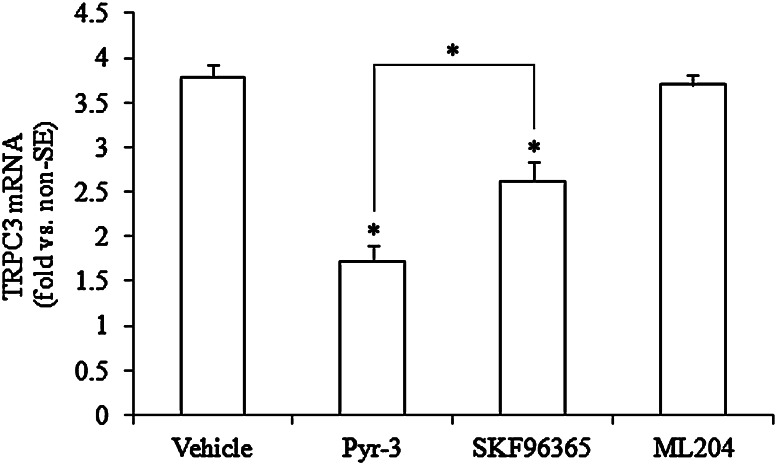
qRT-PCR data showing the effects of Pyr-3, SKF96365 and ML204 on TRPC3 mRNA expression at 3 days after SE (mean ± S.E.M). Significant differences from vehicle-treated animals (*p < 0.05)
Fig. 5
Fig. 5
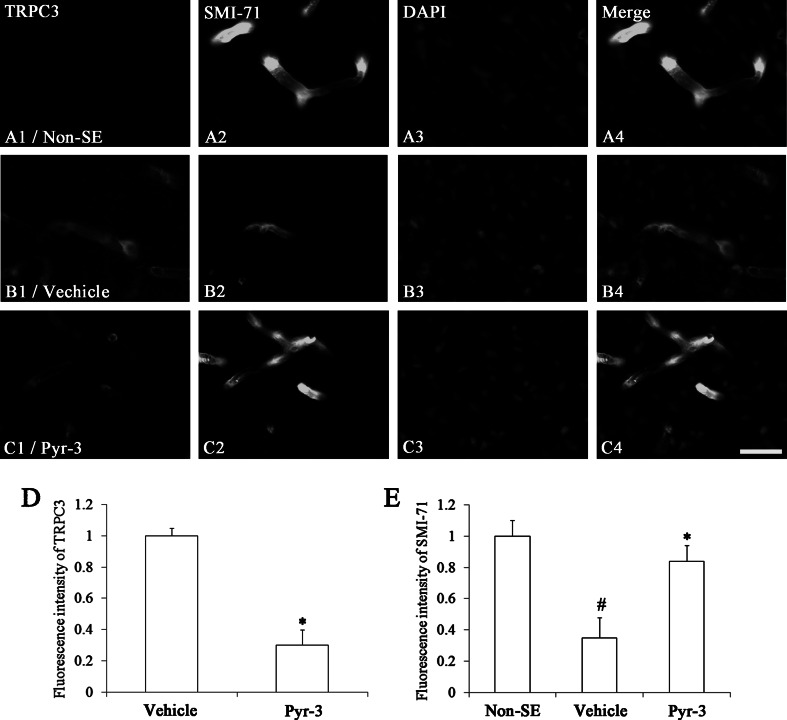
Effect of Pyr-3 on SMI-71 immunoreactivity in endothelial cells at 3 days after SE. a non-SE animals; b vehicle-treated animals; c Pyr-3-treated animals. Panels 1, 2, 3, and 4 are TRPC3, SMI-71, DAPI counterstaining, and merge images, respectively. Bar = 12.5 μm. d, e Quantitative analyses of fluorescence intensity of TRPC3 (d) and SMI-71 (e) in the PC following SE (mean ± S.E.M). Significant differences from non-SE (# p < 0.05) or vehicle-treated animals (*p < 0.05)

References

    1. Ahmmed GU, Malik AB (2005) Functional role of TRPC channels in the regulation of endothelial permeability. Pflugers Arch 451:131–142 - DOI - PubMed
    1. Amaral MD, Pozzo-Miller L (2007) BDNF induces calcium elevations associated with IBDNF, a nonselective cationic current mediated by TRPC channels. J Neurophysiol 98:2476–2482 - DOI - PMC - PubMed
    1. Ates N, van Luijtelaar EL, Drinkenburg WH, Vossen JM, Coenen AM (1992) Effects of loreclezole on epileptic activity and on EEG and behaviour in rats with absence seizures. Epilepsy Res 13:43–48 - DOI - PubMed
    1. Bedi KS (1991) Effects of undernutrition during early life on granule cell numbers in the rat dentate gyrus. J Comp Neurol 311:425–433 - DOI - PubMed
    1. Beech DJ, Bahnasi YM, Dedman AM, Al-Shawaf E (2009) TRPC channel lipid specificity and mechanisms of lipid regulation. Cell Calcium 45:583–588 - DOI - PMC - PubMed

Publication types

Substances

LinkOut - more resources