


What are the causes for failures of primary hip arthroplasties in France?
- PMID: 23529633
- PMCID: PMC3825891
- DOI: 10.1007/s11999-013-2935-5
What are the causes for failures of primary hip arthroplasties in France?
Abstract
Background: There are no large database cohorts describing the causes for failure of primary THAs in France. Because implants and causes for revision vary between national registers, it is important to obtain data from all countries.
Questions/purposes: We therefore determined (1) the mechanisms of failure of primary THAs, (2) their order of appearance with time, (3) the types of surgical techniques and implant designs used to perform revision THAs, and (4) 90-day complications after revision THA in France.
Methods: We prospectively collected data on all 2107 first-time revision THAs from 30 tertiary centers from January 1, 2010, to December 31, 2011. A dual-mobility liner had been used in 251 hips. Mean time from primary procedure to revision THA was 11.2 years (range, 1 day to 42 years). Mean age at revision was 70 years (range, 17-104 years).
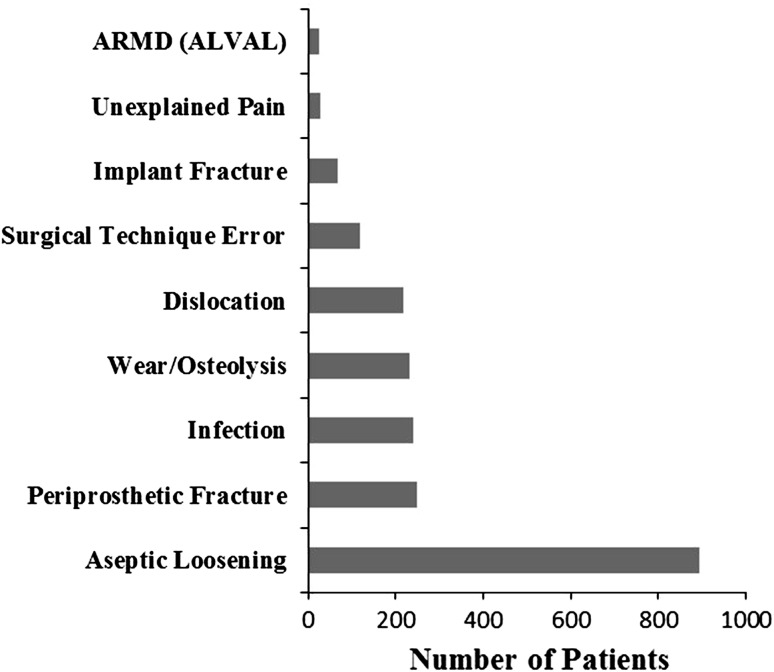
Results: The causes for revision were mechanical loosening (42%), periprosthetic fracture (12%), infection (11%), wear/osteolysis (11%), dislocation (10%), surgical technique error (6%), and implant fracture (3%). The most common type of revision procedure was all-component revision (49%). A dual-mobility liner was used in 1184 hips (62%). The 90-day dislocation rate was less than 4%, and mortality rate was 1.6%.
Conclusions: Contrary to other reported data, we found dislocation was not the main cause for failure of primary THAs but was still the more frequent early complication after revision. These findings might be related to the use of dual-mobility sockets in more than 10% of primary THAs and more than 60% of revision THAs.
Figures
References
-
- Australian Orthopaedic Association. National Joint Replacement Report 2011. Available at: http://www.dmac.adelaide.edu.au/aoanjirr/publications. Accessed October 25, 2012.
-
- Charnley J. Low Friction Arthroplasty of the Hip: Theory and Practice. New York, NY: Springer; 1979.
-
- Dripps RD. New classification of physical status. Anesthesiology. 1963;24:111.
MeSH terms
LinkOut - more resources
Full Text Sources
Other Literature Sources
Medical
