


Elevated risk of prostate cancer among men with Lynch syndrome
- PMID: 23530095
- PMCID: PMC3641694
- DOI: 10.1200/JCO.2012.44.1238
Elevated risk of prostate cancer among men with Lynch syndrome
Abstract
Purpose: Prostate cancer has been described as a component tumor of Lynch syndrome (LS), with tumors obtained from mutation carriers demonstrating the DNA mismatch repair deficiency phenotype. Previous studies quantifying prostate cancer risk in LS have provided conflicting results.
Methods: We examined cancer histories of probands and their first- through fourth-degree relatives for 198 independent mutation-positive LS families enrolled in two US familial cancer registries. Modified segregation analysis was used to calculate age-specific cumulative risk or penetrance estimates, with accompanying Wald-type CIs. Cumulative lifetime risks and hazard ratio (HR) estimates for prostate cancer were calculated and compared with those of the general population.
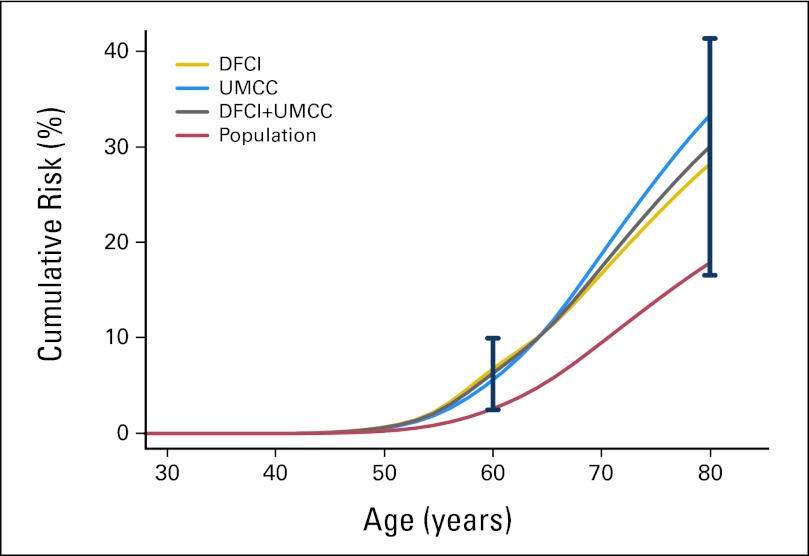
Results: Ninety-seven cases of prostate cancer were observed in 4,127 men. Median age at prostate cancer diagnosis was 65 years (range, 38 to 89 years), with 11.53% of affected individuals diagnosed before age 50 years. The cumulative risk of prostate cancer at ages 60 and 80 years was 6.30% (95% CI, 2.47 to 9.96) and 30.0% (95% CI, 16.54 to 41.30), as compared with the population risk of 2.59% and 17.84%, respectively. The overall prostate cancer HR among carriers was 1.99 (95% CI, 1.31 to 3.03).
Conclusion: The cumulative lifetime risk of prostate cancer in individuals with LS is two-fold higher than in the general population and is slightly higher in carriers diagnosed before age 60 years (HR, 2.48; 95% CI, 1.34 to 4.59). These estimates are clinically valuable to quantify risk for both patients and providers.
Conflict of interest statement
Authors' disclosures of potential conflicts of interest and author contributions are found at the end of this article.
Figures
Comment in
-
Is prostate cancer a Lynch syndrome cancer?Asian J Androl. 2013 Sep;15(5):588-9. doi: 10.1038/aja.2013.87. Epub 2013 Jul 1. Asian J Androl. 2013. PMID: 23817498 Free PMC article. No abstract available.
References
-
- Aarnio M, Mecklin JP, Aaltonen LA, et al. Life-time risk of different cancers in hereditary non-polyposis colorectal cancer (HNPCC) syndrome. Int J Cancer. 1995;64:430–433. - PubMed
-
- Aarnio M, Sankila R, Pukkala E, et al. Cancer risk in mutation carriers of DNA-mismatch-repair genes. Int J Cancer. 1999;81:214–218. - PubMed
-
- Bonadona V, Bonaïti B, Olschwang S, et al. Cancer risks associated with germline mutations in MLH1, MSH2, and MSH6 genes in Lynch syndrome. JAMA. 2011;305:2304–2310. - PubMed
Publication types
MeSH terms
Grants and funding
LinkOut - more resources
Full Text Sources
Other Literature Sources
Medical
