


Large-scale use of the modified checklist for autism in low-risk toddlers
- PMID: 23530174
- PMCID: PMC3608483
- DOI: 10.1542/peds.2012-1525
Large-scale use of the modified checklist for autism in low-risk toddlers
Abstract
Objective: The purpose of the study was to examine use of the Modified Checklist for Autism in Toddlers (M-CHAT) as an autism-specific screening instrument in a large, geographically diverse pediatrics-based sample.
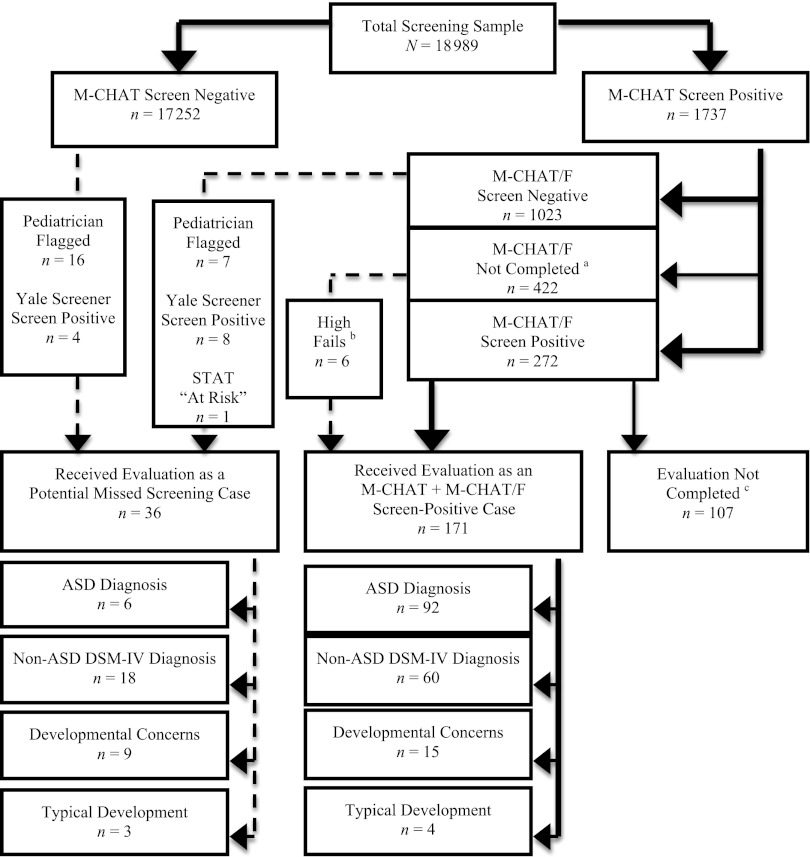
Methods: The M-CHAT and the M-CHAT Follow-Up (M-CHAT/F) were used to screen 18,989 toddlers at pediatric well-child visits in 2 US geographic regions. Pediatricians directly referred children to ascertain potential missed screening cases. Screen-positive children received the M-CHAT/F; children who continued to screen positive after the M-CHAT/F received a diagnostic evaluation.
Results: Results indicated that 54% of children who screened positive on the M-CHAT and M-CHAT/F presented with an autism spectrum disorder (ASD), and 98% presented with clinically significant developmental concerns warranting intervention. An M-CHAT total score cutoff of ≥3 identifies nearly all screen-positive cases, and for ease of scoring the use of only the M-CHAT total score cutoff is recommended. An M-CHAT total score of 7 serves as an appropriate clinical cutoff, and providers can bypass the M-CHAT/F and refer immediately to evaluation and intervention if a child obtains a score of ≥7.
Conclusions: This study provides empirical support for the utility of population screening for ASD with the use of the M-CHAT in a primary care setting. Results suggest that the M-CHAT continues to be an effective screening instrument for ASD when the 2-step screening process is used. The M-CHAT is widely used at pediatric offices, and this study provides updated results to facilitate use and scoring of the M-CHAT by clinical providers.
Figures
References
-
- American Psychiatric Association. Diagnostic and Statistical Manual of Mental Disorders. 4th ed, text revision. Washington, DC: American Psychiatric Association; 2000
-
- Centers for Disease Control and Prevention Prevalence of autism spectrum disorders—autism and developmental disabilities monitoring network, 14 sites, United States, 2008. MMWR Surveill Summ. 2012;61:1–19 - PubMed
-
- Filipek PA, Accardo PJ, Baranek GT, et al. The screening and diagnosis of autistic spectrum disorders. J Autism Dev Disord. 1999;29(6):439–484 - PubMed
-
- Harris SL, Handleman JS. Age and IQ at intake as predictors of placement for young children with autism: a four- to six-year follow-up. J Autism Dev Disord. 2000;30(2):137–142 - PubMed
-
- Howard JS, Sparkman CR, Cohen HG, Green G, Stanislaw H. A comparison of intensive behavior analytic and eclectic treatments for young children with autism. Res Dev Disabil. 2005;26(4):359–383 - PubMed
Publication types
MeSH terms
Grants and funding
LinkOut - more resources
Full Text Sources
Other Literature Sources
