


Predictors of periprosthetic fracture after total knee replacement: an analysis of 21,723 cases
- PMID: 23530873
- PMCID: PMC3639338
- DOI: 10.3109/17453674.2013.788436
Predictors of periprosthetic fracture after total knee replacement: an analysis of 21,723 cases
Abstract
Background and purpose: Periprosthetic fracture is a devastating complication of total knee replacement (TKR). Most published studies have not comprehensively assessed clinical and demographic predictors. We wanted to determine the incidence and predictors of postoperative periprosthetic fracture after primary and revision TKR.
Patients and methods: We used prospectively collected data in the Mayo Clinic Total Joint Registry on all patients who underwent primary or revision TKR at the Mayo Clinic, Rochester, from 1989 through 2008. We assessed incidence of postoperative periprosthetic fractures and modifiable (comorbidity, body mass index) and unmodifiable factors (age, sex, operative diagnosis, ASA class, previous cardiac disease, and previous thromboembolic disease) as predictors of postoperative periprosthetic fractures. We used multivariable-adjusted Cox regression analyses separately for primary and revision TKR.
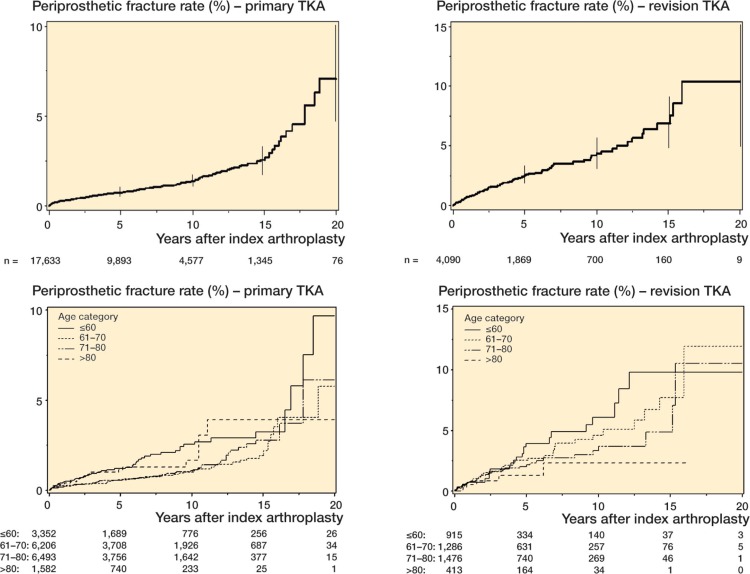
Results: 12,914 patients underwent 17,633 primary TKRs and 3,286 patients underwent 4,090 revision TKRs during the period 1989-2008. 1.1% of patients (188/17,633) after primary TKR and 2.5% of patients (104/4,090) after revision TKR sustained a postoperative periprosthetic fracture on or after postoperative day 1. Older age was associated with lower risk of periprosthetic fractures after primary TKR (p < 0.001). Compared to ≤ 60 years, risk was lower for ages 61-70 years (hazard ratio (HR) = 0.5, 95% confidence interval (CI): 0.3-0.7)) and 71-80 years (HR = 0.6, CI: 0.4-0.8), but not for age > 80 years (HR = 0.9, CI: 0.5-1.6). In revision TKR cohort, a diagnosis of non-union (HR = 4.9, CI: 1.2-20), infection (HR = 2.9, CI: 1.3-6.4) or previous surgery with components removed (HR = 2.1, CI: 1.3-3.4) increased the risk of postoperative periprosthetic fracture, compared to a diagnosis of loosening/wear/osteolysis.
Interpretation: We identified significant risk factors for periprosthetic fracture after primary and revision TKR. Patients with these risk factors can be informed by their surgeons of increased risk of this uncommon, but serious complication of TKR.
Figures
References
-
- Aaron RK, Scott R. Supracondylar fracture of the femur after total knee arthroplasty. Clin Orthop. 1987;(219):136–9. - PubMed
-
- Beals RK, Tower SS. Periprosthetic fractures of the femur. An analysis of 93 fractures. Clin Orthop. 1996;(327):238–46. - PubMed
-
- Berry DJ, Kessler M, Morrey BF. Maintaining a hip registry for 25 years. Mayo Clinic experience. Clin Orthop. 1997;(344):61–8. - PubMed
-
- Bethea JS, 3rd, DeAndrade JR, Fleming LL, Lindenbaum SD, Welch RB. Proximal femoral fractures following total hip arthroplasty. Clin Orthop. 1982;(170):95–106. - PubMed
-
- Bhattacharyya T, Chang D, Meigs JB, Estok DM. 2nd, Malchau H. Mortality after periprosthetic fracture of the femur. J Bone Joint Surg (Am) 2007;89(12):2658–62. - PubMed
Publication types
MeSH terms
Grants and funding
LinkOut - more resources
Full Text Sources
Other Literature Sources
Medical