. 2013 Spring;13(1):100-8.

Neurobiology of peripheral nerve injury, regeneration, and functional recovery: from bench top research to bedside application

Affiliations

Neurobiology of peripheral nerve injury, regeneration, and functional recovery: from bench top research to bedside application

Wale Sulaiman et al. Ochsner J. 2013 Spring.

Abstract

Objectives: We review the state-of-the-art neurobiology of nerve injury and regeneration, especially as it relates to return of useful function in patients who have sustained injuries to large nerve trunks such as the brachial plexus.

Methods: This review focuses on research conducted in our laboratory at Ochsner and at other laboratories related to the neurobiology of nerve injury with emphasis on how some of the key findings from animal research help us understand the pathophysiology of poor functional recovery after nerve injury.

Conclusions: Published research on the neurobiology of nerve injury and regeneration strongly suggests that chronic Schwann cell denervation, chronic neuronal axotomy, and misdirection of regenerating axons into wrong endoneurial tubes are primarily responsible for poor functional recovery. The effect of muscle denervation atrophy is secondary. Experimental therapeutic strategies (which we are currently investigating in our laboratory at Ochsner) to combat these 3 neurobiologic phenomena have the potential to improve the return of function in patients who have sustained nerve injuries.

Keywords: Axotomy; Schwann cells; cytokines; denervation; nerve growth factors; nerve regeneration; neurobiology; peripheral nerve injuries; recovery of function.


Conflict of interest statement

The authors have no financial or proprietary interest in the subject matter of this article.

Figures

Figure 1.
Figure 1.
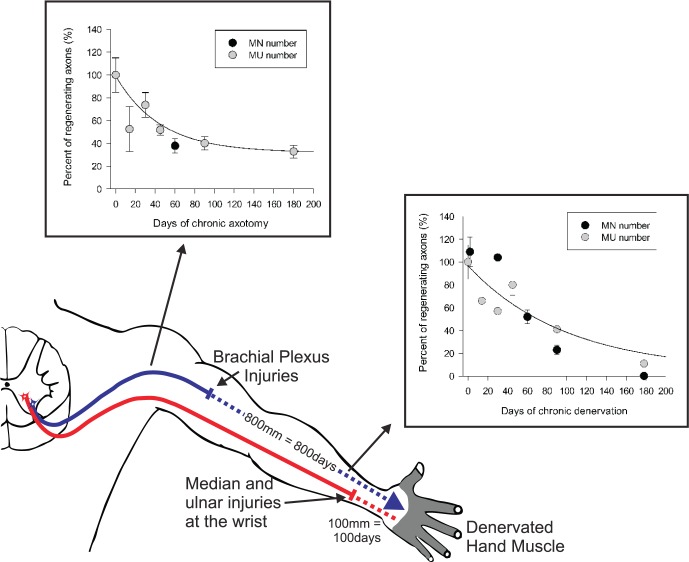
Schematic illustration of proximal nerve injuries to the brachial plexus that require prolonged regeneration times for the regenerating axons to reinnervate the muscles in the hand. During this time, injured neurons are chronically axotomized and Schwann cells of the distal stump of injured nerves are chronically denervated. The graphs in the inserts demonstrate the progressive decline in the capacity of injured motoneurons that regenerate axons (MN number) and reinnervate muscles (motor unit [MU] number) as a result of chronic Schwann cell denervation and chronic neuronal axotomy.
Figure 2.
Figure 2.
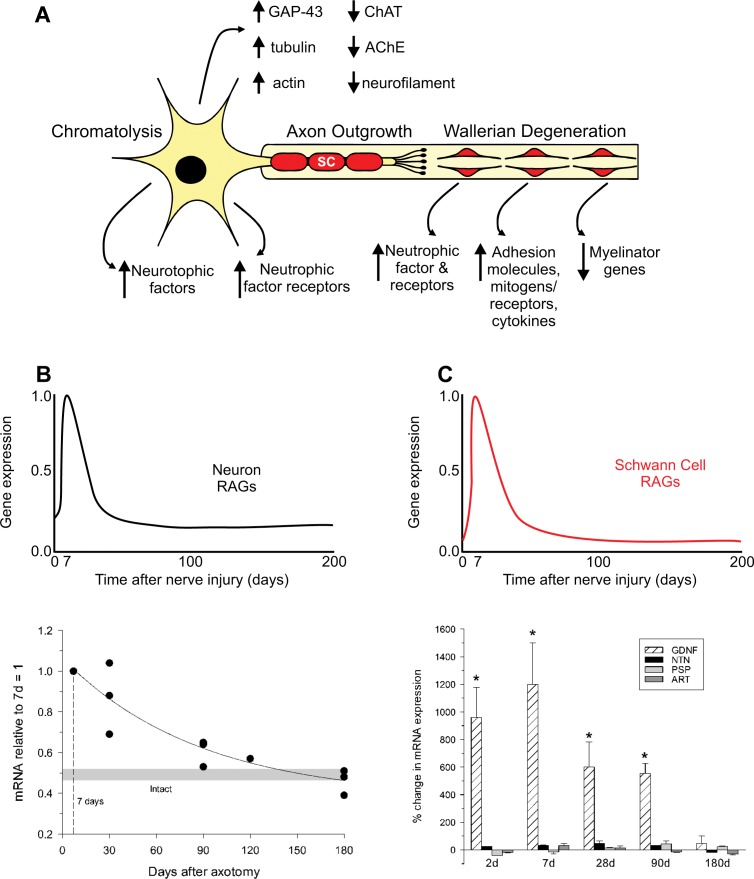
After nerve injury, regeneration-associated genes (RAGs) are upregulated transiently in the neurons while genes associated with normal synaptic transmission are downregulated (A and B). Schwann cells in the denervated nerve stumps undergo proliferation during Wallerian degeneration and express many RAGs while myelin-associated genes are downregulated (A). The gene profiles support the outgrowth of axons, but the expression is very short lived such that over time (while regenerating axons grow at a slow rate of 1 mm/d) the expression of RAGs is downregulated and the capacity of injured neurons to regenerate their axons and Schwann cells to support regeneration is diminished (C). Examples of progressive decline in mRNA levels are plotted for tubulin in neurons and GDNF in Schwann cells in the graphs.
Figure 3.
Figure 3.
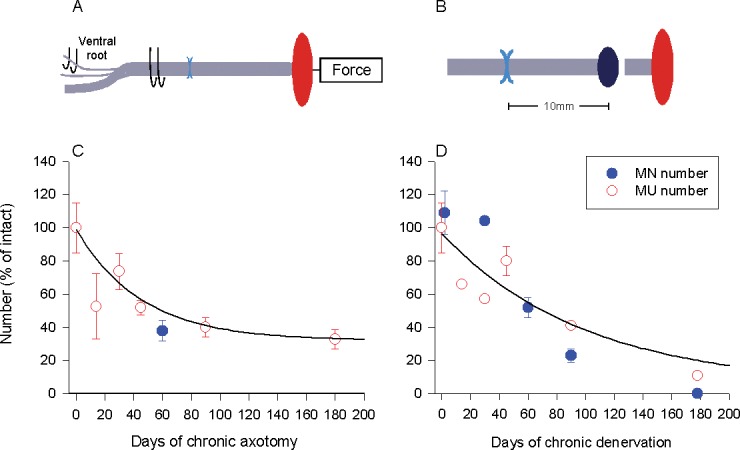
Regenerative capacity declines with time due to prolonged axotomy and Schwann cell denervation. In rats, we experimentally prolonged either (A) the duration of time during which motoneurons were prevented from regenerating their axons (chronic axotomy; by delaying the suture of the proximal nerve stump to a freshly denervated distal nerve stump) or (B) the denervation of Schwann cells in the distal nerve stumps (chronic denervation; by delaying the suture of a freshly cut proximal nerve stump to a nerve stump that was chronically denervated prior to nerve repair). The capacity of the neurons for regeneration after chronic axotomy of motoneurons or chronic denervation of Schwann cells and target muscles was determined either by (a) calculating the number of reinnervated muscle units (the nerve and the muscle fibers that the one motoneuron supplies) using force measurements in response to stimulation of single axons and the muscle nerve or (b) counting backlabelling motoneurons that had regenerated their axons successfully by application of a retrograde dye to the regenerating axons in the nerve stump distal to the site of nerve repair. The evaluations of regenerative success obtained by the methods of motoneuron counts and counts of motor units were in good agreement demonstrating the progressive decline in regenerative capacity as a function of (C) chronic axotomy of the motoneurons and (D) chronic denervation of the Schwann cells.

References

    1. Sulaiman OAR, Midha R, Gordon T. Pathophysiology of surgical nerve disorders. In: Winn HR, editor. Youmans Neurological Surgery. 6th ed. Philadelphia, PA: Saunders;; 2011. pp. 2368–2379. In. ed.
    1. Sulaiman OA, Gordon T. Effects of short- and long-term Schwann cell denervation on peripheral nerve regeneration, myelination, and size. Glia. 2000 Dec;32(3):234–246. - PubMed
    1. Sunderland S. Nerves and Nerve Injuries. Edinburgh, Scotland: Churchill Livingstone;; 1978.
    1. Sulaiman WA, Kline DG. Nerve surgery: a review and insights about its future. Clin Neurosurg. 2006;53:38–47. - PubMed
    1. Fu SY, Gordon T. Contributing factors to poor functional recovery after delayed nerve repair: prolonged axotomy. J Neurosci. 1995 May;15(5 Pt 2):3876–3885. - PMC - PubMed

LinkOut - more resources