


Complete tylosis formation in a latest Permian conifer stem
- PMID: 23532049
- PMCID: PMC3662507
- DOI: 10.1093/aob/mct060
Complete tylosis formation in a latest Permian conifer stem
Abstract
Background and aims: Our knowledge of tylosis formation is mainly based on observations of extant plants; however, its developmental and functional significance are less well understood in fossil plants. This study, for the first time, describes a complete tylosis formation in a fossil woody conifer and discusses its ecophysiological implications.
Methods: The permineralized stem of Shenoxylon mirabile was collected from the upper Permian (Changhsingian) Sunjiagou Formation of Shitanjing coalfield, northern China. Samples from different portions of the stem were prepared by using the standard thin-sectioning technique and studied in transmitted light.
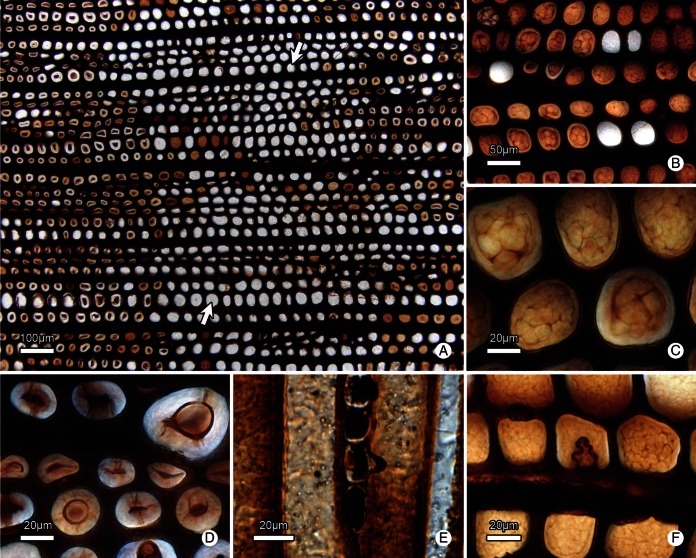
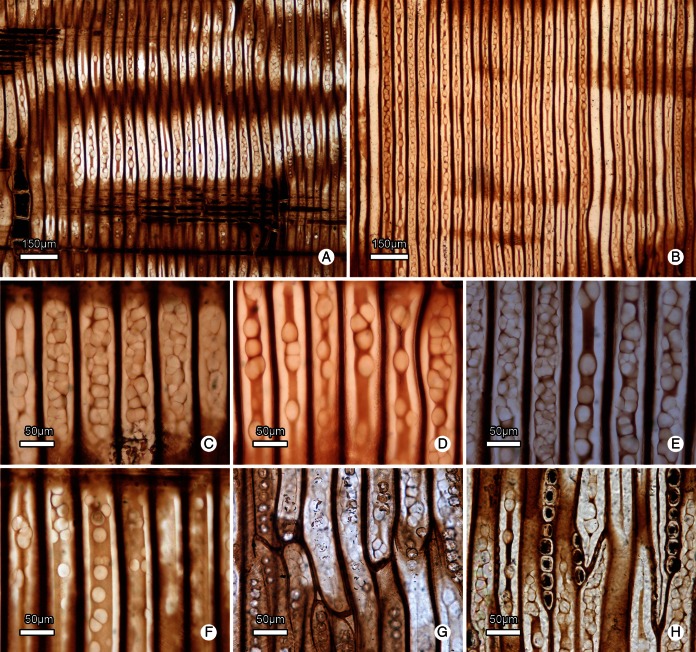
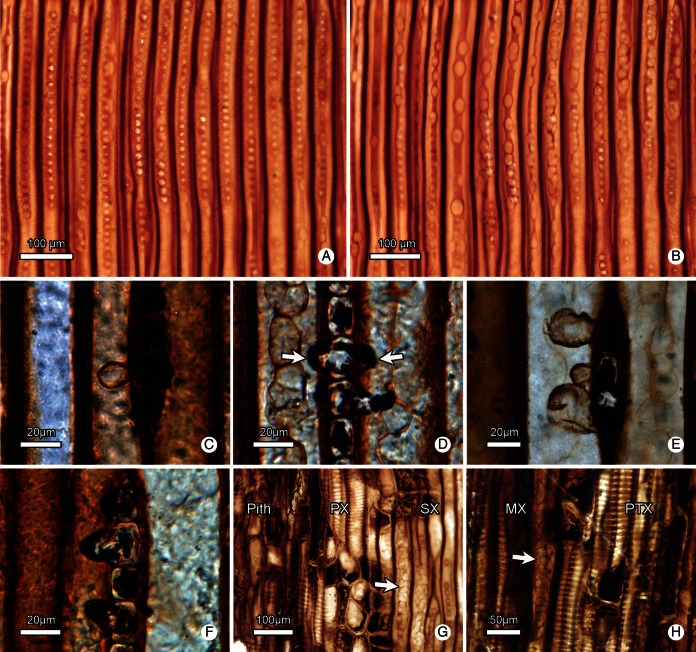
Key results: The outgrowth of ray parenchyma cells protruded into adjacent tracheids through pits initially forming small pyriform or balloon-shaped structures, which became globular or slightly elongated when they reached their maximum size. The tracheid luminae were gradually occluded by densely spaced tyloses. The host tracheids are arranged in distinct concentric zones representing different growth phases of tylosis formation within a single growth ring.
Conclusions: The extensive development of tyloses from the innermost heartwood (metaxylem) tracheids to the outermost sapwood tracheids suggests that the plant was highly vulnerable and reacted strongly to environmental stress. Based on the evidence available, the tyloses were probably not produced in response to wound reaction or pathogenic infection, since evidence of wood traumatic events or fungal invasion are not recognizable. Rather, they may represent an ecophysiological response to the constant environmental stimuli.
Keywords: China; Shenoxylon mirabile; conifer wood; ecophysiological response; fossil plant; late Permian; tylose.
Figures
References
-
- Arnold CA. Silicified plant remains from the Mesozoic and Tertiary of Western North America. II. Some fossil woods from northern Alaska. Papers of the Michigan Academy of Science, Arts and Letters. 1952;38:9–19.
-
- Bancroft H. Some fossil dicotyledonous woods from Mount Elgon, East Africa. I. American Journal of Botany. 1935;22:164–183.
-
- Biggs AR. Occurrence and location of suberin in wound reaction zones in xylem of 17 tree species. Phytopathology. 1987;77:718–725.
-
- Brett DW. Fossil oak wood from the British Eocene. Palaeontology. 1960;3:86–92.
-
- Castañeda-Posadas C, Calvillo-Canadell L, Cevallos-Ferriz SRS. Woods from Miocene sediments in Panotla, Tlaxcala, Mexico. Review of Palaeobotany and Palynology. 2009;156:494–506.
Publication types
MeSH terms
LinkOut - more resources
Full Text Sources
Other Literature Sources
