. 2013 Mar 25:4:37.
doi: 10.3389/fgene.2013.00037. eCollection 2013.

The ATM signaling network in development and disease

Affiliations

The ATM signaling network in development and disease

Travis H Stracker et al. Front Genet. .

Abstract

The DNA damage response (DDR) rapidly recognizes DNA lesions and initiates the appropriate cellular programs to maintain genome integrity. This includes the coordination of cell cycle checkpoints, transcription, translation, DNA repair, metabolism, and cell fate decisions, such as apoptosis or senescence (Jackson and Bartek, 2009). DNA double-strand breaks (DSBs) represent one of the most cytotoxic DNA lesions and defects in their metabolism underlie many human hereditary diseases characterized by genomic instability (Stracker and Petrini, 2011; McKinnon, 2012). Patients with hereditary defects in the DDR display defects in development, particularly affecting the central nervous system, the immune system and the germline, as well as aberrant metabolic regulation and cancer predisposition. Central to the DDR to DSBs is the ataxia-telangiectasia mutated (ATM) kinase, a master controller of signal transduction. Understanding how ATM signaling regulates various aspects of the DDR and its roles in vivo is critical for our understanding of human disease, its diagnosis and its treatment. This review will describe the general roles of ATM signaling and highlight some recent advances that have shed light on the diverse roles of ATM and related proteins in human disease.

Keywords: AT like disease; ATM; DNA repair; Mre11 complex; Nijmegen breakage syndrome; apoptosis; ataxia-telangiectasia; senescence.


Figures
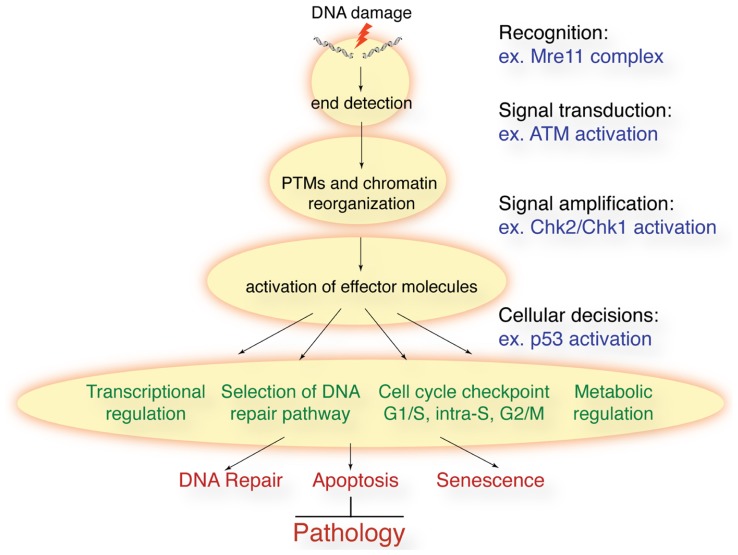
FIGURE 1
FIGURE 1
Schematic of the DDR to DSBs. Following DSB induction, they are recognized by sensor proteins such as the Mre11 complex. This leads to the activation of ATM and related kinases that promote rapid post-translational modifications (PTMs) on many proteins and remodeling of chromatin structure around the break sites. Effector proteins such as the Chk1 and Chk2 kinases amplify the signal and cells can activate cell cycle checkpoints, regulate transcription, translation, and metabolism, and activate the appropriate DNA repair processes. In some cellular contexts, or in the face of irreparable lesions, cells can activate apoptosis and senescence. The collective result is the prevention of genomic instability and the accompanying pathological outcomes.
FIGURE 2
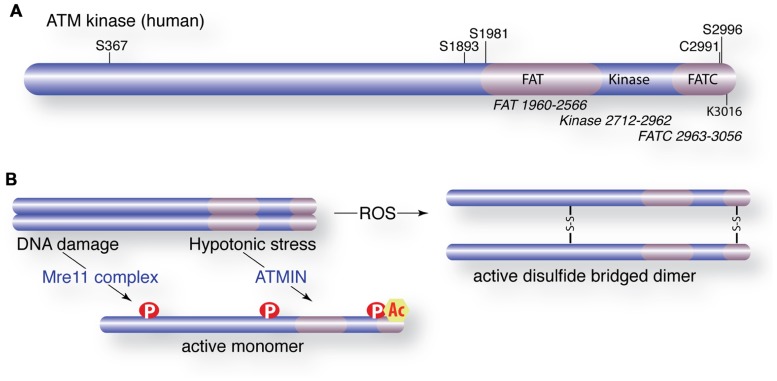
FIGURE 2
Activation of ATM and post-translational modifications. (A) Schematic of the ATM protein with domain organization (FAT = FRAP, ATM, and TRAP). Major autophosphorylation sites (S367, S1893, S1981, S2996), the TIP60 acetylation site (K3016) and a critical cysteine involved in ROS activation are shown. (B) Activation of ATM by DNA damage or hypotonic stress requires the Mre11 complex (Mre11, Rad50, Nbs1) or ATMIN, respectively. Activated ATM is monomeric, phosphorylated and acetylated. Alternatively, ATM is activated directly by ROS that oxidizes cysteine residues to promote disulfide bridge-mediated dimerization.
FIGURE 3
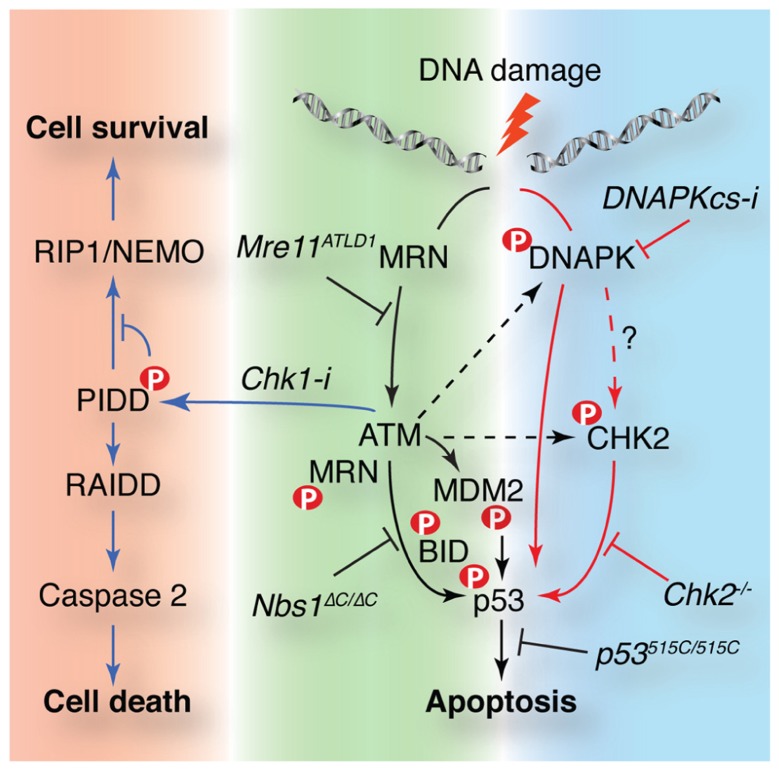
FIGURE 3
ATM controls cellular survival in response to DNA damage through multiple pathways. DNA damage activates apoptosis in a p53-dependent manner in some cell types such as lymphocytes. p53 is activated by parallel pathways controlled by the Mre11 complex and ATM (black arrows) or DNA-PK and Chk2 (red arrows). The Mre11 complex is required for ATM activation and plays downstream roles mediating access to targets such as BID. Chk2 can act independently of ATM and may be a target of DNA-PK that is required for ATM-independent p53-dependent apoptosis. MDM2 phosphorylation by ATM is required for p53 stability and activity. ATM is also required for the Chk1 sensitized cell death pathway. ATM phosphorylates p53-induced protein with a death domain (PIDD) when Chk1 is inhibited favoring RIP associated Ich-1/CED homologous protein with death domain (RAIDD) binding that promotes caspase 2 activation and cell death. Murine alleles or small molecules (Chk1 or DNA-PKcs inhibitors) that affect these pathways are noted in italics. ATM targets are indicated with a red P.
FIGURE 4
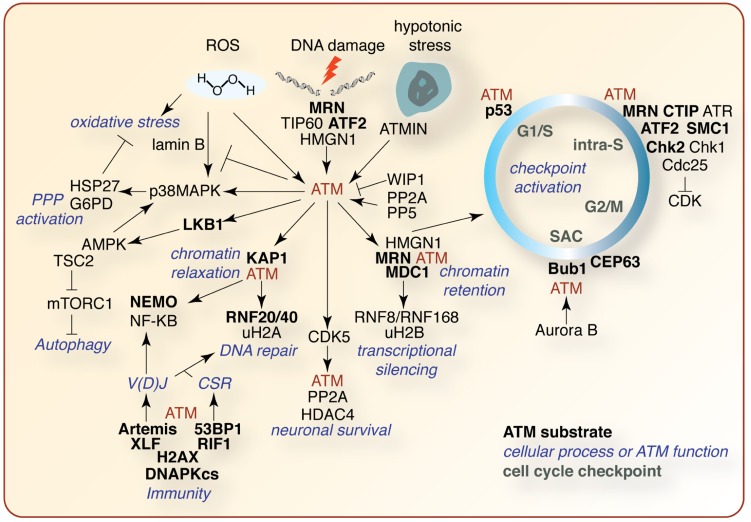
FIGURE 4
Selected summary of the ATM signaling network. A non-comprehensive schematic of ATM signaling pathways described in the text. ATM substrates are indicated in bold black, other pathway effectors in black, affected cellular processes in blue, and cell cycle checkpoints in green. See text for details regarding the signaling pathways depicted.

References

    1. Alexander A., Cai S. L., Kim J., Nanez A., Sahin M., Maclean K. H., et al. (2010a). ATM signals to TSC2 in the cytoplasm to regulate mTORC1 in response to ROS. Proc. Natl. Acad. Sci. U.S.A. 107 4153–4158 - PMC - PubMed
    1. Alexander A., Kim J., Walker C. L. (2010b). ATM engages the TSC2/mTORC1 signaling node to regulate autophagy. Autophagy 6 672–673 - PMC - PubMed
    1. Ali A., Zhang J., Bao S., Liu I., Otterness D., Dean N. M., et al. (2004). Requirement of protein phosphatase 5 in DNA-damage-induced ATM activation. Genes Dev. 18 249–254 - PMC - PubMed
    1. Ando K., Kernan J. L., Liu P. H., Sanda T., Logette E., Tschopp J., et al. (2012). PIDD death-domain phosphorylation by ATM controls prodeath versus prosurvival PIDDosome signaling. Mol. Cell 47 681–693 - PMC - PubMed
    1. Bakkenist C. J., Kastan M. B. (2003). DNA damage activates ATM through intermolecular autophosphorylation and dimer dissociation. Nature 421 499–506 - PubMed