


Evidence for Genetic Reassortment between Human Rotaviruses by Full Genome Sequencing of G3P[4] and G2P[4] Strains Co-circulating in India
- PMID: 23532829
- PMCID: PMC3601198
- DOI: 10.2149/tmh.2012-29
Evidence for Genetic Reassortment between Human Rotaviruses by Full Genome Sequencing of G3P[4] and G2P[4] Strains Co-circulating in India
Abstract
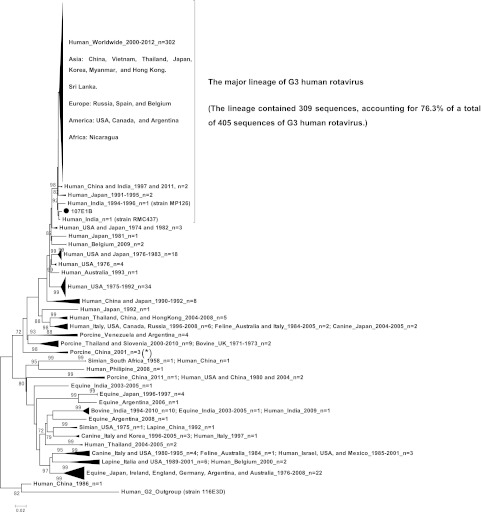
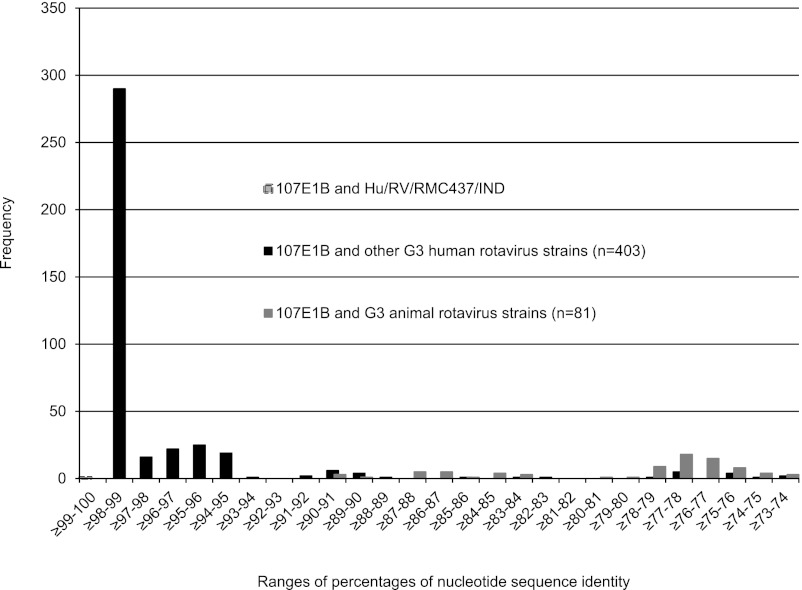
Rotavirus A causes severe diarrhoea in infants and young children worldwide. Many unusual combinations of G and P genotypes have been observed in rotaviruses circulating in developing countries. Mixed infection of a single individual with more than one strain is a mechanism by which genetic reassortants are formed with unusual G and P combinations. However, few studies have provided direct evidence for the formation of such unusual strains as a result of co-infection of co-circulating strains. Here, we used full-genome sequencing to re-analyze a G3P[4] strain (107E1B) and a G2P[4] strain (116E3D) detected in India in 1993 and showed that 107E1B had virtually an identical nucleotide sequence with 116E3D, except the VP7 gene. Phylogenetic analysis revealed that the 107E1B VP7 gene was of typical human rotavirus origin, with a 99.3% nucleotide sequence identity with another Indian G3 VP7 gene. Thus, this study provided robust evidence for the formation of the G3P[4] strain through genetic reassortment in which a G2P[4] strain with a typical DS-1 genogroup background acquired the VP7 gene from a co-circulating G3 human rotavirus strain. This study established a basis on which to facilitate full genome sequence analysis of an increasing number of G3P[4] strains in China and elsewhere in the world.
Keywords: G3P[4]; full genome sequencing; human rotavirus; mixed infection; reassortment.
Figures
References
-
- Cunliffe NA, Nakagomi O. Reoviruses. In: Greenwood D, Slack RCB, Barer MR, Irving WB, eds. Medical Microbiology. 18th ed. London: Churchill Livingstone; 2012. pp. 559–565
-
- Tate JE, Burton AH, Boschi-Pinto C, Steele AD, Duque J, Parashar UD; WHO-coordinated Global Rotavirus Surveillance Network. 2008 estimate of worldwide rotavirus-associated mortality in children younger than 5 years before the introduction of universal rotavirus vaccination programmes: a systematic review and meta-analysis. Lancet Infect Dis 2012; 12: 136–141 - PubMed
-
- Estes MK, Kapikian AZ. Rotaviruses and their replication. In: Knipe DM, Howley PM, eds. Fields Virology. 5th ed. Philadelphia, PA: Lippincott, Williams & Wilkins; 2007. pp. 1917–1974
-
- Gentsch JR, Laird AR, Bielfelt B, Griffin DD, Banyai K, Ramachandran M, Jain V, Cunliffe NA, Nakagomi O, Kirkwood CD, Fischer TK, Parashar UD, Bresee JS, Jiang B, Glass RI. Serotype diversity and reassortment between human and animal rotavirus strains: implications for rotavirus vaccine programs. J Infect Dis 2005; 192 Suppl 1: S146–S159 - PubMed
-
- Kawai K, O’Brien MA, Goveia MG, Mast TC, El Khoury AC. Burden of rotavirus gastroenteritis and distribution of rotavirus strains in Asia: A systematic review. Vaccine 2012; 30: 1244–1254 - PubMed
LinkOut - more resources
Full Text Sources
Other Literature Sources