


Metabolic reprogramming and validation of hyperpolarized 13C lactate as a prostate cancer biomarker using a human prostate tissue slice culture bioreactor
- PMID: 23532911
- PMCID: PMC3976546
- DOI: 10.1002/pros.22665
Metabolic reprogramming and validation of hyperpolarized 13C lactate as a prostate cancer biomarker using a human prostate tissue slice culture bioreactor
Abstract
Background: The treatment of prostate cancer has been impeded by the lack of both clinically relevant disease models and metabolic markers that track tumor progression. Hyperpolarized (HP) (13) C MR spectroscopy has emerged as a new technology to investigate the metabolic shifts in prostate cancer. In this study, we investigate the glucose reprogramming using HP (13) C pyruvate MR in a patient-derived prostate tissue slice culture (TSC) model.
Methods: The steady-state metabolite concentrations in freshly excised human prostate TSCs were assessed and compared to those from snap-frozen biopsy samples. The TSCs were then applied to a perfused cell (bioreactor) platform, and the bioenergetics and the dynamic pyruvate flux of the TSCs were investigated by (31) P and HP (13) C MR, respectively.
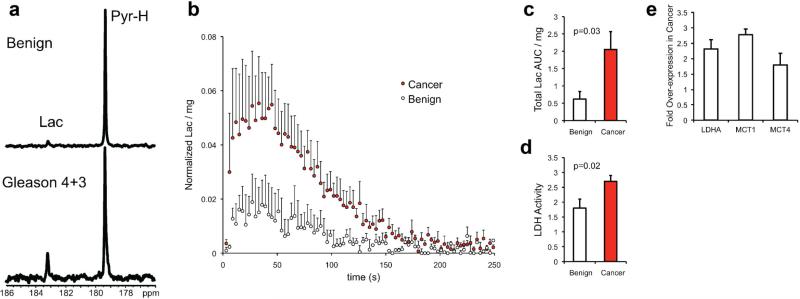
Results: The prostate TSCs demonstrated steady-state glycolytic and phospholipid metabolism, and bioenergetics that recapitulate features of prostate cancer in vivo. (13) C spectra following injection of HP (13) C pyruvate showed significantly increased pyruvate to lactate flux in malignant as compared to the benign prostate TSCs. This increased flux in the malignant prostate TSCs correlated with both increased expression of monocarboxylate transporters (MCT) and activity of lactate dehydrogenase (LDH).
Conclusions: We provide the first mechanistic evidence for HP (13) C lactate as a prostate cancer biomarker in living human tissues, critical for the interpretation of in vivo studies. More broadly, the clinically relevant metabolic model system in combination with HP MR can facilitate the identification of clinically translatable biomarkers of prostate cancer presence, aggressiveness, and treatment response.
Copyright © 2013 Wiley Periodicals, Inc.
Figures
References
-
- Siegel R, Naishadham D, Jemal A. Cancer statistics, 2012. CA Cancer J Clin. 2012;62:10–29. - PubMed
-
- Han M, Partin AW, Piantadosi S, Epstein JI, Walsh PC. Era specific biochemical recurrence-free survival following radical prostatectomy for clinically localized prostate cancer. J Urol. 2001;166:416–419. - PubMed
-
- McNeal JE, Bostwick DG, Kindrachuk RA, Redwine EA, Freiha FS, Stamey TA. Patterns of progression in prostate cancer. Lancet. 1986;1:60–63. - PubMed
-
- Wei JT, Dunn RL, Sandler HM, McLaughlin PW, Montie JE, Litwin MS, Nyquist L, Sanda MG. Comprehensive comparison of health-related quality of life after contemporary therapies for localized prostate cancer. J Clin Oncol. 2002;20:557–566. - PubMed
-
- Bill-Axelson A, Holmberg L, Ruutu M, Haggman M, Andersson SO, Bratell S, Spangberg A, Busch C, Nordling S, Garmo H, Palmgren J, Adami HO, Norlen BJ, Johansson JE. Radical prostatectomy versus watchful waiting in early prostate cancer. N Engl J Med. 2005;352:1977–1984. - PubMed
Publication types
MeSH terms
Substances
Grants and funding
LinkOut - more resources
Full Text Sources
Other Literature Sources
Medical
Research Materials
Miscellaneous
