Review
doi: 10.1056/NEJMcp1213178.
Clinical practice. Short stature in childhood--challenges and choices
Affiliations
- PMID: 23534561
- PMCID: PMC5754004
- DOI: 10.1056/NEJMcp1213178
Item in Clipboard
Review
Clinical practice. Short stature in childhood--challenges and choices
N Engl J Med.
.
No abstract available
Conflict of interest statement
No other potential conflict of interest relevant to this article was reported. Disclosure forms provided by the authors are available with the full text of this article at
Figures
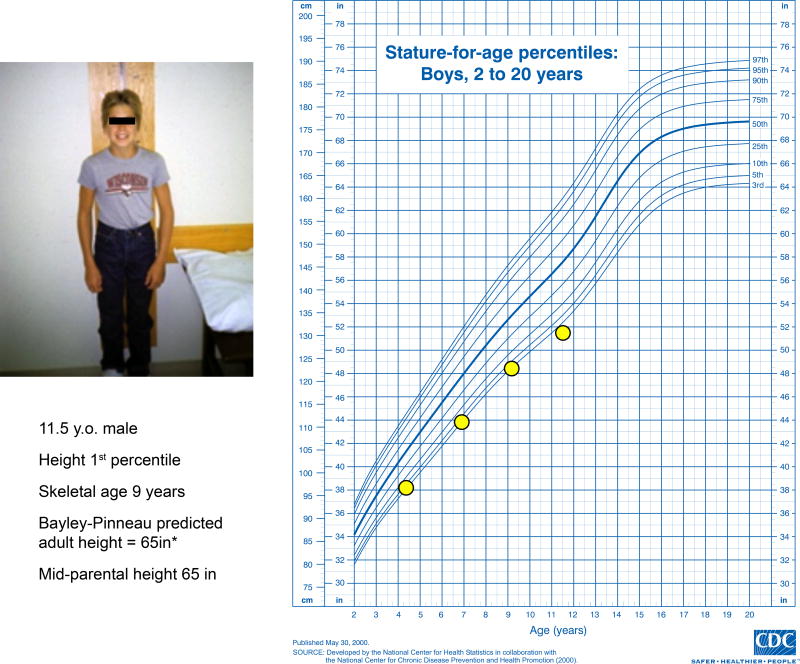
Growth curve and clinical data of the patient. Predicted adult height (PAH) for observation-alone approach calculated using Bayley-Pinneau method.
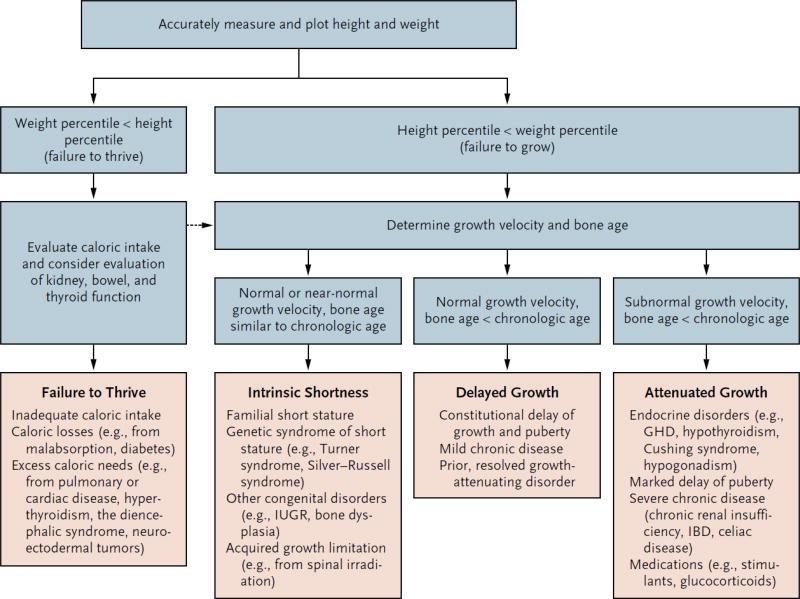
Conceptual approach to the evaluation and differential diagnosis of worrisome growth and short stature. (adapted from) Key: * = downward crossing of percentiles, height < 3rd percentile, or height inappropriate for family, or abnormal body proportions; %tile = growth curve percentile; GV = growth velocity; BA = bone age; CA = chronological age; TS = Turner syndrome; RSS = Russell Silver syndrome; IUGR = intrauterine growth restriction; CDGP = constitutional delay in growth and puberty; GHD = growth hormone deficiency; CS = Cushing syndrome; CRI = chronic renal insufficiency; IBD = inflammatory bowel disease
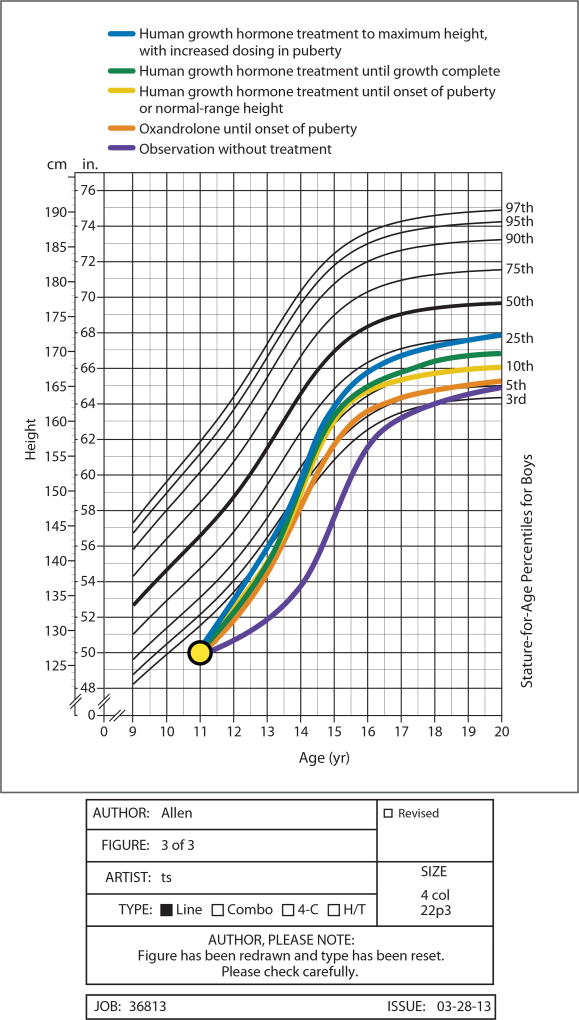
Illustration of approximate projections (± 1.3 inches based on Bayley Pinneau adult height predictions at 11 years of age with bone age of 9) for growth trajectory and adult height for various short stature treatments based on published reports of their effects * = assuming increase in growth rate to ~8 cm/year until onset of puberty ** = assuming average reported increment in height gain for ISS + ~1 cm/year of treatment., *** = assuming normal pubertal growth after cessation of hGH at onset of puberty (and thus no significant difference from more prolonged standard dose hGH therapy). **** =assuming additional increment of 3.6 cm of height (compared to standard-dose hGH therapy) due to 3 years of high-dose (0.7mg/kg/wk) hGH.
References
-
- Zachmann MSB, Frank M, Frisch H, Prader A. Bayley-Pinneau, Roche-Wainer-Thissen, and Tanner height predictions in normal children and in patients with various pathologic conditions. The Journal of pediatrics. 1978;93:749–53. - PubMed
-
- Deodati A, Cianfarani S. Impact of growth hormone therapy on adult height of children with idiopathic short stature: systematic review. BMJ. 2011;342 - PubMed
-
- Finkelstein BS, Imperiale TF, Speroff T, Marrero U, Radcliffe DJ, Cuttler L. Effect of growth hormone therapy on height in children with idiopathic short stature: a meta-analysis. Arch Pediatr Adolesc Med. 2002;156:230–40. - PubMed
-
- Leschek EW, Rose SR, Yanovski JA, et al. Effect of growth hormone treatment on adult height in peripubertal children with idiopathic short stature: a randomized, double-blind, placebo-controlled trial. The Journal of clinical endocrinology and metabolism. 2004;89:3140–8. - PubMed
-
- Wit JM, Rekers-Mombarg LT, Cutler GB, et al. Growth hormone (GH) treatment to final height in children with idiopathic short stature: evidence for a dose effect. The Journal of pediatrics. 2005;146:45–53. - PubMed
Publication types
MeSH terms
Substances
Grants and funding
LinkOut - more resources
Full Text Sources
Other Literature Sources
Medical