. 2013 May;10(5):841-51.
doi: 10.4161/rna.24203. Epub 2013 Mar 27.

crRNA and tracrRNA guide Cas9-mediated DNA interference in Streptococcus thermophilus

Affiliations

crRNA and tracrRNA guide Cas9-mediated DNA interference in Streptococcus thermophilus

Tautvydas Karvelis et al. RNA Biol. 2013 May.

Abstract

The Cas9-crRNA complex of the Streptococcus thermophilus DGCC7710 CRISPR3-Cas system functions as an RNA-guided endonuclease with crRNA-directed target sequence recognition and protein-mediated DNA cleavage. We show here that an additional RNA molecule, tracrRNA (trans-activating CRISPR RNA), co-purifies with the Cas9 protein isolated from the heterologous E. coli strain carrying the S. thermophilus DGCC7710 CRISPR3-Cas system. We provide experimental evidence that tracrRNA is required for Cas9-mediated DNA interference both in vitro and in vivo. We show that Cas9 specifically promotes duplex formation between the precursor crRNA (pre-crRNA) transcript and tracrRNA, in vitro. Furthermore, the housekeeping RNase III contributes to primary pre-crRNA-tracrRNA duplex cleavage for mature crRNA biogenesis. RNase III, however, is not required in the processing of a short pre-crRNA transcribed from a minimal CRISPR array containing a single spacer. Finally, we show that an in vitro-assembled ternary Cas9-crRNA-tracrRNA complex cleaves DNA. This study further specifies the molecular basis for crRNA-based re-programming of Cas9 to specifically cleave any target DNA sequence for precise genome surgery. The processes for crRNA maturation and effector complex assembly established here will contribute to the further development of the Cas9 re-programmable system for genome editing applications.

Keywords: CRISPR; DNA silencing; Type II CRISPR-Cas systems.


Figures
None
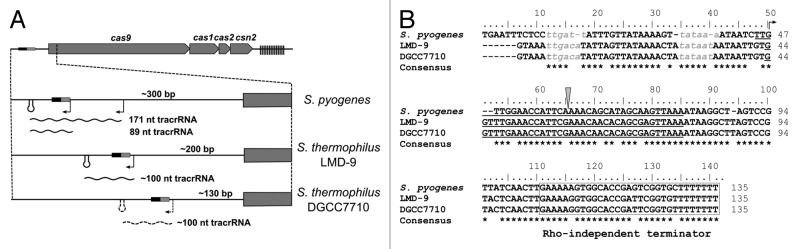
Figure 1. tracrRNA in S. pyogenes, S. thermophilus LMD-9 and DGCC7710 strains. (A) tracrRNA-encoding regions, promoters and terminators. The tracrRNA length in S. pyogenes was previously determined by deep sequencing and in LMD-9 by northern blot analysis. Putative promoters and terminators in DGCC7710 CRISPR3 are drawn as a dashed line. The distance in bp between the tracrRNA-encoding sequence and the cas9 translation initiation codon is indicated above each fragment. (B) Alignment of tracrRNA-encoding loci in S. thermophilus LMD-9 CRISPR3 and DGCC7710 CRISPR3 systems. The anti-repeat regions complementary to the repeat sequences in crRNA are underlined, the putative promoters are shown in gray, the Rho-independent terminators are boxed. The RNase III cleavage site and transcription site in S. pyogenes is indicated by a gray triangle and arrow, respectively.
None
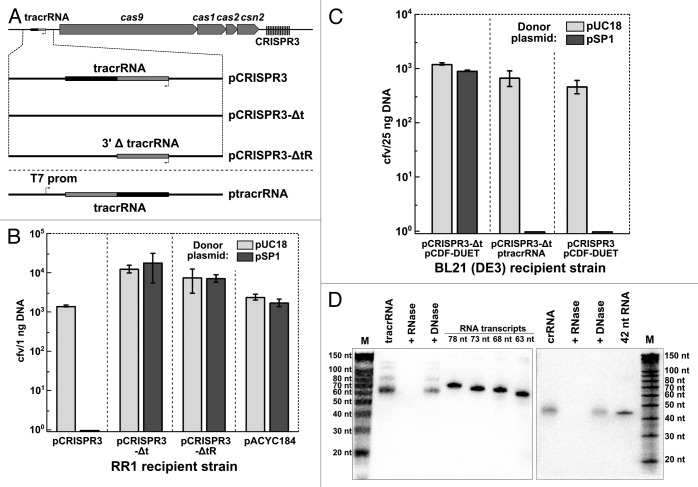
Figure 2. The tracrRNA is required for interference. (A) Schematic representation of plasmids used for plasmid transformation interference assays. The pCRISPR3-Δt plasmid encodes a CRISPR3-Cas system without tracrRNA. In pCRISPR3-ΔtR, tracrRNA contains only the anti-repeat region and lacks its 3′-end. ptracrRNA plasmid was obtained by inserting a full-length tracrRNA-encoding sequence under the control of T7 RNA polymerase promoter in the pCDF-DUET plasmid. (B) The deletion or shortening of tracrRNA inactivates CRISPR3-Cas interference. (C) tracrRNA can be provided in trans on a separate plasmid. (D) Cas9 co-purifies with ~65 nt tracrRNA and 42 nt tracrRNA. Northern blot analysis of nucleic acids extracted from purified active St-Cas9 complex using anti-tracrRNA (left panel) and anti-crRNA (right panel) oligonucleotide probes. The estimated size of the tracrRNA is ~65 nt, albeit minor amounts of longer tracrRNAs intermediates are present. M, RNA size markers.
None
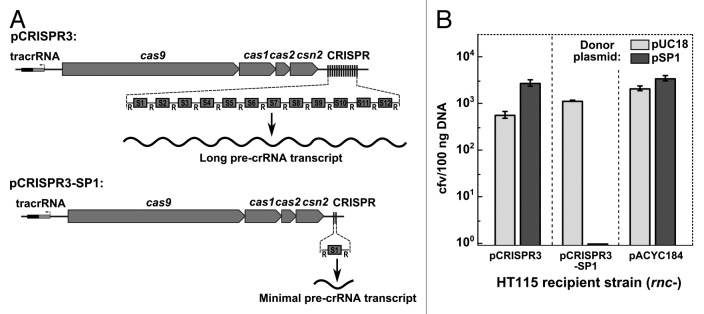
Figure 3. Involvement of tracrRNA and RNase III in plasmid interference. (A) Schematic representation of plasmids used in the plasmid transformation assay and corresponding pre-crRNA transcripts. The pCRISPR3 plasmid encodes a full-length pre-crRNA transcript, whereas pCRISPR3-SP1 encodes a minimal pre-crRNA transcript. (B) CRISPR3-Cas system plasmid interference assay in the rnc- (RNase III-deficient) E. coli HT115 strain.
None
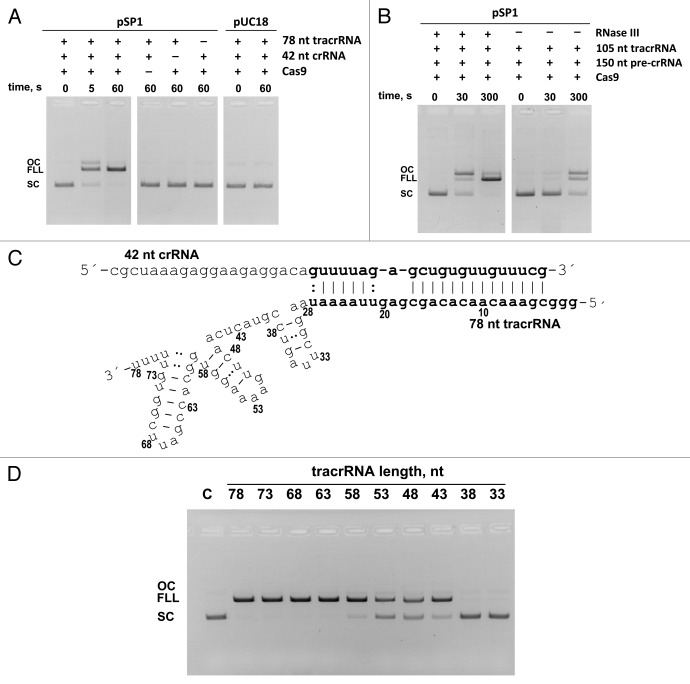
Figure 4. Plasmid DNA cleavage by the in vitro assembled effector pre-crRNA:tracrRNA:Cas9 complex. (A) Cas9, 42 nt crRNA and 78 nt tracrRNA were used for complex assembly. The Cas9-crRNA complex was incubated with pSP1 or pUC18 plasmids in a reaction buffer. pSP1 plasmid contained a proto-spacer SP1 sequence flanked by the 5′-NGGNG-3′PAM sequence. Proto-spacer SP1 sequence is absent in pUC18. Reaction products were analyzed by electrophoresis on agarose gel. SC, super-coiled plasmid DNA; OC, open circular DNA nicked on one of DNA strands; FLL, full-length linear DNA cut on both strands. Under the reaction conditions the pSP1 plasmid is converted into a linear form while the pUC18 plasmid lacking the proto-spacer SP1 sequence is resistant to cleavage. In the reaction mixes lacking one of the components (Cas9, crRNA or tracrRNA) pSP1 plasmid is not cleaved. (B) pSP1 plasmid cleavage by the effector complex assembled in vitro in presence and absence of RNase III. The effector complex was assembled by mixing st-Cas9, 150 nt pre-crRNA, 105 nt tracrRNA in the presence (left panel) or absence (right panel) of RNase III. The 150 nt pre-crRNA is arranged as follows (5′-3′): GGG-20 nt leader sequence 36 nt repeat(R1), 30 nt targeting spacer (S1), 36 nt repeat(R2), 25 nt spacer (truncated S2). (C) Schematic representation of 42 nt crRNA:78 nt crRNA duplex structure. The putative secondary structures of the non-complementary part of the tracrRNA identified by RNAfold are shown. The positions of 5 nt 3′-truncations in the non-complementary region are indicated. (D) pSP1 plasmid cleavage by the effector complex assembled in vitro using tracrRNAs of different lengths.
None
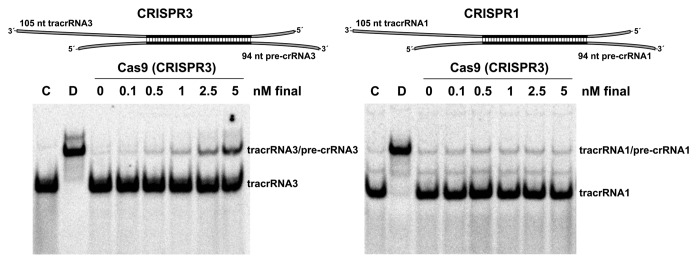
Figure 5. tracrRNA and pre-crRNA annealing in the presence of Cas9. 105 nt tracrRNA and 94 nt pre-crRNA used in the annealing assay are represented above the gels. Complementary sequences are indicated in black. Non-denaturing PAGE analysis of duplex assembly between tracrRNA3 and pre-crRNA3 of CRISPR3 system (left panel) and tracrRNA1 and pre-crRNA1 from CRISPR1 (right panel) at varying concentrations of Cas9 from CRISPR3. C, control lanes, containing only labeled tracrRNA; D, tracrRNA/pre-crRNA duplex, formed by heating tracrRNA:pre-crRNA mixture (1:100 molar ratio) to 95°C and slowly cooling down to room temperature.
None
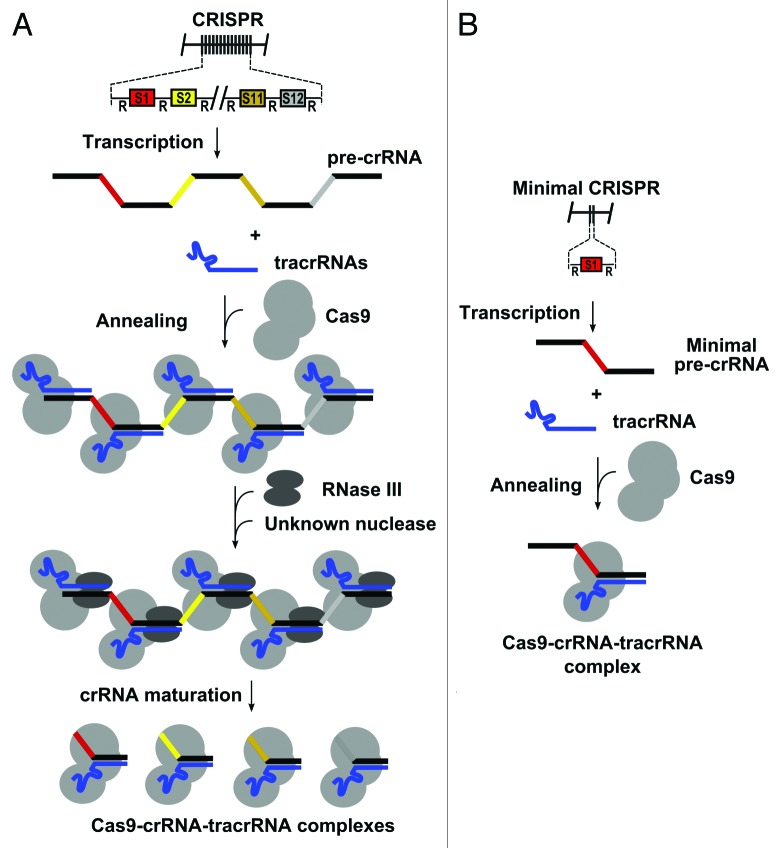
Figure 6. Schematic representation of crRNA maturation/processing and Cas9-crRNA-tracrRNA complex assembly pathways. (A). The wild-type CRISPR locus is transcribed as a long pre-crRNA molecule. Cas9 promotes pre-crRNA:tracrRNA duplex formation. The tracrRNA/pre-crRNA duplex regions are recognized and cleaved by the host RNase III to generate effector complexes that undergo further trimming at the 5′ end by unknown nuclease(s) to produce mature Cas9-crRNA-tracrRNA complexes. (B) Short pre-crRNA transcripts produce functional effector complexes in the absence of RNase III.

References

    1. Barrangou R, Fremaux C, Deveau H, Richards M, Boyaval P, Moineau S, et al. CRISPR provides acquired resistance against viruses in prokaryotes. Science. 2007;315:1709–12. doi: 10.1126/science.1138140. - DOI - PubMed
    1. Bolotin A, Quinquis B, Sorokin A, Ehrlich SD. Clustered regularly interspaced short palindrome repeats (CRISPRs) have spacers of extrachromosomal origin. Microbiology. 2005;151:2551–61. doi: 10.1099/mic.0.28048-0. - DOI - PubMed
    1. Mojica FJM, Díez-Villaseñor C, García-Martínez J, Soria E. Intervening sequences of regularly spaced prokaryotic repeats derive from foreign genetic elements. J Mol Evol. 2005;60:174–82. doi: 10.1007/s00239-004-0046-3. - DOI - PubMed
    1. Brouns SJJ, Jore MM, Lundgren M, Westra ER, Slijkhuis RJ, Snijders AP, et al. Small CRISPR RNAs guide antiviral defense in prokaryotes. Science. 2008;321:960–4. doi: 10.1126/science.1159689. - DOI - PMC - PubMed
    1. Makarova KS, Haft DH, Barrangou R, Brouns SJ, Charpentier E, Horvath P, et al. Evolution and classification of the CRISPR-Cas systems. Nat Rev Microbiol. 2011;9:467–77. doi: 10.1038/nrmicro2577. - DOI - PMC - PubMed

Publication types

MeSH terms