Review
. 2013 Mar 27;14(4):6981-7015.
doi: 10.3390/ijms14046981.

Melatonin and pancreatic islets: interrelationships between melatonin, insulin and glucagon

Affiliations
Review

Melatonin and pancreatic islets: interrelationships between melatonin, insulin and glucagon

Elmar Peschke et al. Int J Mol Sci. .

Abstract

The pineal hormone melatonin exerts its influence in the periphery through activation of two specific trans-membrane receptors: MT1 and MT2. Both isoforms are expressed in the islet of Langerhans and are involved in the modulation of insulin secretion from β-cells and in glucagon secretion from α-cells. De-synchrony of receptor signaling may lead to the development of type 2 diabetes. This notion has recently been supported by genome-wide association studies identifying particularly the MT2 as a risk factor for this rapidly spreading metabolic disturbance. Since melatonin is secreted in a clearly diurnal fashion, it is safe to assume that it also has a diurnal impact on the blood-glucose-regulating function of the islet. This factor has hitherto been underestimated; the disruption of diurnal signaling within the islet may be one of the most important mechanisms leading to metabolic disturbances. The study of melatonin-insulin interactions in diabetic rat models has revealed an inverse relationship: an increase in melatonin levels leads to a down-regulation of insulin secretion and vice versa. Elucidation of the possible inverse interrelationship in man may open new avenues in the therapy of diabetes.


Figures

Figure 1
Figure 1
The pineal hormone melatonin acts on the pancreatic β-cell via two receptor isoforms (MT1 and MT2) which transmit their signals through guanosine triphosphate (GTP)-binding proteins (G-proteins). The inhibitory action of melatonin on insulin secretion is transmitted by activation of the Gi-protein signaling cascade involving cyclic adenosine monophosphate (cAMP) (MT1-dependent signaling) or cAMP and cyclic guanosine monophosphate (cGMP) as second messengers (MT2). Melatonin downregulates adenylate or guanylate cyclase activity, leading to reduced second messenger levels and attenuated protein kinase A (pKA) or protein kinase G (pKG) activity. Consecutively insulin secretion is reduced. As a secondary effect, phosphorylation and activation of the cAMP-modulated transcription factor cAMP response element-binding protein (CREB) is downregulated. In addition, the MT1 receptor is also known to alternatively couple to Gq-proteins and thus modulates cell-internal IP3 and Ca2+ levels. Melatonin signaling impinges on the rhythm of an autonomous, islet-located circadian clock as a synchronizer. This rhythm is generated by the antiphasic action of the clock genes Per and Cry (coding for a heterodimer with inhibitory action) or Bmal and Clock (producing heterodimeric proteins with transcriptionally enhancing action).
Figure 2
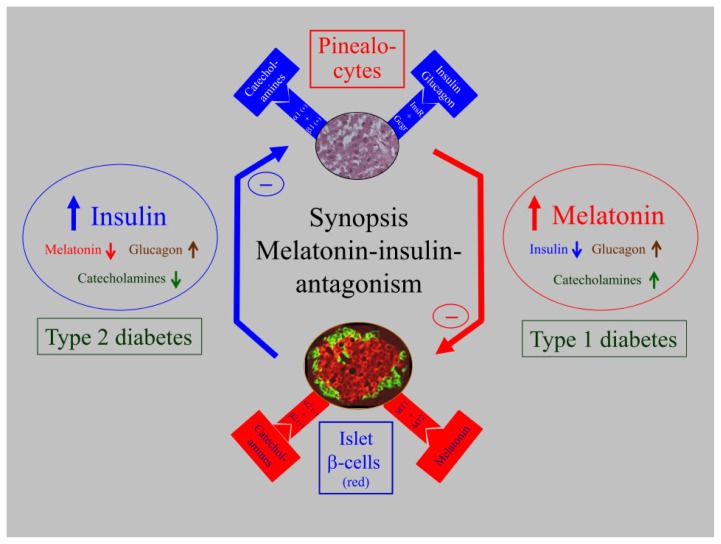
Figure 2
Synoptic presentation of the insulin–melatonin antagonism in relation to the importance of melatonin for type 1 and type 2 diabetes, including interactions with glucagon and catecholamines. At a relatively early stage of type 2 diabetes (left side), insulin secretion is increased while melatonin synthesis is decreased. These reactions were observed in type 2 diabetic Goto Kakizaki (GK) rats and humans. In contrast, under type 1 diabetic conditions (right side), insulin was greatly reduced and, subsequently, melatonin was significantly increased. These reactions were observed in streptozotocin (STZ)-treated Wistar (WR) rats, as well as in LEW.1AR1-iddm rats, a spontaneous animal model of human type 1 diabetes mellitus. Thus, the influence of insulin on the pinealocytes is mediated by insulin receptors in the pineal gland (upper panel), and the influence of melatonin on the pancreatic β-cells is mediated by the MT1 and MT2 melatonin receptors (lower panel). Much more conclusive, however, is the well-known insulin-catecholamine relationship, which may be a key to understanding the insulin-melatonin antagonism. The increase of catecholamines stimulates adrenoceptor β1 and, consequently, the cAMP cascade, while adrenoceptor α1 activates the IP3 cascade in the pineal gland; together they stimulate melatonin synthesis and secretion (upper panel). Catecholamines (in contrast to acetylcholine), on the other hand, have an inhibitory effect on the insulin secretion (lower panel). To support this, the GK rat model of type 2 diabetes shows diminished plasma catecholamines (left side), whereas the rat models of type 1 diabetes (STZ and LEW.1AR1-iddm) exhibit increased catecholamines (right side). This supports the conviction that type 1 diabetes is associated with stress and enhanced melatonin secretion. An explanation of the increased melatonin levels in type 1 diabetic STZ and also possibly LEW.1AR1-iddm rats could be that melatonin protects the organism by attenuating the oxidative stress-induced β-cell damage in type 1 diabetes.

References

    1. Parhon C.I. Congrès d’Endocrinologie de Bucarest. 1939;I:187.
    1. Parhon C.I., Potop I., Felix E., Boeru V. Influenta epifisectomiei si a administrarii de extract epifisar asupra unor data metabolice privind mineralele (Ca, K, P, Si, Mg), lipidele, protidele si glucidele, la sobolanul alb adult. Stud. Cercet. Endocr. 1952;3:321–329.
    1. Milcou I., Nanu L., Marcean R. De l’existence d’une hormone hypoglycémiante épiphysaire synergique de l’insuline. Ann. Endocrinol. (Paris) 1957;18:612–620. - PubMed
    1. Milcu S.M. Role de l’épiphyse dans le metabolisme glucidique. J. Annu. Diabetol. Dieu. 1968;9:163–180. - PubMed
    1. Milcu S.M., Milcu I. Über ein hypoglykämisch wirkendes Hormon in der Zirbeldrüse. Medizinische. 1958;17:711–715. - PubMed

Publication types