. 2013 Jun;7(6):1112-5.
doi: 10.1038/ismej.2013.15. Epub 2013 Mar 28.

Biphasic assembly of the murine intestinal microbiota during early development

Affiliations

Biphasic assembly of the murine intestinal microbiota during early development

Ida Gisela Pantoja-Feliciano et al. ISME J. 2013 Jun.

Abstract

The birth canal provides mammals with a primary maternal inoculum, which develops into distinctive body site-specific microbial communities post-natally. We characterized the distal gut microbiota from birth to weaning in mice. One-day-old mice had colonic microbiota that resembled maternal vaginal communities, but at days 3 and 9 of age there was a substantial loss of intestinal bacterial diversity and dominance of Lactobacillus. By weaning (21 days), diverse intestinal bacteria had established, including strict anaerobes. Our results are consistent with vertical transmission of maternal microbiota and demonstrate a nonlinear ecological succession involving an early drop in bacterial diversity and shift in dominance from Streptococcus to Lactobacillus, followed by an increase in diversity of anaerobes, after the introduction of solid food. Mammalian newborns are born highly susceptible to colonization, and lactation may control microbiome assembly during early development.


Figures
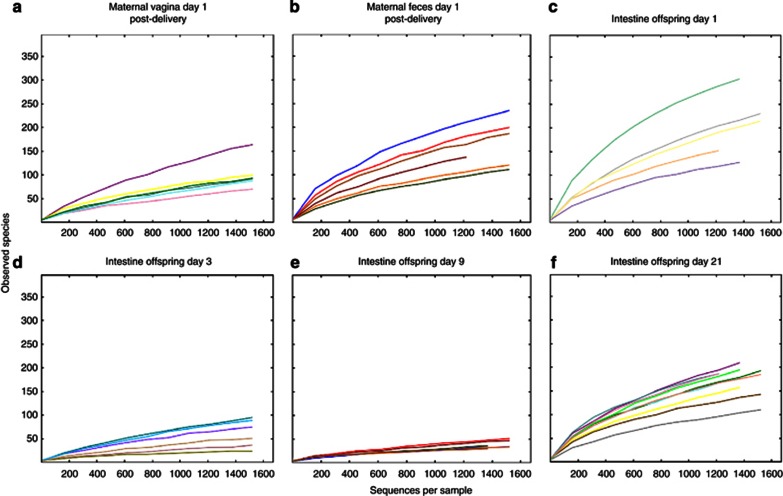
Figure 1
Figure 1
Rarefaction curves of observed species from mothers and offspring mice. (a) Maternal vagina, day 1 post delivery; (b), maternal feces, day 1 post delivery; (c), offspring intestine, day 1 of life; (d), offspring intestine, day 3 of life; (e), offspring intestine, day 9 of life; (f), offspring intestine, day 21 of life.
Figure 2
Figure 2
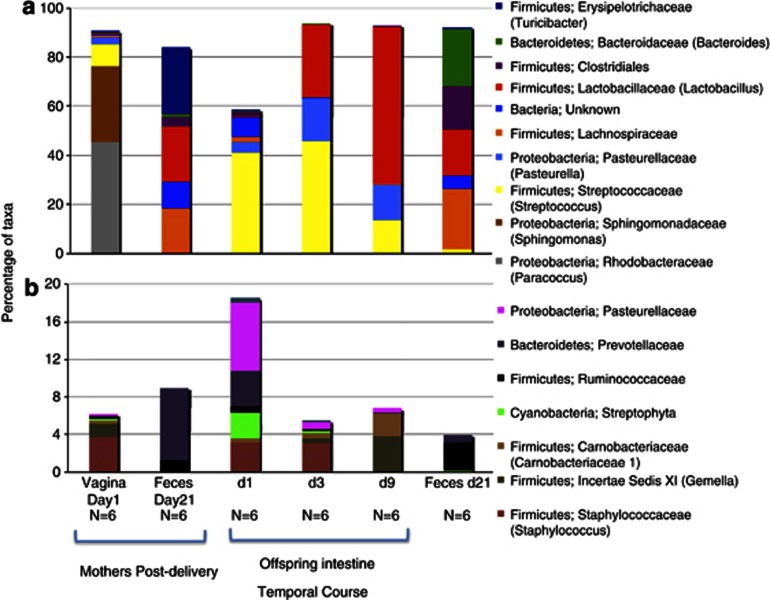
Proportions of colonic bacterial families in maternal vagina and feces, and during offspring development. (a) dominating taxa. (b) low abundance taxa.

References

    1. Andersson AF, Lindberg M, Jakobsson H, Backhed F, Nyren P, Engstrand L. Comparative analysis of human gut microbiota by barcoded pyrosequencing. PLoS One. 2008;3:e2836. - PMC - PubMed
    1. Angelakis E, Armougom F, Million M, Raoult D. The relationship between gut microbiota and weight gain in humans. Future Microbiol. 2012;7:91–109. - PubMed

    1. Caporaso JG, Kuczynski J, Stombaugh J, Bittinger K, Bushman FD, Costello EK, et al. QIIME allows analysis of high-throughput community sequencing data. Nat Methods. 2010;7:335–336. - PMC - PubMed
    1. Dominguez-Bello MG, Costello EK, Contreras M, Magris M, Hidalgo G, Fierer N, et al. Delivery mode shapes the acquisition and structure of the initial microbiota across multiple body habitats in newborns. Proc Natl Acad Sci USA. 2010;107:11971–11975. - PMC - PubMed
    1. Fierer N, Hamady M, Lauber CL, Knight R. The influence of sex, handedness, and washing on the diversity of hand surface bacteria. Proc Natl Acad Sci USA. 2008;105:17994–17999. - PMC - PubMed

Publication types