


Adenosine receptors as drug targets--what are the challenges?
- PMID: 23535933
- PMCID: PMC3930074
- DOI: 10.1038/nrd3955
Adenosine receptors as drug targets--what are the challenges?
Abstract
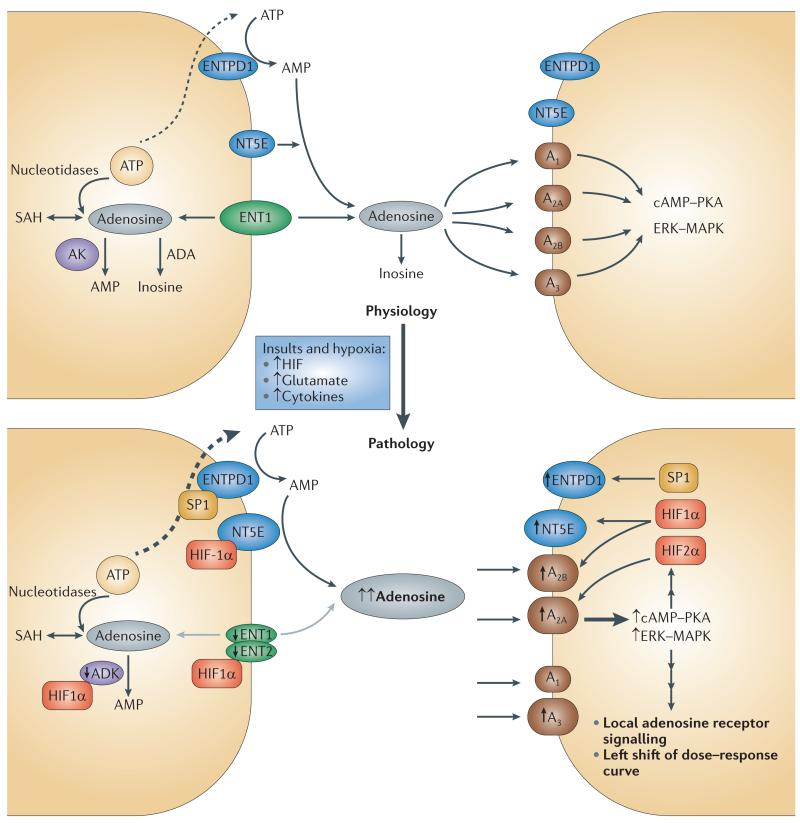
Adenosine signalling has long been a target for drug development, with adenosine itself or its derivatives being used clinically since the 1940s. In addition, methylxanthines such as caffeine have profound biological effects as antagonists at adenosine receptors. Moreover, drugs such as dipyridamole and methotrexate act by enhancing the activation of adenosine receptors. There is strong evidence that adenosine has a functional role in many diseases, and several pharmacological compounds specifically targeting individual adenosine receptors--either directly or indirectly--have now entered the clinic. However, only one adenosine receptor-specific agent--the adenosine A2A receptor agonist regadenoson (Lexiscan; Astellas Pharma)--has so far gained approval from the US Food and Drug Administration (FDA). Here, we focus on the biology of adenosine signalling to identify hurdles in the development of additional pharmacological compounds targeting adenosine receptors and discuss strategies to overcome these challenges.
Figures
References
-
-
Fredholm BB, et al. International Union of Pharmacology. XXV. Nomenclature and classification of adenosine receptors. Pharmacol. Rev. 2001;53:527–552. This is an overview of the current knowledge of adenosine receptor biology, from gene structure to expression, distribution, biochemical properties, pharmacological profiles, signalling and behavioural responses, focusing on receptor nomenclature and classification
-
-
-
Fredholm BB, et al. International Union of Basic and Clinical Pharmacology. LXXXI. Nomenclature and classification of adenosine receptors — an update. Pharmacol. Rev. 2011;63:1–34. This is an update of reference 1, based on 10 more years of research.
-
-
-
Eltzschig HK, Sitkovsky MV, Robson SC. Purinergic signaling during inflammation. N. Engl. J. Med. 2012;367:2322–2333. This is a comprehensive review summarizing the biomedical implications of extracellular ATP, ADP and adenosine signalling in the context of a broad range of inflammatory diseases.
-
-
- Johansson SM, Yang JN, Lindgren E, Fredholm BB. Eliminating the antilipolytic adenosine A1 receptor does not lead to compensatory changes in the antilipolytic actions of PGE2 and nicotinic acid. Acta Physiol. 2007;190:87–96. - PubMed
Publication types
MeSH terms
Substances
Grants and funding
LinkOut - more resources
Full Text Sources
Other Literature Sources
