


Neuroprediction of future rearrest
- PMID: 23536303
- PMCID: PMC3625297
- DOI: 10.1073/pnas.1219302110
Neuroprediction of future rearrest
Abstract
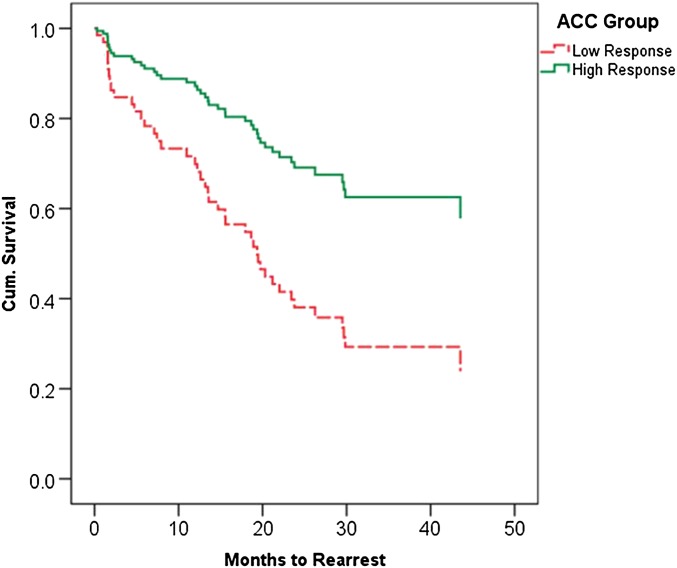
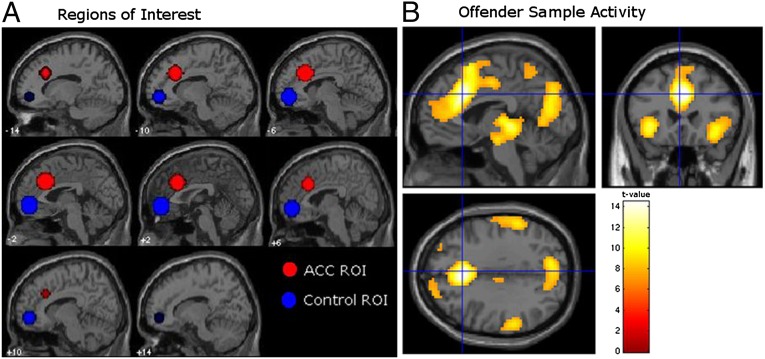
Identification of factors that predict recurrent antisocial behavior is integral to the social sciences, criminal justice procedures, and the effective treatment of high-risk individuals. Here we show that error-related brain activity elicited during performance of an inhibitory task prospectively predicted subsequent rearrest among adult offenders within 4 y of release (N = 96). The odds that an offender with relatively low anterior cingulate activity would be rearrested were approximately double that of an offender with high activity in this region, holding constant other observed risk factors. These results suggest a potential neurocognitive biomarker for persistent antisocial behavior.
Conflict of interest statement
The authors declare no conflict of interest.
Figures
References
-
- Monahan JD. The Clinical Prediction of Violent Behavior. Washington, DC: Government Printing Office; 1981.
-
- Douglas KS, Webster CD, Hart SD, Eaves D, Ogloff JRP, editors. HCR-20: Violence Risk Management Companion Guide. Burnaby, BC, Canada: Mental Health, Law, and Policy Institute, Simon Fraser University; 2001.
-
- Harris GT, Rice ME, Quinsey VL. Violent recidivism of mentally disordered offenders: The development of a statistical prediction instrument. Crim Justice Behav. 1993;20(4):315–335.
-
- Yang M, Wong SCP, Coid J. The efficacy of violence prediction: A meta-analytic comparison of nine risk assessment tools. Psychol Bull. 2010;136(5):740–767. - PubMed
-
- Callicott JH, Weinberger DR. Neuropsychiatric dynamics: The study of mental illness using functional magnetic resonance imaging. Eur J Radiol. 1999;30(2):95–104. - PubMed
Publication types
MeSH terms
Grants and funding
- 1 F32 MH090668-01/MH/NIMH NIH HHS/United States
- R01 DA026964/DA/NIDA NIH HHS/United States
- R01 MH085010/MH/NIMH NIH HHS/United States
- R01 MH070539/MH/NIMH NIH HHS/United States
- 5R01MH070539/MH/NIMH NIH HHS/United States
- K01 DA026502/DA/NIDA NIH HHS/United States
- R01 EB000840/EB/NIBIB NIH HHS/United States
- F32 MH090668/MH/NIMH NIH HHS/United States
- 1R01DA026964/DA/NIDA NIH HHS/United States
- 1R01DA026505/DA/NIDA NIH HHS/United States
- R01 DA026505/DA/NIDA NIH HHS/United States
- 1R01MH085010/MH/NIMH NIH HHS/United States
- 2R01EB000840/EB/NIBIB NIH HHS/United States
LinkOut - more resources
Full Text Sources
Other Literature Sources
