


A novel and major quantitative trait locus for fusarium crown rot resistance in a genotype of Wild Barley (Hordeum spontaneum L.)
- PMID: 23536780
- PMCID: PMC3594225
- DOI: 10.1371/journal.pone.0058040
A novel and major quantitative trait locus for fusarium crown rot resistance in a genotype of Wild Barley (Hordeum spontaneum L.)
Abstract
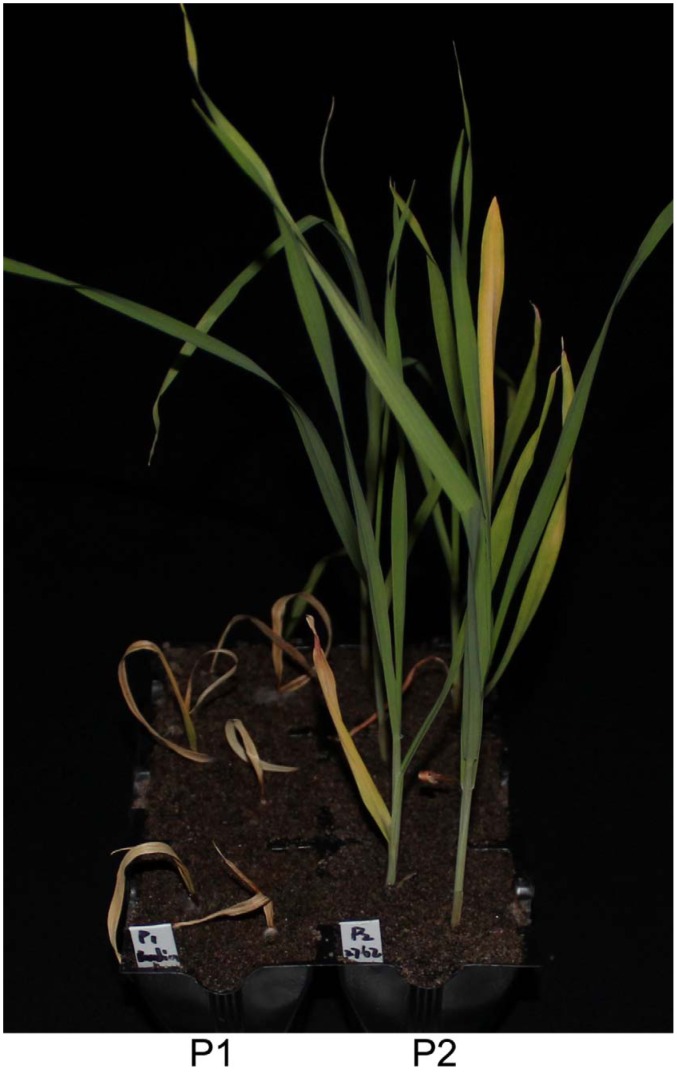
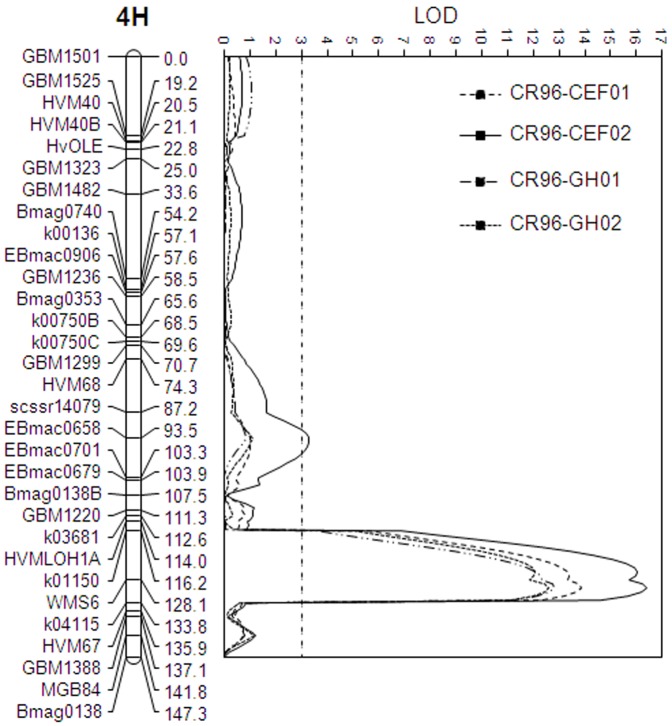
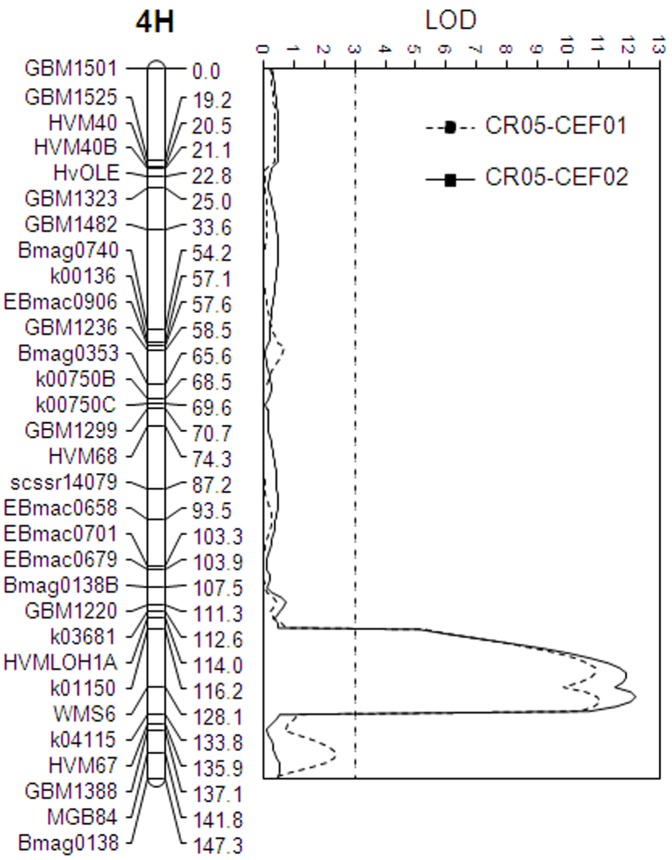
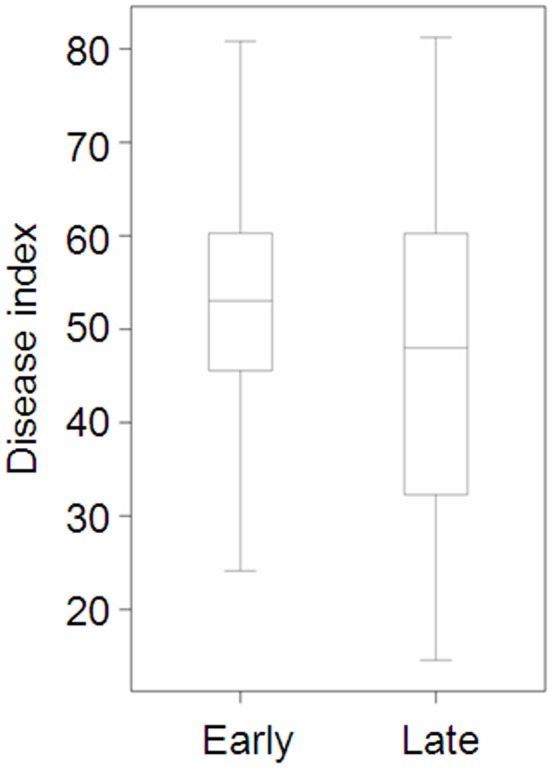
Fusarium crown rot (FCR), caused by various Fusarium species, is a destructive disease of cereal crops in semiarid regions worldwide. As part of our contribution to the development of Fusarium resistant cultivars, we identified several novel sources of resistance by systematically assessing barley genotypes representing different geographical origins and plant types. One of these sources of resistance was investigated in this study by generating and analysing two populations of recombinant inbred lines. A major locus conferring FCR resistance, designated as Qcrs.cpi-4H, was detected in one of the populations (mapping population) and the effects of the QTL was confirmed in the other population. The QTL was mapped to the distal end of chromosome arm 4HL and it is effective against both of the Fusarium isolates tested, one F. pseudograminearum and the other F. graminearum. The QTL explains up to 45.3% of the phenotypic variance. As distinct from an earlier report which demonstrated co-locations of loci conferring FCR resistance and plant height in barley, a correlation between these two traits was not detected in the mapping population. However, as observed in a screen of random genotypes, an association between FCR resistance and plant growth rate was detected and a QTL controlling the latter was detected near the Qcrs.cpi-4H locus in the mapping population. Existing data indicate that, although growth rate may affect FCR resistance, different genes at this locus are likely involved in controlling these two traits.
Conflict of interest statement
Figures
References
-
- Chakraborty S, Liu CJ, Mitter V, Scott JB, Akinsanmi OA, et al. (2006) Pathogen population structure and epidemiology are a key to wheat crown rot and Fusarium head blight management. Australasian Plant Pathology 35: 643–655.
-
- Mudge AM, Dill-Macky R, Dong Y, Gardiner DM, White RG, et al. (2006) A role for the mycotoxin deoxynivalenol in stem colonisation during crown rot disease of wheat caused by Fusarium graminearum and F. pseudograminearum . Physiological and Molecular Plant Pathology 69: 73–85.
-
- Smiley RW, Gourlie JA, Easley SA, Patterson LM, Whittaker RG (2005) Crop damage estimates for crown rot of wheat and barley in the Pacific Northwest. Plant Disease 89: 595–604. - PubMed
-
- Murray GM, Brennan JP (2009) Estimating disease losses to the Australian wheat industry. Australasian Plant Pathology 38: 558–570.
-
- Murray GM, Brennan JP (2010) Estimating disease losses to the Australian barley industry. Australasian Plant Pathology 39: 85–96.
Publication types
MeSH terms
LinkOut - more resources
Full Text Sources
Other Literature Sources
Research Materials
